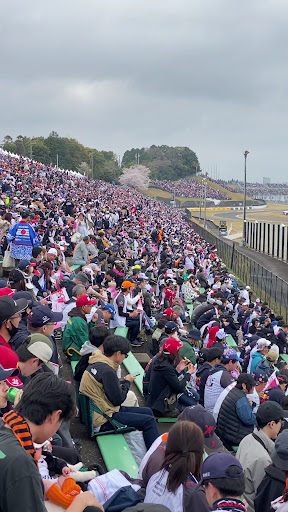
The Suzuka International Racing Course is a motorsport race track located in Ino-Chyou, Suzuka-City, Mie-Prefecture, Japan and operated by Mobilityland Corporation, a subsidiary of Honda Motor Co, Ltd. It has a capacity of more than 150,000.
Soichiro Honda decided to develop a new permanent circuit in Mie prefecture in the late 1950s. Designed as a Honda test track in 1962 by Dutchman John "Hans" Hugenholtz, Suzuka is one of few circuits in the world to have a "figure eight" layout, with the 1.2 km back straight passing over the front section by means of an overpass.
The circuit has been modified four times:
In 1983 a chicane was put at the last curve to slow the cars into the pit straight and the Degner curve was made into two corners instead of one long curve; the circuit was also made considerably safer by adding more crash barriers, more run-off areas and removing straw bales leading into vegetation;
In 2002, the chicane was slightly modified, 130R (marked as 15 on the diagram) was also modified and some of the snake curves were made a bit straighter and faster;
In 2003, the chicane was made slightly faster and closer to the 130R.
Following the death of Daijiro Kato at the 2003 Japanese motorcycle Grand Prix, Suzuka reconfigured the motorcycle variant of what is now known as the Hitachi Automotive Systems Chicane before the final turn, and added a second chicane, between the hairpin and 200R.
The circuit can be used in five configurations; the car full circuit, the motorcycle full circuit, the "Suzuka east," "Suzuka west car," and "Suzuka west motorcycle" configurations. The "east" portion of the course consists of the pit straight to the first half of the Dunlop curve (turn seven), before leading back to the pit straight via a tight right-hander. The "west" course is made up of the other part of the full circuit, including the crossover bridge; the straight leading to the overpass is used for the start/finish line and the grid. The chicane between the hairpin and 200R separates the west and full course sections between cars and motorcycles.
The Degner curve was named in honour of Ernst Degner after he crashed his factory Suzuki 50 there during Suzuka's inaugural All Japan Championship Road Race meeting on 3 November 1962 .
Aylton Senna loves Suzuka. You will see the history...
Read moreThe Suzuka International Racing Course is a motorsport race track located in Ino, Suzuka City, Mie Prefecture, Japan and operated by Mobilityland Corporation, a subsidiary of Honda Motor Co, Ltd. It has a capacity of 155,000.
Soichiro Honda decided to develop a new permanent circuit in Mie prefecture in the late 1950s. Designed as a Honda test track in 1962 by Dutchman John "Hans" Hugenholtz, Suzuka is one of few circuits in the world to have a "figure eight" layout, with the 1.2 km back straight passing over the front section by means of an overpass.
The circuit has been modified four times:
In 1983 a chicane was put at the last curve to slow the cars into the pit straight and the Degner curve was made into two corners instead of one long curve; the circuit was also made considerably safer by adding more crash barriers, more run-off areas and removing straw bales leading into vegetation;
In 2002, the chicane was slightly modified, 130R (marked as 15 on the diagram) was also modified and some of the snake curves were made a bit straighter and faster;
In 2003, the chicane was made slightly faster and closer to the 130R.
Following the death of Daijiro Kato at the 2003 Japanese motorcycle Grand Prix, Suzuka reconfigured the motorcycle variant of what is now known as the Hitachi Automotive Systems Chicane before the final turn, and added a second chicane, between the hairpin and 200R.
The circuit can be used in five configurations; the car full circuit, the motorcycle full circuit, the "Suzuka east," "Suzuka west car," and "Suzuka west motorcycle" configurations. The "east" portion of the course consists of the pit straight to the first half of the Dunlop curve (turn seven), before leading back to the pit straight via a tight right-hander. The "west" course is made up of the other part of the full circuit, including the crossover bridge; the straight leading to the overpass is used for the start/finish line and the grid. The chicane between the hairpin and 200R separates the west and full course sections between cars and motorcycles.
The Degner curve was named in honour of Ernst Degner after he crashed his factory Suzuki 50 there during Suzuka's inaugural All Japan Championship Road Race meeting on 3...
Read moreHorrible. Came here for the F1 after wanting to come for many years. The worst thing is the 4 hour trek after the day is done. The public transport to and from the venue is a massive disgrace to the Japanese people who pride themselves on great public transport. I'm not sure how they let this happen. I lived here for a few years and never experienced anything like this.
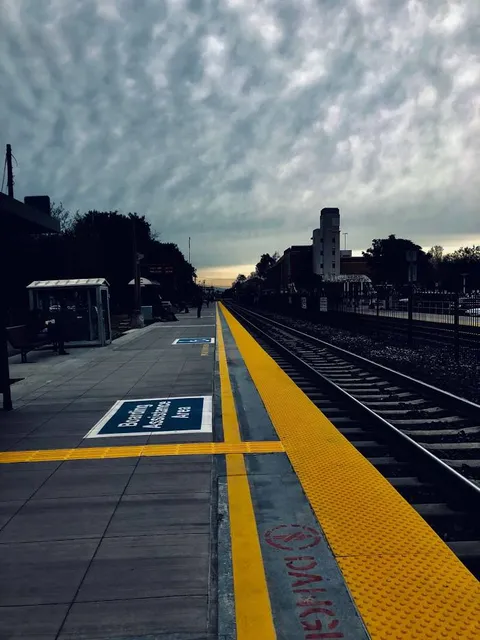
Suzuka circuit station is only used during events. It has no ticket gates and you can't use your transport card and if you don't know about this you have to line up and pay ¥300 yen at the station and can't use your card until you get back to Nagoya and have the station staff reactivate it!!! You then need to line up to buy a return ticket at a temporary booth and it isn't cheap.
You then walk 30min in the scorching sun or rain to the track and fight yourself past millions of people. Buy a stupitly overpriced cap thanks to the F1 corporation.
Line ups at toilets and to get out of the venue are huge. You then proceed back to the station afterwards thinking you're making good time only to be told to line up on the road with a million other people and wait 2 hours for the train back to Nagoya without any toilet or facilities. Not because there too many people there are just zero trains. They are just running a normal Saturday or Sunday timetable. Seriously they don't put on an extra train or two for the event!
Then endure another hour on the train without anything until Nagoya. Then line up at the station to get out because you had to buy a paper ticket that doesn't work at the ticket gates! Then come back the next day to fix up your card because they couldn't do it then because it was too busy. Seriously!
This was on the Saturday qualifying day. As rain was forecast for the Sunday race we pulled the pin as we couldn't go through that again. All modes of transport are the same issue, train, bus, car so unless you're an F1 exec. flying in by chopper then I recommend watching it on the TV and better spend your time in Nagoya visiting the Toyota and Train museums...
Read more