HTML SitemapExplore
logo
Find Things to DoFind The Best Restaurants

Hillary Step — Attraction in Khumbupasanglahmu

Name
Hillary Step
Description
Nearby attractions
Mount Everest
XWFJ+VV, Khumjung, Nepal
Everest South Summit
XWPF+6XF, Khumjung, Nepal
Nearby restaurants
Nearby hotels
Related posts
Keywords
Hillary Step tourism.Hillary Step hotels.Hillary Step bed and breakfast. flights to Hillary Step.Hillary Step attractions.Hillary Step restaurants.Hillary Step travel.Hillary Step travel guide.Hillary Step travel blog.Hillary Step pictures.Hillary Step photos.Hillary Step travel tips.Hillary Step maps.Hillary Step things to do.
Hillary Step things to do, attractions, restaurants, events info and trip planning
Hillary Step
NepalKoshi ProvinceKhumbupasanglahmuHillary Step

Basic Info

Hillary Step

XWPG+R7J, Everest Base Camp Trekking Rte, Khumjung 56000, Nepal
4.6(693)
Open until 12:00 AM
Save
spot

Ratings & Description

Info

attractions: Mount Everest, Everest South Summit, restaurants:
logoLearn more insights from Wanderboat AI.
Open hoursSee all hours
SatClosedOpen

Plan your stay

hotel
Pet-friendly Hotels in Khumbupasanglahmu
Find a cozy hotel nearby and make it a full experience.
hotel
Affordable Hotels in Khumbupasanglahmu
Find a cozy hotel nearby and make it a full experience.
hotel
The Coolest Hotels You Haven't Heard Of (Yet)
Find a cozy hotel nearby and make it a full experience.
hotel
Trending Stays Worth the Hype in Khumbupasanglahmu
Find a cozy hotel nearby and make it a full experience.

Reviews

Nearby attractions of Hillary Step

Mount Everest

Everest South Summit

Mount Everest

Mount Everest

4.0

(117)

Open 24 hours
Click for details
Everest South Summit

Everest South Summit

4.1

(175)

Open 24 hours
Click for details
Get the Appoverlay
Get the AppOne tap to find yournext favorite spots!
Wanderboat LogoWanderboat

Your everyday Al companion for getaway ideas

CompanyAbout Us
InformationAI Trip PlannerSitemap
SocialXInstagramTiktokLinkedin
LegalTerms of ServicePrivacy Policy

Get the app

© 2025 Wanderboat. All rights reserved.
logo

Posts

Saddam HossainSaddam Hossain
The Step was known as the most technically difficult part of the typical Nepal-side Everest climb.In some climbing seasons after heavy snowfall, the rock face could have been bypassed with snow/ice climbing.Climbing the Hillary Step has the danger of a 10,000-foot (3,000 m) drop on the right (when going up) and an 8,000-foot (2,400 m) drop on the left The Hillary Step was where Anatoli Boukreev found a body hanging from ropes at the base of the step in 1996, as stated in his book One expedition noted that climbing the Hillary Step was "strenuous", but did offer some protection from the elements An unaided Hillary Step climb was rated as a Class 4 rock climb, but at almost 29,000-foot (8,800 m) altitude The Hillary Step was destroyed by an earthquake that struck the region in 2015. History The Step was named after Sir Edmund Hillary, who was the first known person, along with Tenzing Norgay, to scale it on the way to the summit during the 1953 British Mount Everest Expedition. Hillary and Tenzing first climbed the Hillary Step on 29 May 1953 by climbing the crack between the snow and the rock.Hillary reported that the snow on the step was harder than at lower elevation.Hillary wrote in 1953 (the reference to Tenzing being hauled up like a fish rankled with Tenzing, and the "fish" simile disappeared from later accounts): After an hour’s steady going we reached the foot of the most formidable-looking problem on the ridge – a rock step some forty feet [12m] high. We had known of the existence of this step from aerial photographs, and had also seen it through our binoculars from Thyangboche. We realised that at this altitude it might well spell the difference between success and failure. The rock itself, smooth and almost holdless, might have been an interesting Sunday afternoon problem for a group of expert rock climbers in the Lake District, but here it was a barrier beyond our feeble strength to overcome. I could see no way of turning it on the steep rock bluff on the west, but fortunately another possibility of tackling it still remained. On its east side was another great cornice, and running up the full forty feet of the step was a narrow crack between the cornice and the rock. Leaving Tenzing to belay me as best he could, I jammed my way into this crack, then kicking backwards with my crampons I sank their spikes deep into the frozen snow behind me and levered myself off the ground. Taking advantage of every little rock hold and all the force of knee, shoulder and arms I could muster, I literally cramponed backwards up the crack, with a fervent prayer that the cornice would remain attached to the rock. Despite the considerable effort involved, my progress although slow was steady, and as Tenzing paid out the rope I inched my way upwards until I could finally reach over the top of the rock and drag myself out of the crack on to a wide ledge. For a few moments I lay regaining my breath and for the first time really felt the fierce determination that nothing now could stop us from reaching the top. I took a firm stand on the ledge and signalled to Tenzing to come on up. As I heaved hard on the rope Tenzing wriggled his way up the crack and finally collapsed exhausted at the top like a giant fish when it has just been hauled from the sea after a terrific struggle. The step had been seen by the first assault party of Tom Bourdillon and Charles Evans when they reached the South Summit on 26 May 1953 at 1 pm (too late to attempt the summit). Seated on the snow dome, they could look closely at the last 300 vertical feet [90m] to the Summit. It was not the gentle snow ridge they’d hoped for ... but a thin crest of snow and ice on rock, steep on the left, overhanging as a cornice on the right. It was interrupted by a formidable-looking 40 foot [12m] rock step two-thirds of the way up.
MarvelousMarvelous
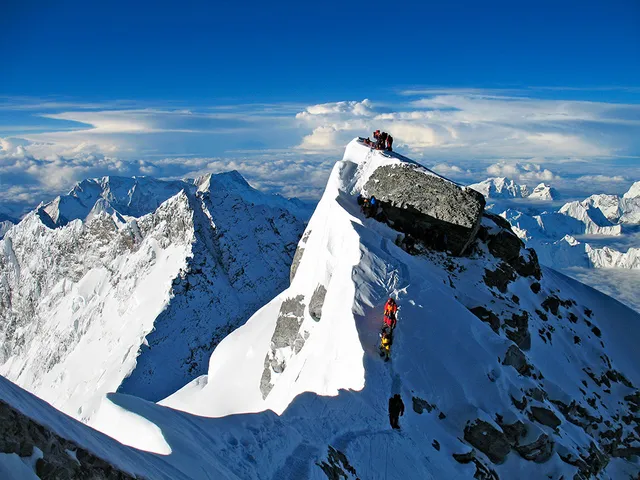
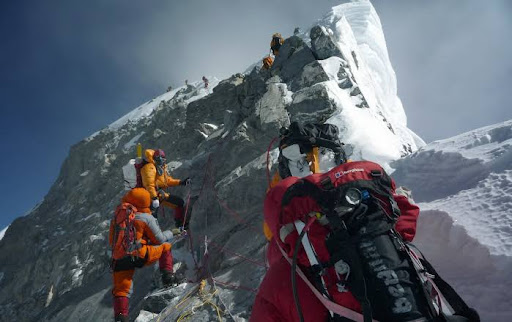
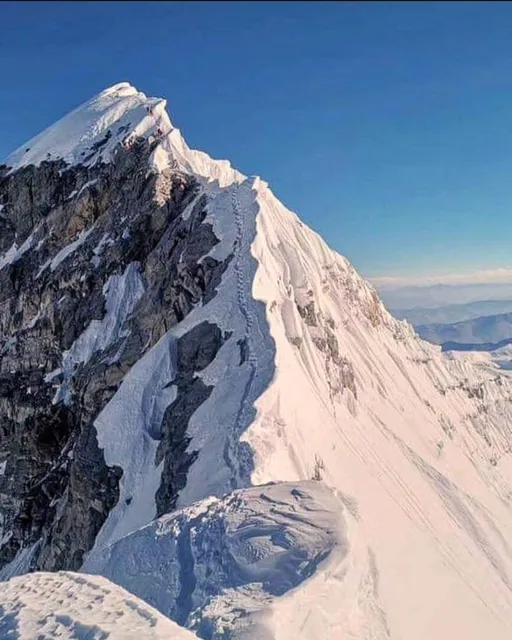
The Hillary Step was a nearly vertical rock face with a height of around 12 metres (39 ft) located very high on Mount Everest at approximately 8,790 metres (28,839 ft) above sea level, near the summit.It was located on the southeast ridge, halfway between the "South Summit" and the true summit, and it gave climbers the last real challenge before reaching the top of the mountain via the southeast route. A wider view of the previous picture, looking up along the southern ridge line. The face of the step is visible with two climbers on it. The face in shadow on the left is the South-West face, and in the light to the right is the top of the East/Kangshung face.The Step was known as the most technically difficult part of the typical Nepal-side Everest climb.In some climbing seasons after heavy snowfall, the rock face could have been bypassed with snow/ice climbing. Climbing the Hillary Step has the danger of a 10,000-foot (3,000 m) drop on the right (when going up) and an 8,000-foot (2,400 m) drop on the left. The Hillary Step was where Anatoli Boukreev found a body hanging from ropes at the base of the step in 1996, as stated in his book The Climb.One expedition noted that climbing the Hillary Step was "strenuous", but did offer some protection from the elements.An unaided Hillary Step climb was rated as a Class 4 rock climb, but at almost 29,000-foot (8,800 m) altitude. All after this I attached a few photos for better imagination and planning you can see them in the image section , so ho see and visit this place. The Hillary Step was a nearly vertical rock face with a height of around 12 metres (39 ft) located very high on Mount Everest at approximately 8,790 metres (28,839 ft) above sea level, near the summit.It was located on the southeast ridge, halfway between the "South Summit" and the true summit, and it gave climbers the last real challenge before reaching the top of the mountain via the southeast route. A wider view of the previous picture, looking up along the southern ridge line. The face of the step is visible with two climbers on it. The face in shadow on the left is the South-West face, and in the light to the right is the top of the East/Kangshung face . The Step was known as the most technically difficult part of the typical Nepal-side Everest climb. In some climbing seasons after heavy snowfall, the rock face could have been All after this I attached a few photos for better imagination and planning you can see them in the image section , so ho see and visit this place.
JRJR
Beautiful place to find best of the Everest view . But lots of things lacking here 1. No good internet or Wi-Fi 2. Poorly conducted restaurents lacking fresh and healthy food 3. Everything expensive due to location 4. Transportation and communication services are poor 5. Poor waste management.
See more posts
See more posts
hotel
Find your stay

Pet-friendly Hotels in Khumbupasanglahmu

Find a cozy hotel nearby and make it a full experience.

The Step was known as the most technically difficult part of the typical Nepal-side Everest climb.In some climbing seasons after heavy snowfall, the rock face could have been bypassed with snow/ice climbing.Climbing the Hillary Step has the danger of a 10,000-foot (3,000 m) drop on the right (when going up) and an 8,000-foot (2,400 m) drop on the left The Hillary Step was where Anatoli Boukreev found a body hanging from ropes at the base of the step in 1996, as stated in his book One expedition noted that climbing the Hillary Step was "strenuous", but did offer some protection from the elements An unaided Hillary Step climb was rated as a Class 4 rock climb, but at almost 29,000-foot (8,800 m) altitude The Hillary Step was destroyed by an earthquake that struck the region in 2015. History The Step was named after Sir Edmund Hillary, who was the first known person, along with Tenzing Norgay, to scale it on the way to the summit during the 1953 British Mount Everest Expedition. Hillary and Tenzing first climbed the Hillary Step on 29 May 1953 by climbing the crack between the snow and the rock.Hillary reported that the snow on the step was harder than at lower elevation.Hillary wrote in 1953 (the reference to Tenzing being hauled up like a fish rankled with Tenzing, and the "fish" simile disappeared from later accounts): After an hour’s steady going we reached the foot of the most formidable-looking problem on the ridge – a rock step some forty feet [12m] high. We had known of the existence of this step from aerial photographs, and had also seen it through our binoculars from Thyangboche. We realised that at this altitude it might well spell the difference between success and failure. The rock itself, smooth and almost holdless, might have been an interesting Sunday afternoon problem for a group of expert rock climbers in the Lake District, but here it was a barrier beyond our feeble strength to overcome. I could see no way of turning it on the steep rock bluff on the west, but fortunately another possibility of tackling it still remained. On its east side was another great cornice, and running up the full forty feet of the step was a narrow crack between the cornice and the rock. Leaving Tenzing to belay me as best he could, I jammed my way into this crack, then kicking backwards with my crampons I sank their spikes deep into the frozen snow behind me and levered myself off the ground. Taking advantage of every little rock hold and all the force of knee, shoulder and arms I could muster, I literally cramponed backwards up the crack, with a fervent prayer that the cornice would remain attached to the rock. Despite the considerable effort involved, my progress although slow was steady, and as Tenzing paid out the rope I inched my way upwards until I could finally reach over the top of the rock and drag myself out of the crack on to a wide ledge. For a few moments I lay regaining my breath and for the first time really felt the fierce determination that nothing now could stop us from reaching the top. I took a firm stand on the ledge and signalled to Tenzing to come on up. As I heaved hard on the rope Tenzing wriggled his way up the crack and finally collapsed exhausted at the top like a giant fish when it has just been hauled from the sea after a terrific struggle. The step had been seen by the first assault party of Tom Bourdillon and Charles Evans when they reached the South Summit on 26 May 1953 at 1 pm (too late to attempt the summit). Seated on the snow dome, they could look closely at the last 300 vertical feet [90m] to the Summit. It was not the gentle snow ridge they’d hoped for ... but a thin crest of snow and ice on rock, steep on the left, overhanging as a cornice on the right. It was interrupted by a formidable-looking 40 foot [12m] rock step two-thirds of the way up.
Saddam Hossain

Saddam Hossain

hotel
Find your stay

Affordable Hotels in Khumbupasanglahmu

Find a cozy hotel nearby and make it a full experience.

Get the Appoverlay
Get the AppOne tap to find yournext favorite spots!
The Hillary Step was a nearly vertical rock face with a height of around 12 metres (39 ft) located very high on Mount Everest at approximately 8,790 metres (28,839 ft) above sea level, near the summit.It was located on the southeast ridge, halfway between the "South Summit" and the true summit, and it gave climbers the last real challenge before reaching the top of the mountain via the southeast route. A wider view of the previous picture, looking up along the southern ridge line. The face of the step is visible with two climbers on it. The face in shadow on the left is the South-West face, and in the light to the right is the top of the East/Kangshung face.The Step was known as the most technically difficult part of the typical Nepal-side Everest climb.In some climbing seasons after heavy snowfall, the rock face could have been bypassed with snow/ice climbing. Climbing the Hillary Step has the danger of a 10,000-foot (3,000 m) drop on the right (when going up) and an 8,000-foot (2,400 m) drop on the left. The Hillary Step was where Anatoli Boukreev found a body hanging from ropes at the base of the step in 1996, as stated in his book The Climb.One expedition noted that climbing the Hillary Step was "strenuous", but did offer some protection from the elements.An unaided Hillary Step climb was rated as a Class 4 rock climb, but at almost 29,000-foot (8,800 m) altitude. All after this I attached a few photos for better imagination and planning you can see them in the image section , so ho see and visit this place. The Hillary Step was a nearly vertical rock face with a height of around 12 metres (39 ft) located very high on Mount Everest at approximately 8,790 metres (28,839 ft) above sea level, near the summit.It was located on the southeast ridge, halfway between the "South Summit" and the true summit, and it gave climbers the last real challenge before reaching the top of the mountain via the southeast route. A wider view of the previous picture, looking up along the southern ridge line. The face of the step is visible with two climbers on it. The face in shadow on the left is the South-West face, and in the light to the right is the top of the East/Kangshung face . The Step was known as the most technically difficult part of the typical Nepal-side Everest climb. In some climbing seasons after heavy snowfall, the rock face could have been All after this I attached a few photos for better imagination and planning you can see them in the image section , so ho see and visit this place.
Marvelous

Marvelous

hotel
Find your stay

The Coolest Hotels You Haven't Heard Of (Yet)

Find a cozy hotel nearby and make it a full experience.

hotel
Find your stay

Trending Stays Worth the Hype in Khumbupasanglahmu

Find a cozy hotel nearby and make it a full experience.

Beautiful place to find best of the Everest view . But lots of things lacking here 1. No good internet or Wi-Fi 2. Poorly conducted restaurents lacking fresh and healthy food 3. Everything expensive due to location 4. Transportation and communication services are poor 5. Poor waste management.
JR

JR

See more posts
See more posts

Reviews of Hillary Step

4.6
(693)
avatar
5.0
4y

The Step was known as the most technically difficult part of the typical Nepal-side Everest climb.In some climbing seasons after heavy snowfall, the rock face could have been bypassed with snow/ice climbing.Climbing the Hillary Step has the danger of a 10,000-foot (3,000 m) drop on the right (when going up) and an 8,000-foot (2,400 m) drop on the left The Hillary Step was where Anatoli Boukreev found a body hanging from ropes at the base of the step in 1996, as stated in his book One expedition noted that climbing the Hillary Step was "strenuous", but did offer some protection from the elements An unaided Hillary Step climb was rated as a Class 4 rock climb, but at almost 29,000-foot (8,800 m) altitude

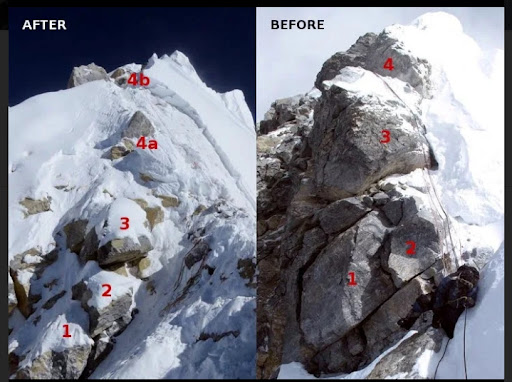
The Hillary Step was destroyed by an earthquake that struck the region in 2015.

History

The Step was named after Sir Edmund Hillary, who was the first known person, along with Tenzing Norgay, to scale it on the way to the summit during the 1953 British Mount Everest Expedition. Hillary and Tenzing first climbed the Hillary Step on 29 May 1953 by climbing the crack between the snow and the rock.Hillary reported that the snow on the step was harder than at lower elevation.Hillary wrote in 1953 (the reference to Tenzing being hauled up like a fish rankled with Tenzing, and the "fish" simile disappeared from later accounts):

After an hour’s steady going we reached the foot of the most formidable-looking problem on the ridge – a rock step some forty feet [12m] high. We had known of the existence of this step from aerial photographs, and had also seen it through our binoculars from Thyangboche. We realised that at this altitude it might well spell the difference between success and failure. The rock itself, smooth and almost holdless, might have been an interesting Sunday afternoon problem for a group of expert rock climbers in the Lake District, but here it was a barrier beyond our feeble strength to overcome. I could see no way of turning it on the steep rock bluff on the west, but fortunately another possibility of tackling it still remained. On its east side was another great cornice, and running up the full forty feet of the step was a narrow crack between the cornice and the rock. Leaving Tenzing to belay me as best he could, I jammed my way into this crack, then kicking backwards with my crampons I sank their spikes deep into the frozen snow behind me and levered myself off the ground. Taking advantage of every little rock hold and all the force of knee, shoulder and arms I could muster, I literally cramponed backwards up the crack, with a fervent prayer that the cornice would remain attached to the rock. Despite the considerable effort involved, my progress although slow was steady, and as Tenzing paid out the rope I inched my way upwards until I could finally reach over the top of the rock and drag myself out of the crack on to a wide ledge. For a few moments I lay regaining my breath and for the first time really felt the fierce determination that nothing now could stop us from reaching the top. I took a firm stand on the ledge and signalled to Tenzing to come on up. As I heaved hard on the rope Tenzing wriggled his way up the crack and finally collapsed exhausted at the top like a giant fish when it has just been hauled from the sea after a terrific struggle.

The step had been seen by the first assault party of Tom Bourdillon and Charles Evans when they reached the South Summit on 26 May 1953 at 1 pm (too late to attempt the summit). Seated on the snow dome, they could look closely at the last 300 vertical feet [90m] to the Summit. It was not the gentle snow ridge they’d hoped for ... but a thin crest of snow and ice on rock, steep on the left, overhanging as a cornice on the right. It was interrupted by a formidable-looking 40 foot [12m] rock step two-thirds...

   Read more

avatar
5.0
4y

The Hillary Step was a nearly vertical rock face with a height of around 12 metres (39 ft) located very high on Mount Everest at approximately 8,790 metres (28,839 ft) above sea level, near the summit.It was located on the southeast ridge, halfway between the "South Summit" and the true summit, and it gave climbers the last real challenge before reaching the top of the mountain via the southeast route. A wider view of the previous picture, looking up along the southern ridge line. The face of the step is visible with two climbers on it. The face in shadow on the left is the South-West face, and in the light to the right is the top of the East/Kangshung face.The Step was known as the most technically difficult part of the typical Nepal-side Everest climb.In some climbing seasons after heavy snowfall, the rock face could have been bypassed with snow/ice climbing. Climbing the Hillary Step has the danger of a 10,000-foot (3,000 m) drop on the right (when going up) and an 8,000-foot (2,400 m) drop on the left. The Hillary Step was where Anatoli Boukreev found a body hanging from ropes at the base of the step in 1996, as stated in his book The Climb.One expedition noted that climbing the Hillary Step was "strenuous", but did offer some protection from the elements.An unaided Hillary Step climb was rated as a Class 4 rock climb, but at almost 29,000-foot (8,800 m) altitude. All after this I attached a few photos for better imagination and planning you can see them in the image section , so ho see and visit this place. The Hillary Step was a nearly vertical rock face with a height of around 12 metres (39 ft) located very high on Mount Everest at approximately 8,790 metres (28,839 ft) above sea level, near the summit.It was located on the southeast ridge, halfway between the "South Summit" and the true summit, and it gave climbers the last real challenge before reaching the top of the mountain via the southeast route. A wider view of the previous picture, looking up along the southern ridge line. The face of the step is visible with two climbers on it. The face in shadow on the left is the South-West face, and in the light to the right is the top of the East/Kangshung face . The Step was known as the most technically difficult part of the typical Nepal-side Everest climb. In some climbing seasons after heavy snowfall, the rock face could have been All after this I attached a few photos for better imagination and planning you can see them in the image section , so ho see and...

   Read more
avatar
5.0
10y

Great view but be warned...they don't mention the hills in the brochure. No swimming pool, arcade or shop. It's a bit like Clovelly in Devon but not quite as steep and not so many robbing Devon c**ts. See you back at the South Summit.

Better than the great wall of china.

As is the grand canyon.

And that place with the big water fall.

Thing is, the great wall of china is s bit of a misnomer. Look how many of them there are in China. Even if they all did a couple of bricks it'd be better than that. Maybe they should take a break from brutalising animals and go do a...

   Read more
Page 1 of 7
Previous
Next