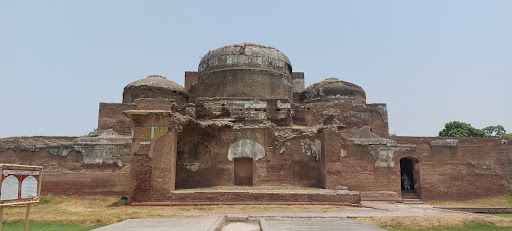
Asif Khan was the brother of Empress Nur Jahan, and father of Arjumand Bano Begum, who became the consort of Shah Jahan under the name Mumtaz Mahal. In 1636, he was elevated as Khan-e-Khana and commander-in-chief and a year later became the governor of Lahore. Asif Khan died on 12 June 1641 in a battle against the forces of rebel Raja Jagat Singh. His tomb was commissioned to be built in the Shahdara Bagh tomb complex in Lahore by Shah Jahan.
Historyedit
Emperor Shah Jahan commissioned the shrine following Khan's death in 1641. According to Abdul Hamid Lahori, author of the Padshahnama, the shrine was under construction for 4 years until 1645 at a cost of 300,000 rupees.1] The tomb was built directly west of the Tomb of Jahangir, and forms an axis with Jahangir's tomb that is interrupted by the Akbari Sarai.[2]
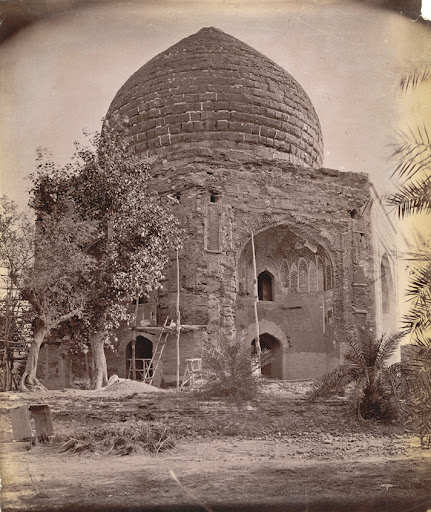
The tomb was heavily damaged during the rule of the Sikh Empire. Lahore's first Sikh rules, Gujjar Singh, Lahna Singh, and Subha Singh, are noted to have damaged the tomb, and planted large pipal trees next to the shrine that obstructed views of it.[2] The trees were removed only in the British era.[2]
The tomb was also plundered by the Sikhs in the 19th century for its marble and sandstone.[6] Ranjit Singh was noted by British explorer William Moorcroft to have removed marble from the tomb's interior, exterior, as well as the various stones that were used to decorate the tomb.[2] The plundered materials were then used to decorate the Golden Temple in Amritsar, as well as for use to build the Hazuri Bagh Baradari near the Lahore Fort.[1
Asif Khan TombThe marble cenotaph of Asif KhanSome of the elaborate surviving tile work
Layout
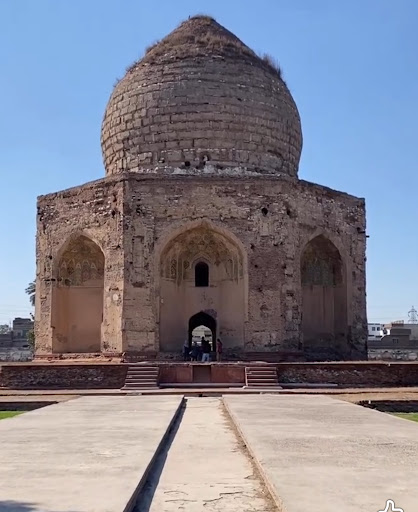
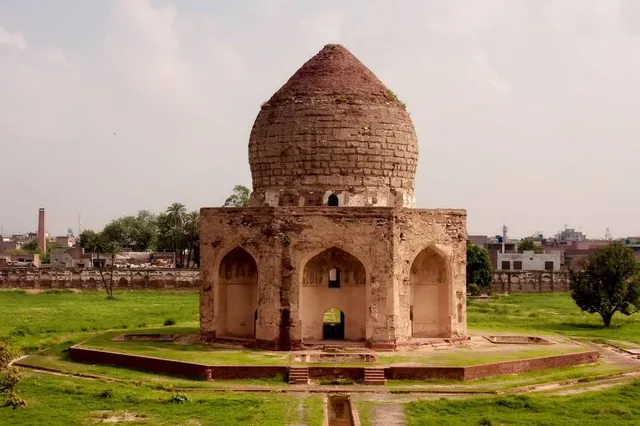
The tomb is built entirely of brick in an octagonal plan, and sits in the centre of a large quadrangle measure 300 yards on each side. The tomb is set upon a chabutra, or podium, that elevates the structe 3 feet 9 inches relative to the garden. Each side of the octagon measures 38 feet 8 inches,
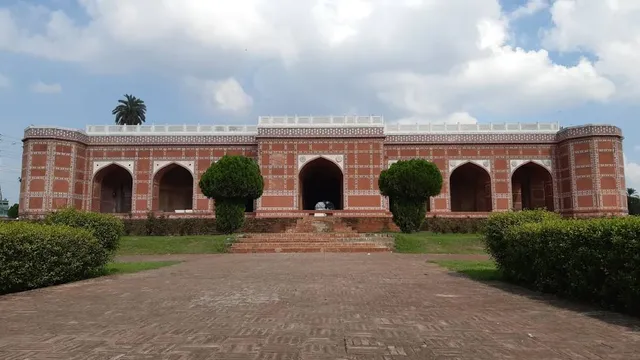
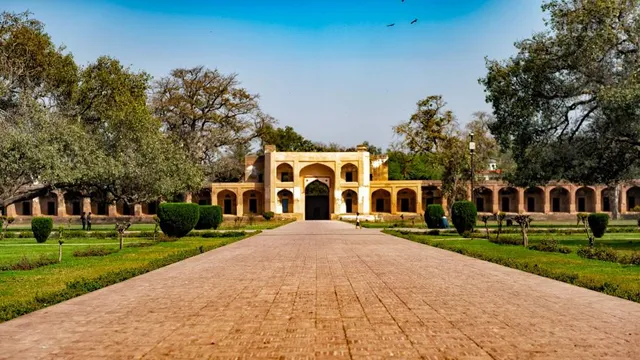
Large gates exist in both northern and southern walls, though the tomb's main gate is the southern one. A small mosque is found in the eastern wall that was converted into a residence during the British period, while the western wall offers access to the Tomb of Jahangir via the Akbari Sarai.
Octagonal tombs were never used for emperors, but were commonly employed for burial of high-ranking noblemen such as Asif Khan. The floor of the platform on which the tomb stands was built with Sang-e Abri, or red limestone, while the outer walls were covered with red sandstone.
Architecture
Exterior
Some of the shrine's tile work still survives
At the time of its construction, the tomb was noted to feature some of the finest examples of building arts and crafts. The exterior originally was adorned with marble stone inlay work and veneered with stucco tracery, and blue kashi tiles typical of Lahore. The floors were decorated with marble, inlaid with precious stones. Each side of the tomb has a deeply recessed iwan, or alcove, with a door and arched window looking into the tomb.
Interior
Some plasterwork still survives on the dome's underside
The tomb's interior features 8 portals that offer access to the interior from the outside. The interior was renowned for its lavish use of white marble and precious stone inlay,which has since disappeared. The inner dome ceiling is decorated in a high plaster relief of interlacing patterns, some of which still survives. The floor was once paved with red sandstone, though this was removed during the Sikh period.
The tomb contains a cenotaph made of pure marble, carved with inscriptions from the Qur'an, similar to that in Emperor Jahangir's adjacent tomb.
Dome
A large central double-layered brick bulbous dome rests atop the octagonal base. The bulbous dome that crowns the tomb was once covered in a marble veneer, and is of a shape that is unique among all Mughal structures. Such bulbous domes were an innovation of Shah Jahan's era, and were used to great effect at other...
Read moreThe Tomb of Asif Khan is a 17th-century mausoleum located in Shahdara Bagh, in the city of Lahore, Punjab. It was built for the Mughal statesman Mirza Abul Hassan Jah, who was titled Asif Khan. Asif Khan was brother of Nur Jahan, and brother-in-law to the Mughal Emperor Jahangir. Asif Khan's tomb is located adjacent to the Tomb of Jahangir, and near the Tomb of Nur Jahan. Asif Khan's tomb was built in a Central Asian architectural style, and stands in the centre of a Persian-style Charbagh garden. Asif Khan was the brother of Empress Nur Jahan, and father of Arjumand Bano Begum, who became the consort of Shah Jahan under the name Mumtaz Mahal. In 1636, he was elevated as Khan-e-Khana and commander-in-chief and a year later became the governor of Lahore. Asif Khan died on 12 June 1641 in a battle against the forces of rebel Raja Jagat Singh. His tomb was commissioned to be built in the Shahdara Bagh tomb complex in Lahore by Shah Jahan. Emperor Shah Jahan commissioned the shrine following Khan's death in 1641. According to Abdul Hamid Lahori, author of the Padshahnama, the shrine was under construction for 4 years until 1645 at a cost of 300,000 rupees. The tomb was built directly west of the Tomb of Jahangir, and forms an axis with Jahangir's tomb that is interrupted by the Akbari Sarai. The tomb was heavily damaged during the rule of the Sikh Empire. Lahore's first Sikh rules, Gujjar Singh, Lahna Singh, and Subha Singh, are noted to have damaged the tomb, and planted large pipal trees next to the shrine that obstructed views of it. The trees were removed only in the British era. The tomb was also plundered by the Sikhs in the 19th century for its marble and sandstone. Ranjit Singh was noted by British explorer William Moorcroft to have removed marble from the tomb's interior, exterior, as well as the various stones that were used to decorate the tomb. The plundered materials were then used to decorate the Golden Temple in Amritsar, as well as for use to build the Hazuri Bagh Baradari near the Lahore Fort. The tomb is built entirely of brick in an octagonal plan, and sits in the centre of a large quadrangle measure 300 yards on each side.The tomb is set upon a chabutra, or podium, that elevates the structe 3 feet 9 inches relative to the garden. Each side of the octagon measures 38 feet 8 inches, Large gates exist in both northern and southern walls, though the tomb's main gate is the southern one. A small mosque is found in the eastern wall that was converted into a residence during the British period, while the western wall offers access to the Tomb of Jahangir via the Akbari Sarai. Octagonal tombs were never used for emperors, but were commonly employed for burial of high-ranking noblemen such as Asif Khan. The floor of the platform on which the tomb stands was built with Sang-e Abri, or red limestone, while the outer walls were covered with red sandstone. At the time of its construction, the tomb was noted to feature some of the finest examples of building arts and crafts. The exterior originally was adorned with marble stone inlay work and veneered with stucco tracery, and blue kashi tiles typical of Lahore. The floors were decorated with marble, inlaid with precious stones. Each side of the tomb has a deeply recessed iwan, or alcove, with a door and arched window looking into the tomb. The tomb's interior features 8 portals that offer access to the interior from the outside. The interior was renowned for its lavish use of white marble and precious stone inlay, which has since disappeared. The inner dome ceiling is decorated in a high plaster relief of interlacing patterns, some of which still survives. The floor was once paved with red sandstone, though this was removed during the Sikh period. The tomb contains a cenotaph made of pure marble, carved with inscriptions from the Qur'an, similar to that in Emperor Jahangir's adjacent tomb. A large central double-layered brick bulbous dome rests atop the...
Read moreThe Monument, a single storey structure, square in plan, consists of a platform with tall octagonal corner towers and a projecting entrance bay in the middle of each side. The exterior of the monument including the lowest stage of the towers, has a red sandstone facing with rich panel decoration inlaid with marble decorative motifs. The four corner towers, with white marble cupolas, rise in five stages to a height of 100 feet with a zigzag inlay of white and yellow marble : the building is divided into a series of vaulted compartments. The interior is embellished with floral frescoes, delicate inlay work (pietra dura) and brilliant marble intersia of various colours. The marble cenctaph with its delicate and colourful pietra dure is engraved with the ninety-nine attributes of Allah. Asif Khan's tomb The tomb, an octagonal structure with a high bulbous dome stands in the centre of a vast garden divided into four squares once set with reservoirs, fountains and pathways. The exterior was originally adorned with rich stone inlay work and the interior decorated with very bold stucco tracery, tile mosaic and ghalibkari. The high bulbous double dome was originally covered with marble veneering. Akbari Sarai The series of tombs called Akbari Sarai, is situated between the tombs of Jahangir and Asif Khan. The open courtyard of the Sarai is flanked on all sides by a raised terrace where are built rows of small cells, numbering 180, fronted with a verandah and a common open passage. The corners of the Sarai are graced by burjis. The Sarai has two stately gateways of usual Mughal style, one on the north and the other on the south. These gateways are beautifully decorated with frescoes and ghalibkari. From the decorative elements, the style of the structure and the size of bricks, the Sarai and the entrance gatoway to the tomb seem to have been built in the same period apparently parts o single building complex of Shah Jahan's Tomb. To the west of the Sarai in the middle of the row of cells is a mosque with three splendid domes. It is graced with red sandstone facing decorated...
Read more