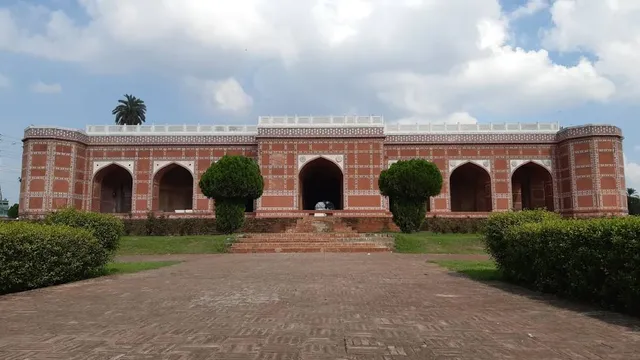
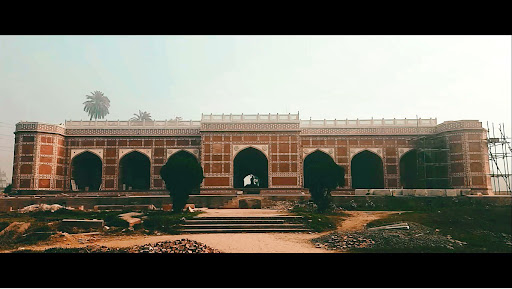
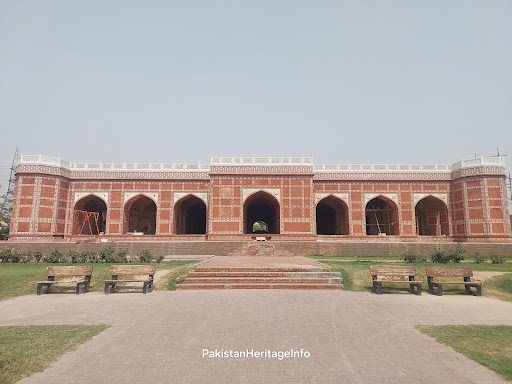
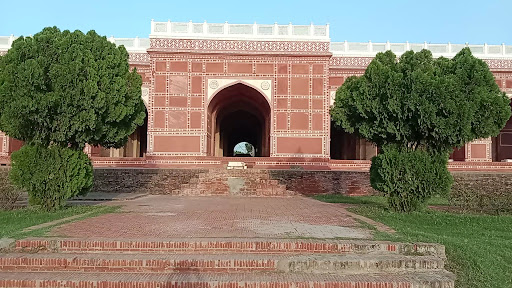
The Tomb of Nur Jahan is a 17th-century mausoleum in Lahore, Pakistan, that was built for the Mughal empress Nur Jahan. The tomb's marble was plundered during the Sikh era in 18th century for use at the Golden Temple in Amritsar. The red sandstone mausoleum, along with the nearby tomb of Jahangir, tomb of Asif Khan, and Akbari Sarai, forms part of an ensemble of Mughal monuments in Lahore's Shahdara Bagh.The mausoleum is located in Shahdara Bagh, across the River Ravi from Lahore. The tomb is part of an ensemble of nearby monuments, including the Tomb of Jahangir, Akbari Sarai, as well as the tomb of Asif Khan. Nur Jahan's tomb was separated from the other monuments by open fields, which were later interrupted by construction of the Lahore-Peshawar Railway Line during the British era. Mehr-un-Nissa, bestowed with the title Nur Jahan, meaning "Light of the World," was the fourth child of Asmat Begum and her husband Mirza Ghiyas Beg, who had both immigrated from Persia. She was first married at the age of 17 to a Persian adventurer named Sher Afghan Ali Quli Khan Istajlu, who was renowned for his brilliant military career, and from whom she bore a daughter, Ladli Begum before he died in 1607. Her father served the Mughal emperor Akbar, who bestowed him with the title of Itmat-ud-daulah ("Pillar of the State"), while her brother Asif Khan served her next husband, the Emperor Jahangir. Nur Jahan was the most powerful Mughal Empress. During her reign between 1611 and 1627, she effectively shaped the expanding Mughal Empire, and contributed towards religious causes and helped foster overseas trade.Having survived Jahangir by 18 years, she died at the age of 68 years and much of the mausoleum was most probably constructed during her lifetime.[5] The tomb took four years to complete at the cost of Rupees three lakhs. Following the ascent of Shah Jahan to the Mughal throne, she was provided a yearly allowance of 200,000 rupees. Given the poor state of relations between her and Shah Jahan, it is likely that she funded the construction of her tomb from her annual allowance. As with the Tomb of Asif Khan, Nur Jahan's tomb was stripped of its ornamental stones and marble during the occupation of Lahore by the army of Ranjit Singh. Much of the materials were used to decorated the Golden Temple in Amritsar and it has been said that half the Golden Temple's splendour derives from marble plundered from Nur Jahan's shrine. The Shahdara ensemble of monuments, including the Nur Jahan tomb, suffered under British rule when a railway line was built between the tombs of Asif Khan and Nur Jahan.The tomb underwent minor repairs but is slated for major restoration.The tomb was built on a podium, in the takhtgah style in which the podium serves as the takht, or "throne." With a platform measuring 158 square feet, the tomb is in the shape of a square and measures 124 feet on each side, and is 19.6 feet high. Minarets may previously have risen from the corners of the mausoleum, similar to the nearby Tomb of Jahangir. Unlike her father's tomb (tomb of I'timād-ud-Daulah), which was constructed in white marble, Nur Jahan's mausoleum is primarily clad in red sandstone, with a flat roofline similar to that of her husband's tomb.The exterior features 7 vaulted arches, which were covered with marble and wrought with flower mosaics in semi-precious stones. The central arch on each side protrudes out from the 3 flanking vaulted arches.Minute paneling was executed in intricate patterns and cornices are honeycomb shaped in several rooms. The inner floor is covered with marble and the outer platform with sandstone. The exterior, encased in red sandstone, was inlaid with floral motifs in addition to white, black and yellow marble. The central vaulted chamber of the tomb contains a marble platform with two cenotaphs, one that commemorates Nur Jahan and the other to commemorate her daughter, Ladli Begum. Built by Hakim Ajmal, Khan of Delhi in 1912, the original...
Read moreThe Tomb of Nur Jahan (Urdu: مقبرہ نورجہاں) is a 17th-century mausoleum in Lahore, Pakistan, that was built for the Mughal empress Nur Jahan. The tomb's marble was plundered during the Sikh era in 18th century for use at the Golden Temple in Amritsar.1[3] The red sandstone mausoleum, along with the nearby tomb of Jahangir, tomb of Asif Khan, and Akbari Sarai, forms part of an ensemble of Mughal monuments in Lahore's Shahdara Bagh. The mausoleum is located in Shahdara Bagh, across the River Ravi from Lahore. The tomb is part of an ensemble of nearby monuments, including the Tomb of Jahangir, Akbari Sarai, as well as the tomb of Asif Khan. Nur Jahan's tomb was separated from the other monuments by open fields,[4] which were later interrupted by construction of the Lahore-Peshawar Railway Line during the British era The tomb was built on a podium,[5] in the takhtgah style in which the podium serves as the takht, or "throne." With a platform measuring 158 square feet, the tomb is in the shape of a square and measures 124 feet on each side, and is 19.6 feet high. Minarets may previously have risen from the corners of the mausoleum, similar to the nearby Tomb of Jahangir.[5]
Exterior Edit Unlike her father's tomb (tomb of I'timād-ud-Daulah), which was constructed in white marble, Nur Jahan's mausoleum is primarily clad in red sandstone, with a flat roofline similar to that of her husband's tomb.[5] The exterior features 7 vaulted arches,[5] which were covered with marble and wrought with flower mosaics in semi-precious stones. The central arch on each side protrudes out from the 3 flanking vaulted arches.[5] Minute paneling was executed in intricate patterns and cornices are honeycomb shaped in several rooms. The inner floor is covered with marble and the outer platform with sandstone. The exterior, encased in red sandstone, was inlaid with floral motifs in addition to white, black and yellow marble. Turtle The central vaulted chamber of the tomb contains a marble platform with two cenotaphs, one that commemorates Nur Jahan and the other to commemorate her daughter, Ladli Begum. Built by Hakim Ajmal, Khan of Delhi in 1912, the original marble sarcophagus bears ornate workmanship and the name of Allah, in the same style and size as seen in the tombs of Jahangir and Asif Khan. On her tomb is inscribed an epitaph: "On the grave of this poor stranger, let there be neither lamp nor rose. Let neither butterfly’s wing burn nor nightingale sing".[10]
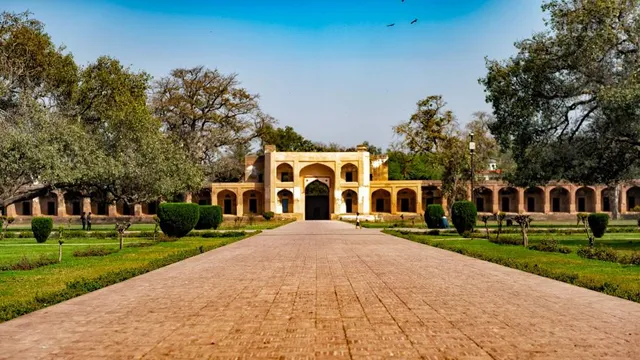
Gardens Edit The tomb stands in the centre of a Persian-style Charbagh.[5] The original garden no longer survives,[5] but once included tulips, roses,...
Read moreTomb of Nur Jahan
Is a 17th-century #mausoleum in Lahore, Pakistan. The tomb took four years to complete at the cost of Rupees three lakhs.
بر مزارِ ما غریباں نے چراغے نے گُلے....... نے پرِ پروانہ سوزد، نے صدائے بلبلے....!
Translation:
On my Grave, there are no candles, no flowers, Neither any moth's feather are burnt, nor any nightingale sings songs over here.
The condition of her tomb is exactly like she predicted in her above verse.
Mughal Queen Nur Jahan (1577–1645) was the most powerful and historical figure of the 17th century She ruled India during the 17th century with elegance.
She was a woman of unusual ability. Jahangir's addiction to opium and alcohol made it easier for Nur Jahan to exert her influence. For many years, she effectively wielded imperial power and was recognized as the real force behind the Mughal throne., and exercised political authority with intelligence, courage and astuteness. She was also responsible for the artistic, architectural, and cultural achievements of the Jahangir era.
Facts
Mehr-un-Nissa was born on 31 May 1577 in Kandahar, Afghanistan, into Persian aristocrat family, to Father Mirza Ghias Beg and Mother Asmat Begam.
At the spring festival of Nauroz in 1611, Jahangir first set eyes upon her remarkable beauty and it is not surprising that Jahangir married her within two months. He first gave her the title Nur Mahal "Light of the Palace" which he changed in 1616 to Nur Jahan, or "Light of the World."
She was the twentieth and the most favorite wife of Jahangir, who was her second husband.
Once she entered the male court without any hesitation, which was a courageous act of that orthodox time, this shows her bravery.
Her artistic achievements include the Mughal gardens of Kashmir and Agra, the tomb of her father Itmad-ud-daula, also in Agra.
6.She was the only Mughal empress to have coinage struck in her name.
She is reported to have slain four tigers with six bullets during one hunt, and someone on this occasion said;
"Though Nur Jahan be in form a woman, In the ranks of men she's a tiger-slayer".
In 1626, Jahangir was captured by rebels while on his way to Kashmir. Nur Jahan intervened & ordered the ministers to organize an attack on the enemy.
She was also poetess and composed Persian poems under the assumed name of Makhfi (meaning hidden).
Nur Jahan died in 1645 at age 68, and is buried with her daughter "Ladli Begum" at Shahdara Bagh in Lahore, Pakistan in a tomb she had built herself, near the tomb of Jahangir. Her brother Asaf Khan's tomb is also...
Read more