HTML SitemapExplore

Tomb of Emperor Jahangir — Attraction in Lahore City Tehsil

Name
Tomb of Emperor Jahangir
Description
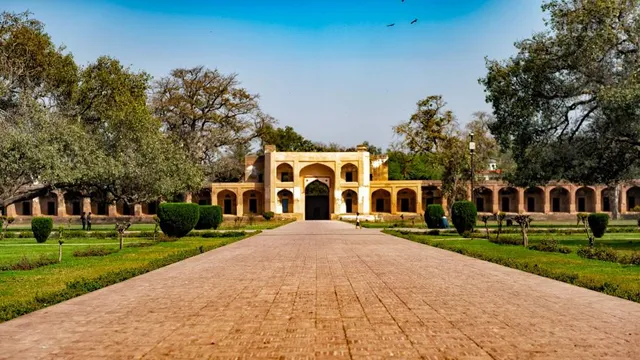
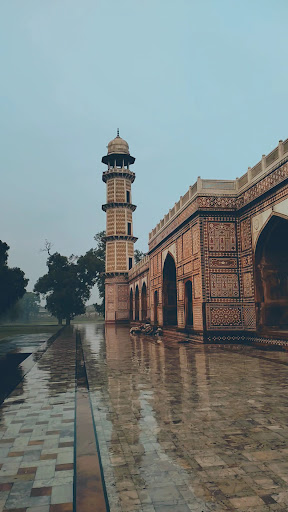
The Tomb of Jahangir is a 17th-century mausoleum built for the Mughal Emperor Jahangir. The mausoleum dates from 1637, and is located in Shahdara Bagh near city of Lahore, Pakistan, along the banks of the Ravi River.
Nearby attractions
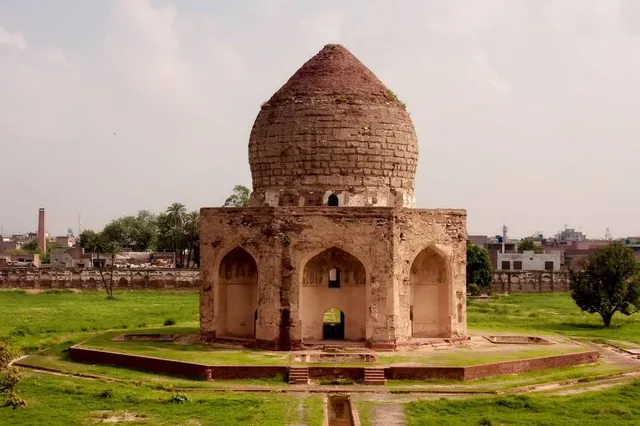
Tomb of Asif Khan
J7FW+2X9, Shahdra Town Road, Shahdara Town, Shahdara, Pakistan
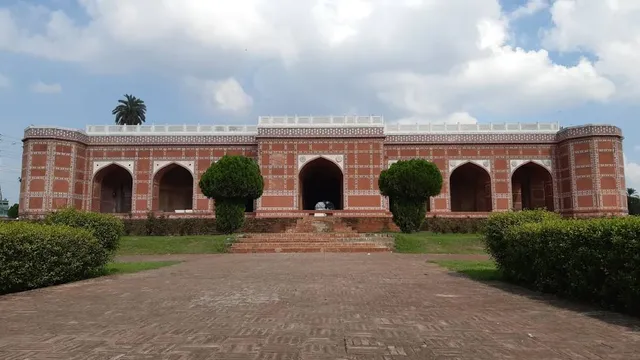
Tomb of Noor Jahan
J7CV+9VQ, Shahdara Town, Shahdara, Pakistan
Nearby restaurants
Nearby local services
Nearby hotels
Related posts
Pakistan: The Living Museum of Gandhara & Mughal Splendor 🌟
Keywords
Tomb of Emperor Jahangir tourism.Tomb of Emperor Jahangir hotels.Tomb of Emperor Jahangir bed and breakfast. flights to Tomb of Emperor Jahangir.Tomb of Emperor Jahangir attractions.Tomb of Emperor Jahangir restaurants.Tomb of Emperor Jahangir local services.Tomb of Emperor Jahangir travel.Tomb of Emperor Jahangir travel guide.Tomb of Emperor Jahangir travel blog.Tomb of Emperor Jahangir pictures.Tomb of Emperor Jahangir photos.Tomb of Emperor Jahangir travel tips.Tomb of Emperor Jahangir maps.Tomb of Emperor Jahangir things to do.
Tomb of Emperor Jahangir things to do, attractions, restaurants, events info and trip planning
Tomb of Emperor Jahangir
PakistanPunjabLahore City TehsilTomb of Emperor Jahangir

Basic Info

Tomb of Emperor Jahangir

Ali hajveri street, Jahangir Tomb Rd, near Ali hajvari mosque, Lahore, Pakistan
4.5(1.4K)
Closed
Save
spot

Ratings & Description

Info

The Tomb of Jahangir is a 17th-century mausoleum built for the Mughal Emperor Jahangir. The mausoleum dates from 1637, and is located in Shahdara Bagh near city of Lahore, Pakistan, along the banks of the Ravi River.

Cultural
Accessibility
attractions: Tomb of Asif Khan, Tomb of Noor Jahan, restaurants: , local businesses:
logoLearn more insights from Wanderboat AI.

Open hoursSee all hours
Tue9 AM - 7 PMClosed

Plan your stay

hotel
Pet-friendly Hotels in Lahore City Tehsil
Find a cozy hotel nearby and make it a full experience.
hotel
Affordable Hotels in Lahore City Tehsil
Find a cozy hotel nearby and make it a full experience.
hotel
The Coolest Hotels You Haven't Heard Of (Yet)
Find a cozy hotel nearby and make it a full experience.
hotel
Trending Stays Worth the Hype in Lahore City Tehsil
Find a cozy hotel nearby and make it a full experience.

Reviews

Live events

MakerBuddy Workshop, Simplifying STEM Learning with Hardware
Sat, Jan 31 • 9:00 AM
Co. For Good - Coworking Spaces, 4A R Block Rd, Johar Block R Phase 2 Town, Lahore, Pakistan
View details
Beyond Freelancing
Beyond Freelancing
Sat, Jan 31 • 10:30 AM
Rspace, GTC 1st Floor , 8-F, Block G Gulberg 2, Lahore, Pakistan
View details

Nearby attractions of Tomb of Emperor Jahangir

Tomb of Asif Khan

Tomb of Noor Jahan

Tomb of Asif Khan

Tomb of Asif Khan

4.2

(653)

Closed
Click for details
Tomb of Noor Jahan

Tomb of Noor Jahan

4.4

(765)

Closed
Click for details
Get the Appoverlay
Get the AppOne tap to find yournext favorite spots!
Wanderboat LogoWanderboat

Your everyday Al companion for getaway ideas

CompanyAbout Us
InformationAI Trip PlannerSitemap
SocialXInstagramTiktokLinkedin
LegalTerms of ServicePrivacy Policy

Get the app

Ā© 2025 Wanderboat. All rights reserved.

Reviews of Tomb of Emperor Jahangir

4.5
(1,405)
avatar
5.0
10y

The building of the tomb is set in a luxuriant square garden which was laid in 1557 by a Nawab during the reign of Emperor Akbar.However,it was acquired later by the accomplished queen of Jahangir,Nurjahan,who named it Dilkusha and always kept it dearly. The garden spreads over an area of about 28 hectares.It is on the fashion of the Persian Charbagh style,thus dividing it into four quarters which in turn get divided into four,each making the whole standing in sixteen divisions separated by means of richly patterned cut and dressed brick-paved walkways with water channels running in the middle.At each intersection a square or octagonal water tank is provided with a white marble fountain ans four red sandstone cascades.The garden is enclosed by a high perimeter wall having gateways in all the four directions. Based on a square plan,the tomb proper is a single storey building,of comparatively low height,standing on a high platform.The exterior of the building has a facing of red sandstone richly inlaid with white marble decorative motifs mostly in the form of ewer,fruit dish and rose-water sprinkler. The central burial chamber has series of rooms around it.An arched veranda in front of these rooms encircles the whole building.A profusely decorated vaulted-bay leads to the central burial chamber,from each of the four sides.The entrance bay,providing access to the central chamber,is on the western side.It is embellished with beautifully done fresco paintings on the ceiling and the side walls while the mosaic work upto dado level adds grace to the passage. The sarcophagus,its platform and the floor are all laid in white marble with exquisite pietra dura work using cut pieces of various stones like sang-e-badal,sang-e-abri,sang-e-moosa and white marble.The cenotaph is a treat to the eye with its beautiful calligraphy done in pietra dura.There are ninety nine attributes of Allah on two sides and Kalima Sharif at the head.At the foot are given the name and date of death of the Monarch,inscribed in Persian,while on the top is an extract in Arabic from the Holy Quran. The court historian of Shahjahan tells that there was another cenotaph built in the middle of the spacious roof.The second cenotaph also rested over a platform and was perhaps decorated with marble railing.Neither the cenotaph nor railing can now be found here.The myth of the building having a second storey removed by the Sikhs during eighteenth/nineteenth century is,however not corroborated from any contemporary written records or the evidence found at the site. The high-rising red sandstone-faced minaret at each corner of the square building adds beauty to its grace.Each of the minarets is crowned with a white marble cupola.The minarets rise in five stages upto a height of over 30 metres and have red sandstone spiral stairs running inside.The minarets are decorated with variegated marble in zig-zag patterns in the middle three stages while a white marble railing,supported over marble brackets,is provided at the top of each stage.The height and design of the minarets compensate well the otherwise dwarfed look of the building. Muhammad Saleh Kamboh tells that the mausoleum over the grave of Jahangir was constructed by Emperor Shahjahan,his son and the successor,at the cost of ten lacs of rupees in ten years. The magnificent building suffered at the hands of the Sikh rulers between 1767 and 1839 when it was stripped off its precious decorations to use them elsewhere in Sikh monuments.It served as a residence for M.Amise,a French officer in Ranjit Singh's army.After his death,the Maharaja gave it to Sultan Muhammad Khan,brother of Dost Muhammad Khan,whose followers also played havoc to this monument.During the British Raj it served as a railway...

Ā Ā Ā Read more
avatar
4.0
7y

Nice Tomb The Tomb of Jahangir (Urdu: Ł…Ł‚ŲØŲ±ŪŁ Ų¬ŪŲ§Ł†ŚÆŪŒŲ±ā€¬ā€Ž) is a 17th century mausoleum built for the Mughal Emperor Jahangir. The mausoleum dates from 1637, and is located in Shahdara Bagh in Lahore, Punjab, Pakistan, along the banks of the Ravi River.1] The site is famous for its interiors that are extensively embellished with frescoes and marble, and its exterior that is richly decorated with pietra dura. The tomb, along with the adjacent Akbari Sarai and the Tomb of Asif Khan, are part of an ensemble currently on the tentative list for UNESCO World Heritage status Though contemporary historians attribute construction of the tomb to Jahangir's son Shah Jahan, the tomb may have been the result of Nur Jahan's vision.[8] Taking inspiration from her father's burial place, she is said to have designed the mausoleum in 1627,[8] and possibly helped fund it.[3] Construction started in 1627,[3] requiring ten years for completion,[9] and cost Rs 10 lakh.[8]

Repair works were undertaken at the tomb in 1814 according to Sikh court records.[10] The tomb complex, however, was also desecrated under Sikh rule when they were pillaged by the army of Ranjit Singh,[11 with building materials used for decoration of the Golden Temple in Amritsar.13 The pillaged grounds were then converted for use as a private residence for an officer in the army of Ranjit Singh, SeƱor Oms, who was also known as Musa Sahib.15 Ranjit Singh further desecrated the mausoleum once more when he ordered that Musa Sahib be buried on the tomb's grounds after dying from cholera in 1828.[16] By 1880, a rumour had begun circulating which alleged that the tomb once was topped by a dome or second storey that was stolen by Ranjit Singh's army,[12] though no evidence has been found to suggest that a dome or second story ever existed at the tomb.[10]

The Shahdara ensemble of monuments suffered further under British rule, when a railway line was built between the tombs of Asif Khan and Nur Jahan.[11] The site was then repaired by the British between 1889-1890.[17]

Flooding from the nearby River Ravi threatened or damaged the site in 1867, 1947, 1950, 1954, 1955, 1957, 1958, 1959, 1962, 1966, 1973, 1976, 1988, and 2010.[11] The site sustained water damage during flooding in 1988 that covered much of the site in 10 feet of water for 5 days.[11]

Architecture Edit

The walls of the tomb are inlaid with carved marble. The tomb was constructed in a Mughal style influenced by Safavid-style architecture from Persia,[18] which may have been introduced into the Mughal Court by Nur Jahan[18] - who was of Persian origin. The mausoleum is laid out as a takhtgah - or a mausoleum built upon a podium which serves as a takht, or "throne."[8]

Exterior Edit

Arcades surround the tomb and feature ghalib kari, or ribs inlaid into arched surfaces on the arch's curved areas In keeping with Sunni religious tradition, Jahangir's great grandfather Babur chose to be buried in a tomb open to the sky at the Gardens of Babur. Jahangir's tomb broke with this tradition by including a roof. In order to forge a compromise with Sunni tradition, Jahangir expressly forbade the construction of a dome over his tomb,[10] and so the roof is simple and free from architectural embellishments which later featured prominently at the Taj Mahal.[19] The mausoleum's faƧade is embellished with red sandstone inlaid with marble motifs.

The square-shaped mausoleum is a 22 foot tall, single-story plinth with arcades lining all four sides of the structure. Vaulted bays along the perimeter of the tomb reflect Timurid architectural styles from Central Asia.[20] The mausoleum's faƧade of red sandstone is inlaid with motifs forged...

Ā Ā Ā Read more
avatar
3.0
5y

Jahangir's Tomb (built 1627-37)

The tomb of Jahangir is located in Shahdara, a suburb of Lahore to the northwest of the city. The area had been a favorite spot of Jahangir and his wife Nur Jahan when they resided in Lahore, and the area was commonly used as a point of departure for travels to and from Kashmir and Lahore. When Jahangir died in 1627 he may have initially been buried in Shahdara in one of its many gardens. His son, Shah Jahan, ordered that a mausoleum befitting an Emperor be built as a permanent memorial.

Construction of the mausoleum lasted 10 years, from 1627 to 37, and was probably funded by the imperial treasury (though there is some evidence that Jahangir's wife, Nur Jahan, may have financed the construction). It occupies a vast quadrangle measuring 600 gaz (approximately 500 meters) to a side and is subdivided into four chahar baghs (four-part gardens). A fountain occupies the center of each of the chahar baghs and the avenues in between, creating a ring of 8 fountains around the central tomb. Water for the fountains was supplied by wells outside of the garden and raised into channels atop of the walls using water wheels that are no longer extant. From there, the water flowed through terra cotta pipes and into the fountains, whereupon the water cascaded into shallow channels running throughout the garden.

The mausoleum itself is square in plan and exactly 100 gaz to a side. Except for the four corner minarets the layout is entirely horizontal with a flat roof covering the whole of the structure. It is likely that this derived from the example set by Jahangir's grandfather, Babur, who preferred burial in a tomb open to the sky in keeping with Sunni Islam precident. Both Jahangir and Shah Jahan would have been familiar with Babur's tomb garden in Kabul in which Babur's wishes were carried out--a screen was erected around the grave site but the cenotaph was not roofed over. At Jahangir's tomb, a compromise of sorts was arrived at by raising a roof over the cenotaph but not constructing any monumental embellishments such as domes. This design was apparently not very popular as it was replicated only once for the tomb of Nur Jahan, Jahangir's wife, at her tomb garden also in Shahdara. Shah Jahan himself was buried in the Taj Mahal, a monument renowned for its use of domes as architectural elements.

At the center of the mausoleum is an octagonal tomb chamber about 8 meters in diameter. It is connected to the outside of the tomb by four hallways facing the four cardinal directions. The cenotaph at the center is carved from a single slab of white marble and decorated with pietra dura inlays of the 99 attributes of God. At its foot is an inscription in Persian recording that "This is the illuminated grave of His Majesty, the Asylum of Pardon, Nooruddin Muhammad Jahangir Padshah 1037 AH".

The establishment of Jahangir's tomb at Shahdara profoundly affected the character of the suburb. Whereas previously the area has been used as a place of relaxation, during Shah Jahan's time the suburb was transformed into a monument to the Mughal's imperial rule. This was only strengthened by the construction of a jilau khana (forecourt) to the west of the tomb and the subsequent construction of a tomb to Jahangir's chief minister Asaf Khan to the west. The ensemble reached its peak when Nur Jahan herself was laid to rest in a tomb slightly to the southwest of the other tombs.

Today, the tomb of Jahangir holds special significance for Pakistanis as it is the only Mughal tomb located in present-day Pakistan. Its image appears on the 1,000 rupee banknote and it remains one of Lahore's most popular...

Ā Ā Ā Read more
Page 1 of 7
Previous
Next

Posts

Pakistan: The Living Museum of Gandhara & Mughal Splendor 🌟
Olivia TaylorOlivia Taylor
Pakistan: The Living Museum of Gandhara & Mughal Splendor 🌟
Your browser does not support the video tag.
anastazjasadventuresanastazjasadventures
Are you thinking of visiting Pakistan? šŸ‡µšŸ‡° Here are my personal top 13 things I recommend to see and do in the beautiful city of LahorešŸ‘‡šŸ¼ 1. Visit Badshahi Mosque (highly recommend going during sunset) 2. Explore Lahore Fort 3. Admire the craftsmanship of Sheesh Mahal (Crystal Palace) 4. Walk around the market at Delhi Gate 5. Shop at Anarkali Bazaar 6. Take a tuktuk ride around the city 7. Visit the Wazeer Khan Mosque 8. See the Tomb of Emperor Jahangir 9. Explore Shahi Hammam (also known as Wazir Khan Hammam) 10. Dine at Haveli restaurant (you get beautiful views of the Badshahi Mosque 11. Take a walk in the historical Bagh-e-Jinnah park (Lawrence Gardens) 12. Drink tea at Pak Tea House - one of the oldest cafes of Pakistan Lahore 13. Learn about Pakistan history and culture at Lahore Museum Found this post useful? Then make sure to SAVE this post for your future trip to Pakistan šŸ‡µšŸ‡° ✨ Follow @anastazjasadventures for more travel and lifestyle tips, and unique adventures ✨ A special thank you to my talented friend @ukhano for taking many of these clips and being a local guide for me in Lahore šŸ™šŸ¼ #visitlahore #dehligate #badshahimosque #lahorefashiontrends #pakistanblogger #exploremoretoday #travelwithme
Mudassir MaqsoodMudassir Maqsood
The tomb of 4th Mughal Emperor, Noor-ud-Din Muhammad Jahangir (1569-1627 A.D) built in the middle of an enormous garden on the right bank of River Ravi at ShahdaraĀ  town on the north- western outskirts of Lahore. Jahangir died at Rajauri on his way to Kashmir and according to his will; his dead body was brought to Lahore and buried in a beautiful garden called, Dilkusha, owned by his favorite and celebrated queen Noor Jahan. The monument took ten years for complition and cost Rs.10 lakhs. The contemporary court accounts credit Shahjahan, son of Jahangir, with the construction of his father’s tomb; it is more likely to have been the result of Noor Jahan’s vision. The tomb and its garden are enclosed by a high brick wall with an imposing gateway on the western side linking the Akbari Sarai. The tomb garden is divided into four main parterres and further sub divided into sixteen equal squares by brick paved walkways with water channels. Each intersection is marked by an alternate octagonal and square cistern.Ā  The division of garden is an attempt to follow the setting of a Chahar Bagh Rauza (paradisal garden mausoleum). The tomb is a single-storey square building, measuring 267 feet on each side and constructed on a high platform. The most striking feature of the building is its arcaded verandah of the inner sanctuary, which runs in front of the series of rooms and four vaulted bays lead to the central burial chamber. The burial chamber contains the marble tomb stone of the Emperor marking the grave underneath. The sarcophagus and the platform are convolutedly inlaid with semi- precious and precious stones depicting floral pattern and ninety- nine attributes of Allah. The bay leading to the grave is profusely ornamented with fresco paintings on the ceiling and side walls at dado level, are bedecked with tile mosaic work. Designs finished with cut pieces of various stones such as Snag-e- Badal, Sang-e Abri and black and white marble on the floor making the overall aesthetic impact more enchanting. Hardly any part is left unembellished. The inner sanctuary is screened by a panel of fine marble beehive fretwork. Four octagonal minarets on each corner of the square structure are built. Each minaret is raised in four stages and crowned with cupola. The three stages in the middle are decorated with horizontally laid zigzag design by inlaying white, yellow, and black marble. Each stage is defined by railing supported with marble bracket. The entrance gate from Akbari Serai is double storey building, the exterior of which is decorated with inlaid geometric and floral designs registered in red sandstone panels. The half of the dome of the arched entrance bears honeycombed pendentives flanked by panels representing summit and bouquet of flowers.
See more posts
See more posts
hotel
Find your stay

Pet-friendly Hotels in Lahore City Tehsil

Find a cozy hotel nearby and make it a full experience.

Pakistan: The Living Museum of Gandhara & Mughal Splendor 🌟
Olivia Taylor

Olivia Taylor

hotel
Find your stay

Affordable Hotels in Lahore City Tehsil

Find a cozy hotel nearby and make it a full experience.

Get the Appoverlay
Get the AppOne tap to find yournext favorite spots!
Are you thinking of visiting Pakistan? šŸ‡µšŸ‡° Here are my personal top 13 things I recommend to see and do in the beautiful city of LahorešŸ‘‡šŸ¼ 1. Visit Badshahi Mosque (highly recommend going during sunset) 2. Explore Lahore Fort 3. Admire the craftsmanship of Sheesh Mahal (Crystal Palace) 4. Walk around the market at Delhi Gate 5. Shop at Anarkali Bazaar 6. Take a tuktuk ride around the city 7. Visit the Wazeer Khan Mosque 8. See the Tomb of Emperor Jahangir 9. Explore Shahi Hammam (also known as Wazir Khan Hammam) 10. Dine at Haveli restaurant (you get beautiful views of the Badshahi Mosque 11. Take a walk in the historical Bagh-e-Jinnah park (Lawrence Gardens) 12. Drink tea at Pak Tea House - one of the oldest cafes of Pakistan Lahore 13. Learn about Pakistan history and culture at Lahore Museum Found this post useful? Then make sure to SAVE this post for your future trip to Pakistan šŸ‡µšŸ‡° ✨ Follow @anastazjasadventures for more travel and lifestyle tips, and unique adventures ✨ A special thank you to my talented friend @ukhano for taking many of these clips and being a local guide for me in Lahore šŸ™šŸ¼ #visitlahore #dehligate #badshahimosque #lahorefashiontrends #pakistanblogger #exploremoretoday #travelwithme
anastazjasadventures

anastazjasadventures

hotel
Find your stay

The Coolest Hotels You Haven't Heard Of (Yet)

Find a cozy hotel nearby and make it a full experience.

hotel
Find your stay

Trending Stays Worth the Hype in Lahore City Tehsil

Find a cozy hotel nearby and make it a full experience.

The tomb of 4th Mughal Emperor, Noor-ud-Din Muhammad Jahangir (1569-1627 A.D) built in the middle of an enormous garden on the right bank of River Ravi at ShahdaraĀ  town on the north- western outskirts of Lahore. Jahangir died at Rajauri on his way to Kashmir and according to his will; his dead body was brought to Lahore and buried in a beautiful garden called, Dilkusha, owned by his favorite and celebrated queen Noor Jahan. The monument took ten years for complition and cost Rs.10 lakhs. The contemporary court accounts credit Shahjahan, son of Jahangir, with the construction of his father’s tomb; it is more likely to have been the result of Noor Jahan’s vision. The tomb and its garden are enclosed by a high brick wall with an imposing gateway on the western side linking the Akbari Sarai. The tomb garden is divided into four main parterres and further sub divided into sixteen equal squares by brick paved walkways with water channels. Each intersection is marked by an alternate octagonal and square cistern.Ā  The division of garden is an attempt to follow the setting of a Chahar Bagh Rauza (paradisal garden mausoleum). The tomb is a single-storey square building, measuring 267 feet on each side and constructed on a high platform. The most striking feature of the building is its arcaded verandah of the inner sanctuary, which runs in front of the series of rooms and four vaulted bays lead to the central burial chamber. The burial chamber contains the marble tomb stone of the Emperor marking the grave underneath. The sarcophagus and the platform are convolutedly inlaid with semi- precious and precious stones depicting floral pattern and ninety- nine attributes of Allah. The bay leading to the grave is profusely ornamented with fresco paintings on the ceiling and side walls at dado level, are bedecked with tile mosaic work. Designs finished with cut pieces of various stones such as Snag-e- Badal, Sang-e Abri and black and white marble on the floor making the overall aesthetic impact more enchanting. Hardly any part is left unembellished. The inner sanctuary is screened by a panel of fine marble beehive fretwork. Four octagonal minarets on each corner of the square structure are built. Each minaret is raised in four stages and crowned with cupola. The three stages in the middle are decorated with horizontally laid zigzag design by inlaying white, yellow, and black marble. Each stage is defined by railing supported with marble bracket. The entrance gate from Akbari Serai is double storey building, the exterior of which is decorated with inlaid geometric and floral designs registered in red sandstone panels. The half of the dome of the arched entrance bears honeycombed pendentives flanked by panels representing summit and bouquet of flowers.
Mudassir Maqsood

Mudassir Maqsood

See more posts
See more posts