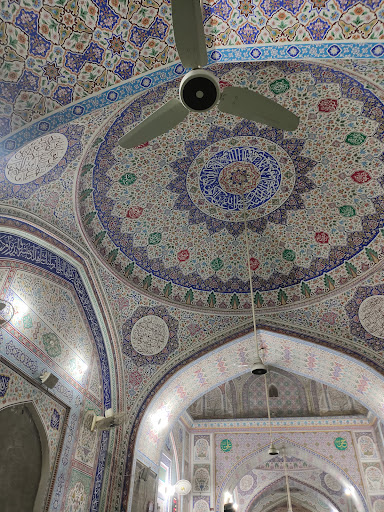
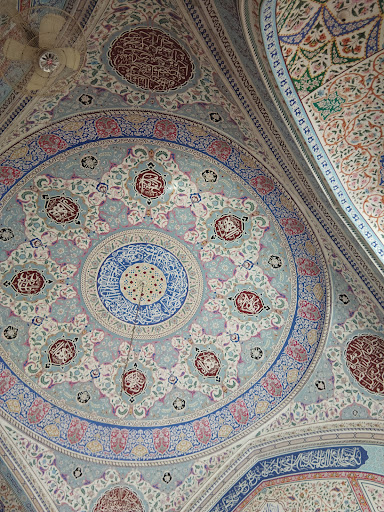
The Shahi Eid Gah Mosque is a late-Mughal era mosque built on the northern outskirts of Multan during the reign of Emperor Muhammad Shah (r. 1719-48). It was funded by Nawab Abdul Samad Khan, the Mughal governor of Multan, who was renowned for both his piety and the efficiency of his administration.
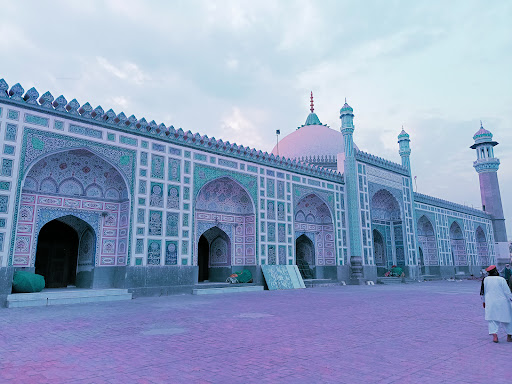
The mosque is oriented north-south with a slight cant to the southwest, allowing its qibla wall to face perpendicular to Mecca. It comprises seven domed chambers symmetrically arranged in a long row, measuring 76 x 16 meters. An enormous courtyard faces the mosque to the east with entrances on the north, east, and south. Then as now, the mosque functioned as an eidgah, a special mosque used for Eid prayers (e.g., the morning of Eid al-Fitr and Eid al-Adha) which was usually located in an open area outside major cities to allow the city's entire population to gather for the major holidays. Eidgah mosques are common in South Asia though they are commonly found throughout the Muslim world, going by different names. For instance, the 12th century Namazgah Mosque in Bukhara, Uzbekistan, was used for the same purpose.
The design of the mosque is fairly restrained, possibly owing to the declining financial situation of the Mughal empire in the early 18th century, as well as its sponsorship by the local governor rather than the Emperor himself. In form, it is reminiscent of typical Mughal-era mosques which featured symmetrical facades with an odd number of bays (usually 3, 5, or 7), corner minarets, a gateway-like opening on the central bay, one or more domes, and copious fresco decoration. The design of the Shahi Eid Gah clearly inspired later examples such as the Abbasi Mosque of Bahawalpur, built in 1849 of more refined materials such as marble which were unavailable (or too expensive) for Abdul Samad Khan's administration. Instead, Abdul Samad Khan made liberal use of the Multani tradition of blue-and-white glazed tiles which prominently cover large areas of the facade, particularly the central bay.
In the mid-19th century Sikh forces were in control of Multan. They converted the Eid Gah into a gunpowder store, reportedly keeping 40,000 pounds of gunpowder inside its seven domed chambers. This volatile situation was made worse when Sikh rebels attempted to assassinate two British officers, Mr. P. A. Agnew and Lieutenant W. A. Anderson, who were seriously wounded. The wounded men were rushed to the dubious safety of the nearby Eid Gah, where they were placed in a makeshift hospital under the main dome, guarded by a dozen Gurkha soldiers and several domestic servants. From his sick bed, Mr. Agnew feared the assassination attempt was the start of an all-out attack against the British, and attempted to arrange for heavy cannon to be brought to bear. However, the Sikh rebels stormed the mosque and killed the two wounded officers, precipitating the British siege of Multan and, ultimately, the eventual destruction of the Sikh Empire.
The siege of Multan proved disastrous for the Eid Gah as the mosque was hit by a shell from a British cannon, igniting the stored gunpowder. The blast damaged a large section of the mosque. Across the city, other ancient monuments were targeted—intentionally or not—resulting in the near-destruction of the tomb of Bahauddin Zakariya and other structures.
During the subsequent British rule the mosque was repaired and converted into a courthouse. In 1891 the building was restored to its original function and has remained active ever since.
As of 2019, the mosque was in the midst of a thorough restoration, as seen in the above...
Read more
 Learn more insights from Wanderboat AI.