Romania: A Country of Rich History and Rapid Development
Nestled in the heart of Eastern Europe, Romania is a country known for its rich cultural heritage, diverse landscapes, and evolving role on the global stage. With a population of around 19 million people, Romania is bordered by Bulgaria, Ukraine, Hungary, Serbia, and Moldova, and is defined by its picturesque Carpathian Mountains, the Black Sea coastline, and the storied region of Transylvania.
Historical Overview
Romania’s history is deeply intertwined with the Roman Empire, from which it takes its name. The region that now constitutes modern Romania was once part of the ancient province of Dacia, which was conquered by the Romans in 106 AD. Over the centuries, Romania endured invasions and rule by various empires, including the Ottoman Empire and the Austro-Hungarian Empire.
In 1859, Romania emerged as a unified state with the union of the principalities of Wallachia and Moldavia. By 1918, the country had expanded its territory to include Transylvania, a region famed for its association with the Dracula legend. The country faced many challenges during the 20th century, enduring two world wars and a communist dictatorship under Nicolae Ceaușescu. Ceaușescu's regime ended in 1989 with a revolution, leading to Romania’s transition toward democracy and capitalism.
Modern Romania
Since the fall of communism, Romania has undergone significant political and economic changes. It joined NATO in 2004 and became a member of the European Union in 2007. These moves marked Romania’s shift toward integrating with Western institutions and securing a role in European geopolitics. While Romania remains one of the EU’s less affluent countries, it has seen impressive economic growth, driven by industries such as IT, automotive, and agriculture.
Bucharest, Romania’s capital, is a bustling metropolis often dubbed "Little Paris" due to its Belle Époque architecture and vibrant cultural scene. Other cities like Cluj-Napoca, Timișoara, and Iași are also important economic and academic hubs.
Culture and Heritage
Romania boasts a unique cultural identity shaped by a blend of Latin, Slavic, Greek, and Ottoman influences. The Romanian language, a Romance language, has a close connection to Latin, reflecting the nation’s Roman heritage. Folk traditions remain vibrant in rural areas, where centuries-old customs, music, and dances are preserved. The country is famous for its painted monasteries, wooden churches, and the UNESCO World Heritage-listed Danube Delta.
One of Romania’s most internationally recognized cultural symbols is the medieval Bran Castle, often associated with the Dracula legend. However, Vlad the Impaler, the historical figure who inspired the Dracula character, never lived in this castle. Nevertheless, the legend draws thousands of tourists annually to Transylvania, a region also known for its fortified churches and Saxon villages.
Economic Growth and Challenges
Romania’s economy has shown considerable progress over the past decade, with growth driven by strong exports, foreign direct investment, and a flourishing tech sector. The country has become an IT hub in Europe, with major companies setting up operations in cities like Bucharest and Cluj-Napoca. Romania’s automotive industry, particularly in manufacturing and innovation, also plays a critical role in the country’s economic development.
Despite this progress, challenges persist. Corruption remains a significant issue, though recent governments have made strides in addressing it through reforms and crackdowns. Additionally, Romania faces demographic challenges, with a shrinking and aging population due to high emigration rates and low birth rates.
Natural Beauty and Tourism
Romania’s diverse landscapes offer stunning natural beauty, from the rolling hills of Transylvania to the beaches of the Black Sea and the untamed wilderness of the Carpathian Mountains. The country’s national parks and nature reserves, such as the Retezat National Park and the Danube Delta, are a draw for eco-tourism...
Read moreThis was one of my first stops in my visit to Romania. A visit that I enjoyed but still a bit frustrated about but we will get to that later.
Reaching the destination was easy enough with plenty of parking available right outside the venue. The parking is paid but barely costs a thing for the time you spend in the mines.
Upon entry you are greeted with help desks on your left where you can buy tickets on the day or walk straight up to the turnstiles in the middle where you can gain entry by showing your e-tickets to the staff member who will scan them there.
There is also an option of a tour guide which you can enquire about at the desks if that’s what you prefer or are in a larger group.
On the website it states any photography should be for personal use and anything for professional use would need to be booked and a fee paid.
As with most tourists I brought my camera with me to take some photos to reflect back on and document my trip but I was told at the entrance that I could not take my camera due to their policies and I would have to leave it in one of the paid lockers available or in the car.
Being a visitor I complied with the rules and went to leave the camera in the car. Upon returning however the same staff member allowed several other individuals into the venue with similar or bigger cameras than I had with me…and yes I did let them know it was only for personal use.
Nevertheless I didn’t let that ruin my trip and snapped a few shots on my phone instead. Fortunately that was the only incident of that kind and the rest of my trip in Romania was delightful.
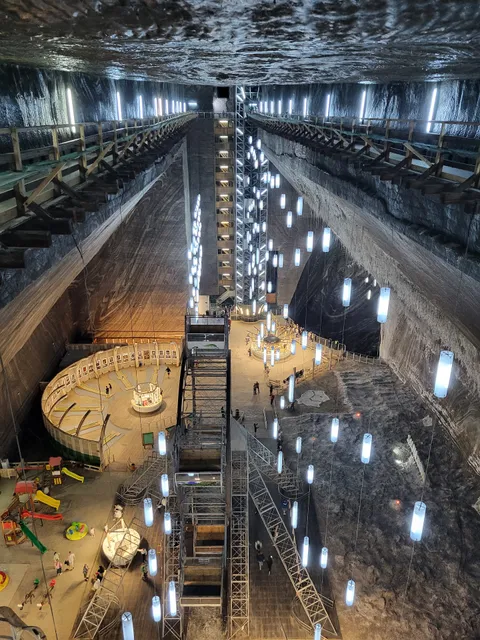
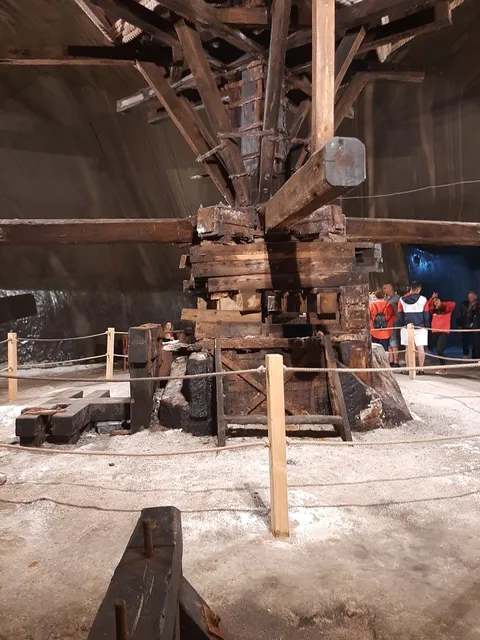
Now back to the mines themselves. The mines passages and walking routes were nicely lit creating a nice ambience where things were visible but not too bright that it ruined the atmosphere of being down the mines.
One thing I will say, it does get cold down there with a temperature roughly staying between 10-13 degrees Celsius so wrap up or take a jumper just in case.
There are two options getting down to the main areas of the mine, the lift or the stairs. If you’re going to take the stairs maybe I’d suggest taking them down and then getting the lift up as there are a fair few steps.
The lifts hold a limited capacity and travel up and down at a reduced speed which I assume so for safety so the wait times can be quite long so be prepared.
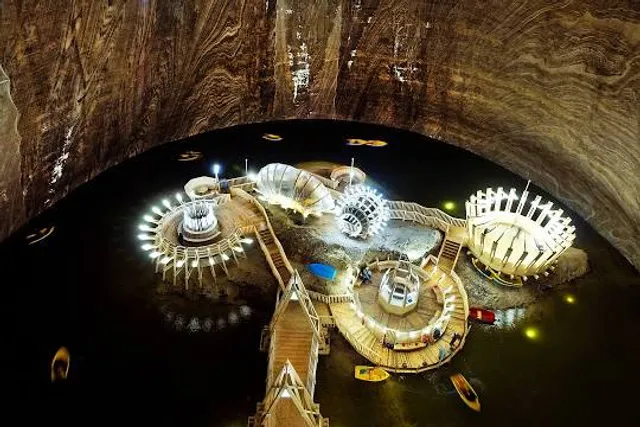
There is also a gift shop as well as many activities for the whole family when you reach the main area of the mine including row boats, ferris wheel, table tennis, mini golf etc. Please be advised that some of these activities have additional fees and booking once you’re down there.
Overall the trip to Salina Turda was good and I learnt a lot from the information dotted around the mine as you walk around. It is truly something you should experience if you visit Romania or...
Read moreMuch hype, less to offer. The mine is very small compared to the one in Praid. I was disappointed by the visit we paid yesterday. The price is huge, 50 RON per adult, 60 on the weekends. Parking is not included, 5 RON per hour, if you manage to find a spot (good luck with that, as it is usually very crowded). If you would like to purchase the tickets online, there is an extra 12 RON processing fee. Everything seems like the management is just hungry for money, they let way too many people in at once. Inside, there are barely any places to sit down (at the first level). There is absolutely nothing to do for free. The mine is so small, that 5-10 minutes is enough to walk to every existing corner. There is no bar, no snacks available, just some cheap souvenirs that are overpriced. No service and no internet either. For 60 RON entrance you would expect they could have pulled an internet cable downstairs. The furniture is in bad shape, full with salt drops and writings. It's been in this state since 4-5 years when I last visited. On the second floor, next to the lake, the plastic covering the roof of the sitting areas is mostly missing, so salt drops keep falling on your head. It is such a cheap repair, yet they don't seem keen on doing anything about it. The direction markings are quite bad. There are 2 entrances, on the two opposite sides of the mine, and you can cross it from inside, it's like 800-1000 m walk. We first missed the descending to the mine chambers, as the signs pointing them out were quite small. Huuuge crowds at the elevator, toilet and even on the stairs. It's close to Cluj and many might regard it as "great", but do yourself a favor, drive a little more and go to some other mine, this is just not worth it...
Read more