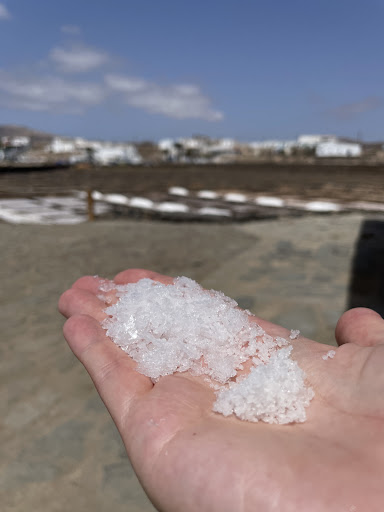
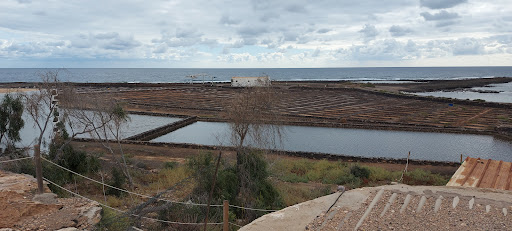
The Museo de la Sal is the last working saline on Fuerteventura. There were quite a few of them. Most remember only names on it as in Jandía for example, the Punta Salinas, on which breaks a wave popular with locals. The old saline on the Isla de Lobos is still clearly visible in its basic features. The saline in Salinas del Carmen is based on a saltworks from the year 1770, probably a superstructure of a still older saline, which was overbuilt once again in 1910 with another redesigned saline. In 1995, the Cabildo de Fuerteventura acquired the 26,100 m2 saline, declared it a cultural asset in 1998, restored it and set up a museum and showroom, and put the unit into operation in 2002. As part of the privatization initiative, the museum has been run by a private operator since 2018. The exhibition area has been modernized and made significantly more attractive, the production of the first-class "Espuma del mar", the meerschaum salt, has been massively expanded. The history of the Saline over the centuries is highly interesting and can be read in detail in the history of the place Salinas del Carmen.For centuries, the operation of salt pans on Fuerteventura was prohibited, which was explicitly regulated by decree 1641. Salt was a monopoly product. With the invention of French cans and their optimization by the British, as a conserved food source for troops, Fuerteventura experienced a small economic boom. The main buyer initially was Great Britain, that equipped his troops with it. In the waters around the island it was swarming with fish from the Canary Islands, especially the fatty fish sardine, which is ideal for preserves and has a high nutritional value. A lot of salt is needed for the production process and that too is abundant in Fuerteventura. The Atlantic is very salty. A good eight to ten percent by weight of salt contains the water. If one liter of water evaporates in the sun, ten grams of salt are conveniently obtained.The inside of the museum is a modern and entertaining demonstration of the salt extraction process, especially in relation to the production of the high-quality sea foam salt produced in the Salinas del Carmen. Very fine and high-quality salt from the foam crowns of the Atlantic waves. The saline itself is a masterpiece of salt-mining. Architect Alberto Luengo, a specialist in salt works, who has already restored some of these historic buildings, as well as those in Salinas del Carmen, describes the site literally as "ingenious". The location for the saline was chosen so first class and the system integrated into the landscape that it works completely self-sufficient, without any pump or bucket just by the energy of the Atlantic waves and the sunlight. To understand how it works, the museum should not be left out. The saline has a production area of 26,100 m2 of which 10,270 m2 are restored and in operation. At full load, it could produce 700 tons of high quality sea foam salt p.a. produce.On the northern part of the saline is a slightly elevated cliff, which acts as a natural breakwater. At high tide and surf, the incoming waves break. The natural lava pit was walled up and designed as a basin. These are the so-called "los saltaderos". The foam crowns of the waves splash over the enclosure, the high-quality salt spray pours down into the natural catch basin. This process is done by the tides every six hours, so the trade winds blow steady and massive enough, which is almost always the case. The resulting surf continues down the east coast and is losing more and more power.From the "saltaderos", the water flows through canals taking advantage of the difference in altitude to four large shallow pools, the so-called "los soleaderos". Shallow basins built on Schlick floodplain. Since silt, a clay-sand mixture, forms a water-impermeable layer, the basins had to be edged. In the "soleaderos", the preheating basin, the water stays around for 8 - 10 days depending on the season and warms up to 15 - 18 degrees Celsius due to the incoming sun. In midsummer, that can happen...
Read more


 Learn more insights from Wanderboat AI.