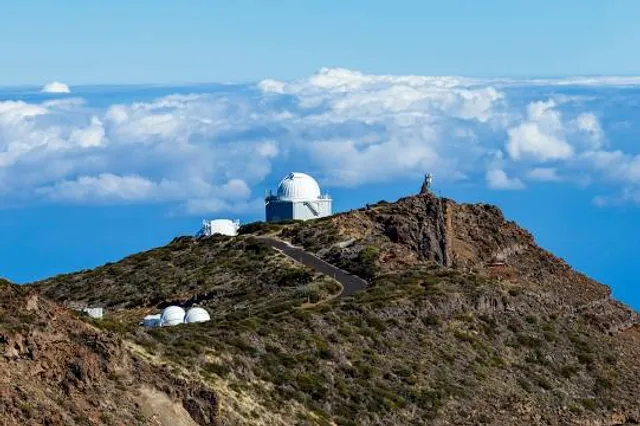
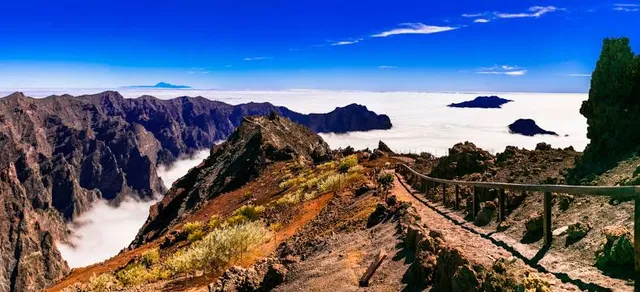
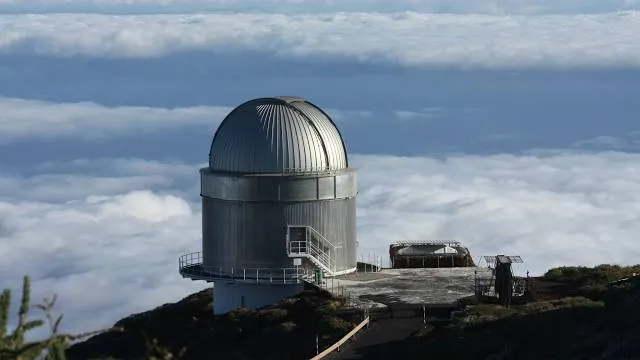
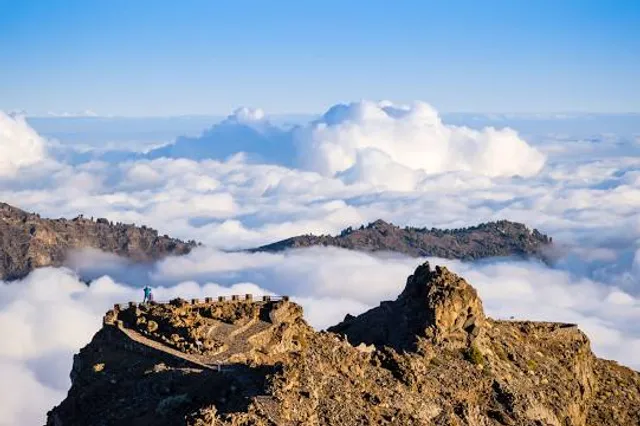
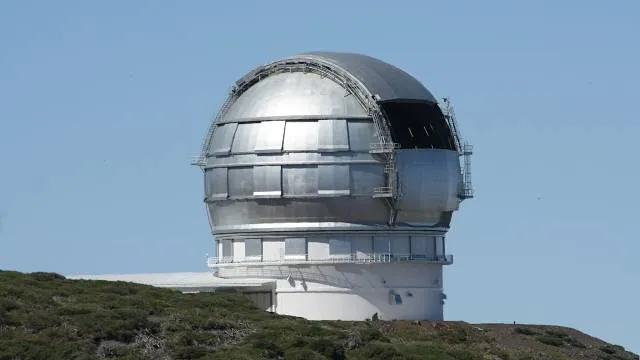
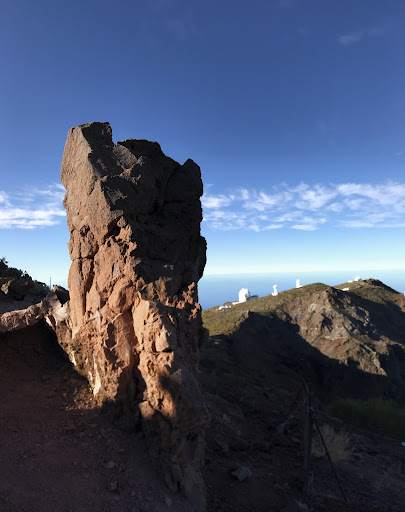
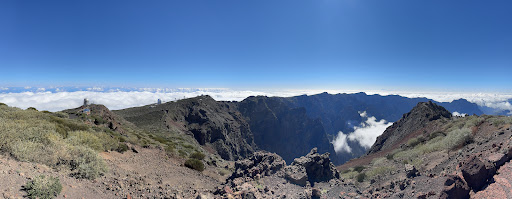
The Pico Veleta is in the list multiple times, accompanied by many Canary Island climbs. Usually these start from sea level, and end at the highest point of the island. The east side of the Roque de los Muchachos covers a staggering 2590 meters of elevation. The west side is not much easier, coming in at 2289 meters. As a reference: Mont Ventoux from Bédois: 1603m. Since the east side contains a short descent, the total elevation is more than the height of the summit. Something that's quite common on vulcanian climbs. The east side climb starts in Santa Cruz de la Palma, the capital of the island. A massive 41 kilometers separate the seaside report from the Roque. During the climb you'll notice a huge difference in vegetation. On the coast there's mostly mediterranean plants like oranges, lemons and avocado's. Later on you'll find pine trees, ending in grass fields. Around 2000 meters you can look into an old crater which is packed in clouds more often than not. These clouds are rarely seen above 2200 meters, so you'll probably end above the clouds. A magic experience. The gradients are moderate, between 6-9%. The 41 km length, combined with the lack of oxygen will however put you to the limit. Around 2200 meters there's a flat section, followed by a short descent. The last 3 km are uphill, leading to the largest observatory in the world. The futuristic, silver bowls of the observatory really emphasize the Vulcanian moon landscape. On the summit, there's a parking lot where you'll find the sign with the elevation. The scenic view on the top offers a magnificent view on Tenerife, Caldera (the old crater) and the beaches below. The west side can be approached in more than one way. The description below is the north west climb starting from Mirador El Serradero. This is a lovely viewing point on the rugged coastline of the island, near Santa Domingo. From here it's a 30 km non-stop climb. Averaging at 7,5% is far from a walk in the park. After Santa Domingo, the climb starts off with a series of switchbacks, still offering views on the sea. This well-maintained, wide and calm road runs through a beautiful green surrounding. About halfway, around 1200 meters, multiple roads gather at Hoya Grande. There's a clear sign indicating the direction to the Roche. The upcoming kilometer is tough, averaging at 11%. Subsequently you'll ride endless kilometers though a stunning area packed with pine trees and rock formations. Above 2000, there's only grass. Clouds are common in the afternoon. As soon as you're above the clouds, a magical world opens up. Around 2150 meters there's an exit, which goes up towards the observatory. The last 3 km are shared with the climb from the east. Be aware, there are no restaurants or other places to fill your water supplies. Take plenty of fluids. This applies to both climbs. Apart from that, it's very peaceful. In april, you won't encounter more than 4 cars per hour. The Roque de los Muchachos is not an ordinary climb, it's a...
Read moreSpectacular place. None of the photos you see can fully describe it. You have to see that with your own eyes. We visited in July. In the afternoon. Parking was almost empty. Maybe it was some anomaly, but it was quite hot (around 32 celsius which was like 8 degree more than it was in Santa Cruz.) Full sun, so remember to use sunscreen and if you plan to walk - take some water with you. Driving to the top is a journey on its own with many beautiful spots to stop and enjoy the view, so take your time, stop whenever you want. Road is in rather well condition and should not be a problem to drive for an average driver, though there is endless number of turns. But it may be rather tiring than challenging. I didn't feel stressed at any time of the drive. We took the eastern route to the top and drove down the western one. In my opinion, the eastern route is more interesting. Overall, definite must see, no 1 spot...
Read moreStunning, majestic, transcendent, breathtaking... an absolute must-visit of La Palma. This magical place above the clouds will reward you with a once in a lifetime experience. From here you can see the entire volcano caldera, three of the other islands in the horizon and a stunning depth of space in any direction that will leave you speechless. Ridiculously easy to access by car, with a small parking lot from which you can take a short path towards the best views, passing by impressive rock formations. If you’re in luck, a small group of friendly local ravens will let you take a picture with them in exchange for a small treat. Together with a view of the astronomical observatories nearby, this is one place you will be remembering often as one of the highlights of...
Read more