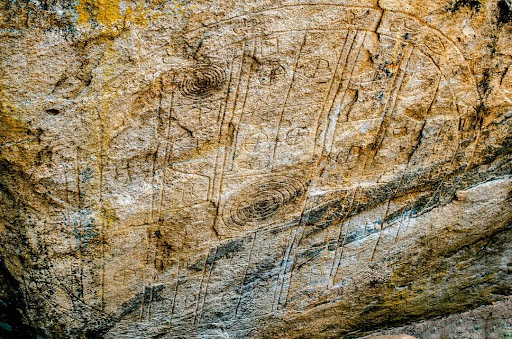
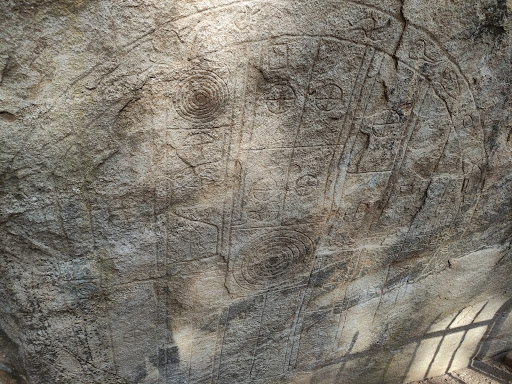
Hidden on the side of a boulder face at the Ran Masu Uyana ( The Royal Goldfish Park) sandwiched between the Tissa Wewa and the Isurumuniya Rock Temple at Anuradhapura, Sri Lanka is a unique artefact of Ancient Sri Lanka which is locally known as “Bawa Chakraya” or the “Sakwala Chakraya“
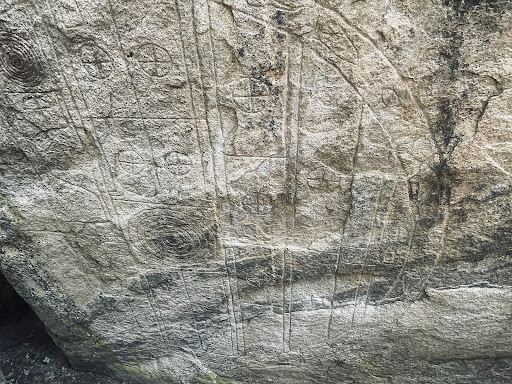
The centre of the chakra is filled by a large circle comprising seven concentric rings, within a square 1 ft 2 in., to which cross lines are drawn vertically and horizontally from the encircling hand, cutting the chakra into quadrants. Further, parallel lines divide the circles vertically into ten strips, or slices, varying in width from 3 in. to 9 in., but matching to the left and right of the central vertical line.
This circular petroglyph is 6 feet in diameter with strange symbols and has attracted historians and archaeologists, pre-historic investigators and believers of extraterrestrials.
According to the description in the Archaeological Survey Report of HCP Bell in 1911, the centre of the chakra is filled by a large circle comprising seven concentric rings, within a square 1 ft 2 in., to which cross lines are drawn vertically and horizontally from the encircling hand, cutting the chakra into quadrants. Further, parallel lines divide the circles vertically into ten strips, or slices, varying in width from 3 in. to 9 in., but matching to the left and right of the central vertical line.
All strips but the outer two are bisected by the horizontal baseline and subdivided into dual or quadripartite partitions. The outermost strips, un-bisected, contain a single small circle, quadrisected by cross lines, and a figure of phallic suggestion.
In each of the penultimate divisions right and left is a tiny circle in line with the horizontal bisection of the chakra, but nothing else. In the third pair are shown four more quadrisected circles, two and two, one in each of the upper and lower partitions left and right.
The fourth strip to the right contains four more such circles, bigger, and each in a separate partition. But that to the left has compressed its circles into a quadripartite panel below the horizontal baseline; leaving the upper panel free for four distinct diagrams – the second seven-ringed circle (differing only in size from its larger counterpart in the centre of the chakra), beneath which are two umbrella~like emblems, and a pinnated three forked figure -the whole intertwined by a fret.
Each of the eight divisions of the fifth strips, which meet as one broad band, above and below the concentric ringed circle on either side of the central vertical line of the chakra holds one of the small circles with cross lines; the two left upper partitions containing also a square and a wavy diagonal line. Outside all these divisions is the 4-inch tier or band bounding the chakra.
Bell believes this petroglyph is the ancients’ understanding of the universe and considers this as a cosmographical chart of the universe or a “map of the worlds” as described in the ancient Buddhist texts. He also rightfully believes that this would be perhaps the oldest map in existence in the world.
The Anuradhapura kingdom was in existence from about 400 BC to about 1000 AD but some believe this artefact to be at least 5000 years old and connect it to the period of King Ravana.
Extraterrestrial Theorists believe that this is a Stargate of an ancient lost civilization who travelled the world with this extraterrestrial invention. Other similar star gates have been found at a Puerta de Hayu Marka or The Gateway to The Gods in Peru close to Lake Titicaca and at the Abu Sir...
Read moreThe Stargate, or Sakwala Chakraya, located in Ranmasu Uyana Royal Park in Anuradhapura, Sri Lanka, is an intriguing and enigmatic artifact. This mysterious set of diagrams, etched onto granite rocks, is believed by some to depict the structure of the solar system and the universe, sparking curiosity and debate among scholars and enthusiasts alike.
Location and Significance: Ranmasu Uyana Royal Park, situated in the ancient city of Anuradhapura, serves as the backdrop for the Sakwala Chakraya. Anuradhapura was the capital of Sri Lanka from the 4th century BCE until the 11th century CE and is renowned for its well-preserved ruins of ancient Sri Lankan civilization, including stupas, palaces, and monasteries.
Description of the Sakwala Chakraya: The Sakwala Chakraya is a complex geometric carving, approximately six feet in diameter, featuring concentric circles, radial lines, and intricate symbolic motifs. The design's precision and detail suggest it held significant importance for those who created it.
Theories and Interpretations:
Astronomical Map: One of the prevailing theories is that the Sakwala Chakraya functions as an ancient astronomical map. The concentric circles and radial lines could represent celestial bodies, their orbits, and possibly even constellations. This interpretation implies that the creators had an advanced understanding of astronomy and the structure of the solar system. Scholars who support this theory suggest that the artifact might have been used for observing and tracking celestial events, aiding in the development of a calendar system or navigation.
Depiction of the Universe: Some researchers propose that the diagrams depict not just the solar system but the entire universe. The intricate patterns could symbolize different cosmic layers or realms, reflecting ancient cosmological beliefs. This interpretation aligns with the idea that ancient civilizations often viewed the...
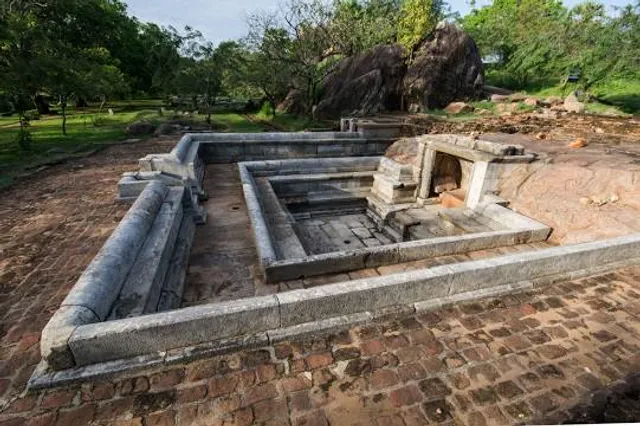
Read moreSandwiched between the Thissa Wewa reservoir and the Isurumuniya Rock Temple, RanmasuUyana of Anuradhapura, a forty acre pleasure garden of the ancient Sri Lankan royals is a unique creation.
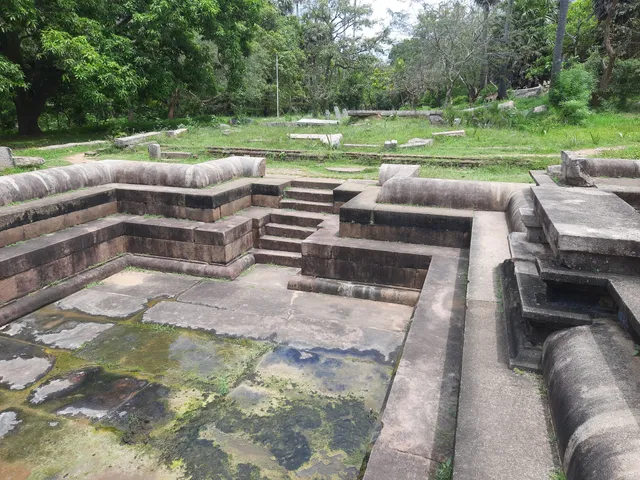
The Ranmasu Uyana was mainly known for its rock sculpted bathing ponds with a sophisticated hydraulics mechanism. A subtle use of pressure difference enables the pumping of water from the nearby Tissa Wewa to the swimming pools of the garden. The pools themselves display a clever use of technology and craftsmanship, in constructing a flawless luxury swimming facility nearly three thousand years ago.
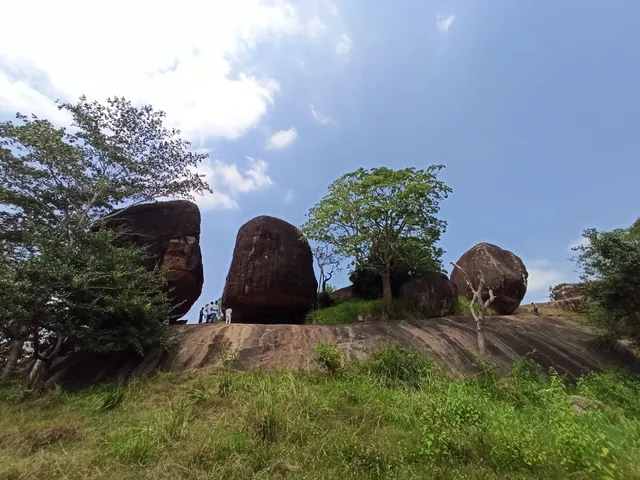
However the true wonder of RanmasuUyana is found among the rock boulders and caves away from the pools. Carved on a stone wall is a strange map like chart known to many as the ‘stargate’. A stargate is believed to be a gateway between the earth and the outer space, through which humans allegedly roamed the universe communicating and engaging with other intelligent beings in the universe. This chart is believed to be the secret code to accessing the stargate. Facing the stargate marking are four seats, which implies that it was a chart, which could be used or manipulated by four individuals.
The discovery of the stargate marking had created waves amidst archaeologists and pre-historic investigators, some drawing parallels between the stargate charts found in Abu Ghurab in Egypt and ‘the gate way to the gods’ in Peru. The bizarre coincidence of all the three marks been found in the vicinity of a water way, with sophisticated engineering methods, had given rise to...
Read more