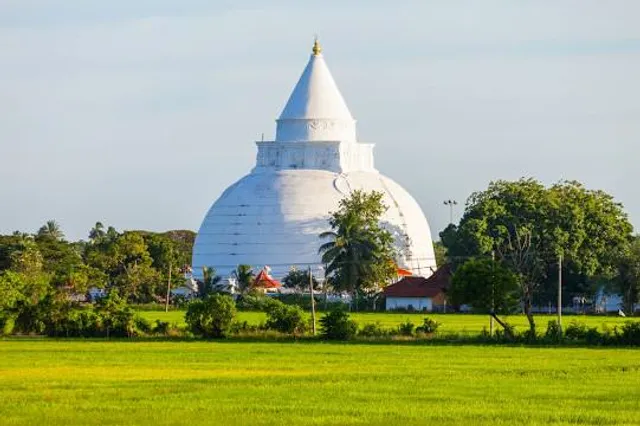
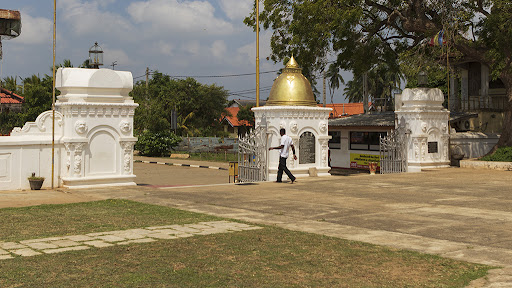
Majestic White Dome visible from afar In the morning hours of 12th February 2019 a group of six of us visited this ancient historic Tissamaharama Buddhist temple said to have been built in 3rd century bc. The bubble-like white temple dome is the major landmark that can be seen from almost anywhere in Tissa. Situated downstream of Lake Tisa Wewa, your eyes automatically get drawn towards this majestic spectacle when you traverse the bund of the lake. There is an irrigation channel, that takes water to the paddy lands beyond, bordering the temple premises. As we drove towards the temple, we saw many people enjoying themselves in the flowing waters of this channel. When you enter the temple premises, the symmetric bubble-like dome looks huge and majestic. We were told that this is the largest stupa in Southern part of Sri Lanka with equal height and diameter of 47.4 metres and a circumference of 167 metres. It had been constructed in the second century BCE but renovated on a number of occasions. Tissamaharama is one of the most sacred locations for Buddhists as Buddha is said to have stayed here during his third visit to Sri Lanka some 25 centuries ago. On full moon poya days and during weekends this sacred place and its environs are full of pilgrims and devotees. Since it was a weekday there were not so many people about. We walked around the Stupa and placed our offering of flowers within the image house. Also within the walls surrounding the Stupa are statues of two ancient kings as well as a Buddha statue in a protective enclosure. There is a large Margosa tree near the outer wall of the premises. Though the leaves of margosa are bitter, it is said that the branches leaning towards the stupa are not at all bitter. I could not however, test the truthfulness of this statement as the branches are far too high for me to pluck its leaves. Outside the main entrance is the compound where the priests live. There is a school for priests adjacent to it. We spoke to some of the student priests, who posed for a photograph. Walking beyond, we visited the bo tree that had its own boundary wall. In addition to the bo-tree, within this area are shrines for Buddhist and Hindu deities, Skanda, Vishnu, Ganesh and Paththini. We sat under the shade of the Margosa tree for almost 45 minutes, enjoying the calm quiet serenity. Some of us took this opportunity to offer our prayers to the great Buddha! There is no entrance fee. There are notices requesting visitors to remove their footwear before entering the temple premises and to be dressed appropriately. The premises are open every day...
Read moreThe Tissamaharama Raja Maha Vihara is an ancient and significant Buddhist temple located in Tissamaharama, in the Southern Province of Sri Lanka. It holds a prominent place in Sri Lankan history and is revered as one of the four major Buddhist monasteries established in the country following the arrival of Arhant Mahinda Thera, who brought Buddhism to Sri Lanka. Key aspects of the Tissamaharama Raja Maha Vihara: Historical Significance: The temple's history stretches back to the 3rd century BC. While some historians believe King Mahanaga of Ruhuna initially built it, it was King Kavan Tissa (2nd century BC) who is credited with bringing the temple to its present state as Silapassa Pirivena. Educational Center: From the 3rd century BC to the 11th century AD, the Tissamaharama monastery was a renowned center for Buddhist education in southern Sri Lanka. Visit of the Buddha: The site is considered sacred as it is believed that Lord Buddha himself consecrated the ground during his third visit to the island, spending time in meditation there with 500 enlightened monks (arhats). Tissamaharama Dagoba: Within the temple premises stands the Tissamaharama Dagoba (stupa), one of the largest stupas in Sri Lanka. It has a distinctive "bubble shape" and is constructed of bricks on a square granite platform. Relics: There are beliefs and some historical evidence suggesting that important Buddhist relics were enshrined here at different times. This includes the frontal bone relic and, according to a pillar inscription found in Kirinda, the left tooth relic of the Buddha. Renovations: Over its long history, the temple has undergone several renovations and expansions by various Sri Lankan kings, including King Ilanaga, King Voharaka Tissa, and King Vijayabahu I, even after being raided by invaders in the 13th century. Architectural Features: The temple showcases ancient Sri Lankan Buddhist architecture, with intricate carvings and murals that depict the rich history of Buddhism on the island. The main stupa is a prominent feature, surrounded by lush greenery and serene pathways. The Tissamaharama Raja Maha Vihara is not only a significant religious site but also a valuable archaeological treasure, offering insights into Sri Lanka's ancient cultural and religious heritage. It continues to be a place of active worship and attracts both pilgrims...
Read moreIn the city of Tissamamarama, there are 4 ancient stupas belonging to the Anuradhapura Era ara lying in a row. These are
•Sndagiri Stupa
•Tissamaharama Stupa
•Yatala Vehera &
•Menik Vehera
Out of these, the most worshiped and the largest is the Tissamaharama Stupa & according to ancient chronicles this stupa has been built by King Kavantissa who ruled Ruhuna in the 1st century BC. But there is also a belief that this stupa was initially built by regional King Mahanaga in the 3rd century BC and King Kavantissa probably enlarged the shrine.
Mahanaga is a brother of King Devanampiyathissa (250-210 BC ). History states that that when Mahanaga was inspecting the construction of Walas Reservoir (වලස් වැව), the queen of Devanampiyathissa send him a bowl of Mangos with the top most one poisoned. Her intention was to kill Mahanaga to ensure the throne to her son after Devanampiyathissa. At that time the son was with his uncle at the tank and child ate the poisoned mango and died on the spot. Fearing reprisal he took his pregnant wife and escaped to Ruhuna where he built up his own regional kingdom surrounding Magama area.
According to chronicles this stupa has been enlarged by king Ilanaga (38-44) renovated by king Voharika Tissa (214-236) and again renovated by king Vijayabahu (1070-1110).
The more recent restoration work of this stupa had begun in 1858 due to the efforts of Wepathaira Sumana Thera, who rediscovered Thissmaharama Vihara after making a pilgrimage to the area. He built a hut in the visinity of the stupa and started living there to supervise the restoration works by him self. It took 16 years to complete the renovation work of the Garbhaya, semi spherical part of the stupa which is 86 feet in height. But Wepathaira Sumana Thera could not complete the restoration of Thissmaharama stupa in his lifetime and after the death of Wepathaira Sumana Thera in 1873, Walpita Medhankara Thero, a monastic brother of Wepathaira Sumana Thera took over the renovation works. By 1895 Walpita Medhankara Thero managed to complete the restoration of Hatharaskotwa of the stupa and enshrined relics in it. The pinnacle of the stupa was ceremoniously placed in 1900 and work was finally...
Read more