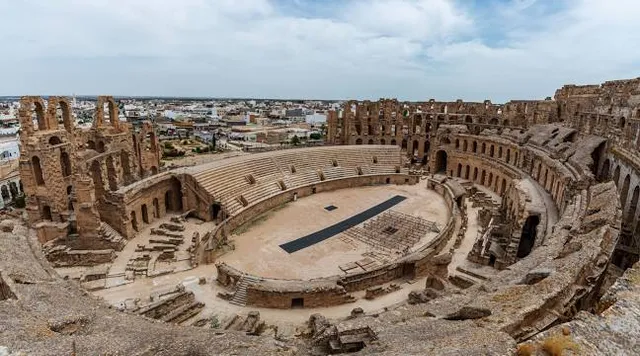
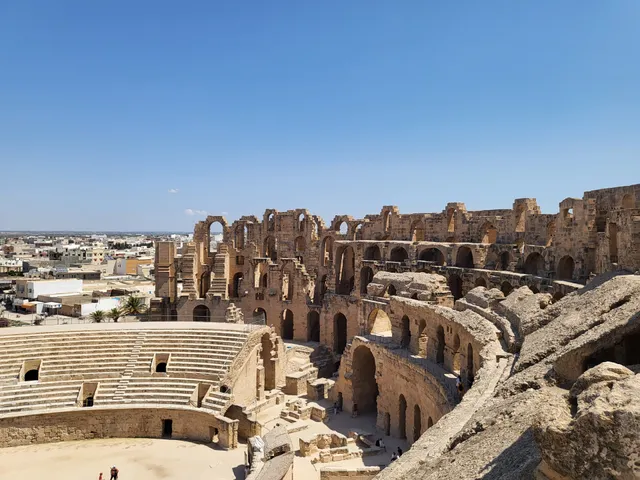
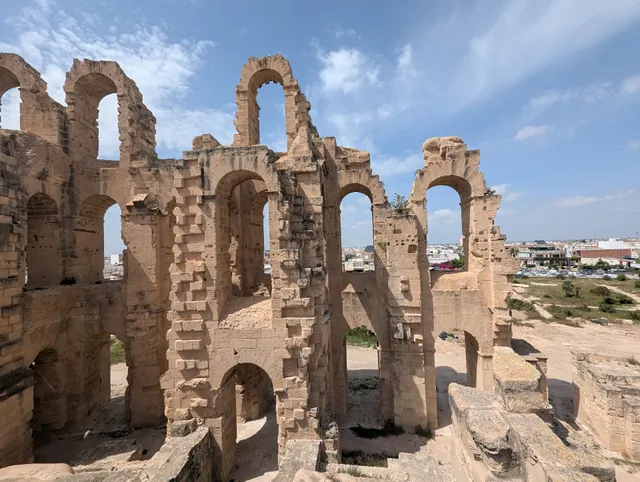
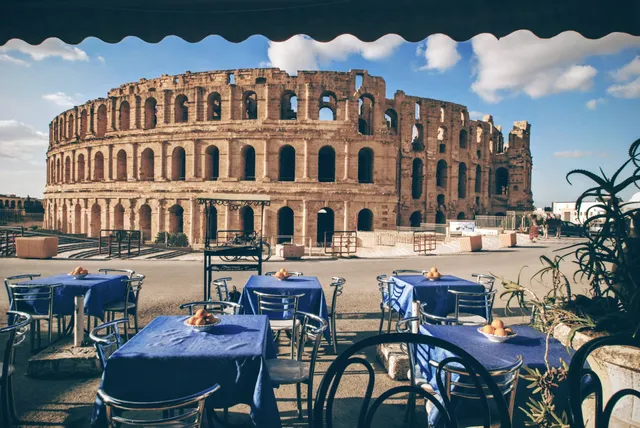
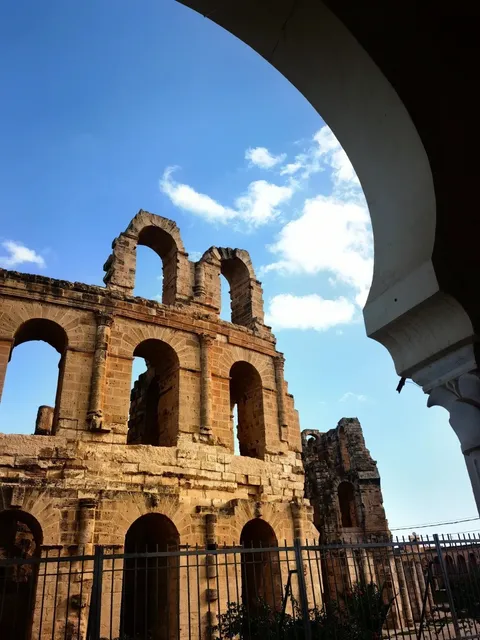
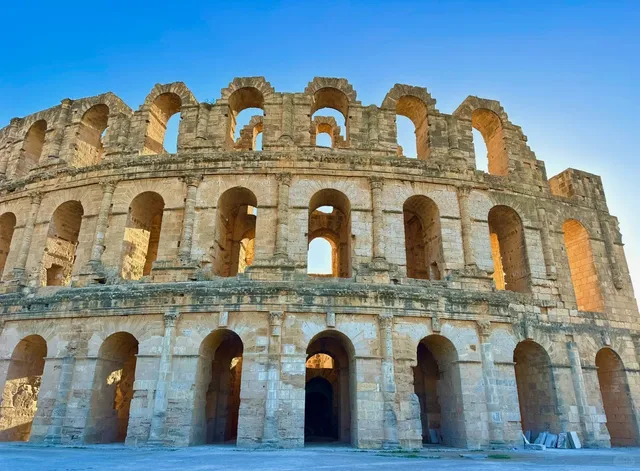
Visiting the Colosseum in Tunisia, also known as the Amphitheatre of El Jem, was an absolutely unforgettable experience. This ancient Roman amphitheatre, built around 238 AD (over 1,780 years ago), is one of the best-preserved in the world. Stepping inside felt like travelling back in time to the days of gladiators and grand spectacles.
One of the highlights of our visit was climbing all the way to the top floor via several flights of stairs. The view from the top was breathtaking. We could see the entire structure of the colosseum and the surrounding town of El Jem. It was incredible to imagine the roar of the crowd and the intensity of the events that once took place here.
Equally fascinating was exploring the basement, where the gladiators and animals were kept before the battles. Walking through the underground passages, we saw the gladiator changing rooms, which felt eerily atmospheric. The stone holding pegs, where they kept the cages full of lions and other animals, were still intact. It was surreal to stand in the spots where they lifted the cages up into the arena, imagining the anticipation and fear that must have filled the air.
Here are some fun facts we learned: It’s the third-largest Roman amphitheatre in the world, seating up to 35,000 people. The entire structure was built without mortar, using perfectly fitted stone blocks. It was used as a fortress during the 7th century by Berber resistance leader Al-Kahina. The underground tunnels (hypogeum) had advanced mechanisms to lift animals and gladiators into the arena. Today, it’s a UNESCO World Heritage Site and has even been featured in movies like Gladiator. The acoustics are so good that concerts are still held here!
The sheer scale and history of this place are mind-blowing. If there’s one thing you should do when visiting Tunisia, it’s exploring the El Jem Colosseum. My wife and I highly recommend it, 2 tips from us: wear comfortable shoes as the ground is very uneven and make you go all the...
Read moreThe Amphitheatre of El Jem is an oval amphitheatre in the modern-day city of El Djem, Tunisia, formerly Thysdrus in the Roman province of Africa. It is listed by UNESCO since 1979 as a World Heritage Site. The amphitheatre was built around 238 AD in Thysdrus, located in the Roman province of Africa Proconsularis in present-day El Djem, Tunisia. It is one of the best preserved Roman stone ruins in the world, and is unique in Africa. As other amphitheatres in the Roman Empire, it was built for spectator events, and it is one of the biggest amphitheatres in the world. The estimated capacity is 35,000, and the sizes of the big and the small axes are respectively 148 metres (486 ft) and 122 metres (400 ft). The amphitheatre is built of stone blocks, located on a flat ground, and is exceptionally well conserved. The amphitheatre of El Jem is the third amphitheatre built on the same place. The belief is that it was constructed by the local proconsul Gordian, who became emperor as Gordian II. In the Middle Ages, it served as a fortress, and the population sought shelter here during the attacks of Vandals in 430 and Arabs in 647. In 1695, during the Revolutions of Tunis, Mohamed Bey El Mouradi made an opening in one of the walls to stop the resistance of the followers of his brother Ali Bey al-Muradi who gathered inside the amphitheater. It is believed that the amphitheatre was used as a saltpetre manufacture in the end of the 18th and in the 19th century. Around 1850, the breach in the wall was enlarged by Ahmad I ibn Mustafa to approximately 30 metres (98 ft). In the second half of the 19th century, the structure was used for shops, dwellings, and...
Read moreThe Amphitheatre of El Jem is an awe-inspiring relic of Roman grandeur in the heart of Tunisia. This colossal structure, reminiscent of the Colosseum in Rome, stands as a monument to the Roman Empire’s far-reaching influence and architectural ambition.
Visitors to El Jem are often struck by the sheer scale of the amphitheater, which could once seat up to 35,000 spectators. Its well-preserved state allows for a tangible connection to the past, where one can almost hear the roar of the crowd and the clash of gladiators. The arena floor and the underground chambers, where combatants and animals were once held, are open for exploration, offering a glimpse into the amphitheater’s operational complexities.
The Amphitheatre of El Jem is not just a historical site; it’s a cultural touchstone that continues to play a role in the community, hosting events and concerts, thus bridging the gap between ancient history and contemporary life.
Despite its historical significance, some visitors have noted the challenges of the hot climate, especially during peak summer months, and recommend early morning visits to avoid the heat Additionally, the town of El Jem itself may not offer many attractions, but the amphitheater is undoubtedly the jewel in its crown.
In summary, the Amphitheatre of El Jem is a must-see for history buffs and those fascinated by ancient civilizations. Its preservation and the ability to freely roam its stands and corridors make it a truly immersive experience, transporting visitors back to the days of the...
Read more