Celsus Library
Ephesus, the fourth largest city of the Roman Empire has magnificent Roman structures that still preserve their glory after two thousand years. One of these spectacular buildings is the Library of Celsus which is counted as one of the biggest libraries of ancient times.
Rome transitioned from a republic to an empire in 27 BC and continuously expanded its territories from Italy to North Africa. Modern-day Greece, France, southern Germany, and Turkey were also added to the empire’s vast land.
Modern Turkey is full of well-organized Greco-Roman cities all around the country. Not only Ephesus but also some other ancient cities in modern Turkey such as Zeugma, Pergamum, Smyrna, Aphrodisias, Side, Aspendos, Pergamum, and Miletos are fine examples that reflect the splendor of the Roman Empire.
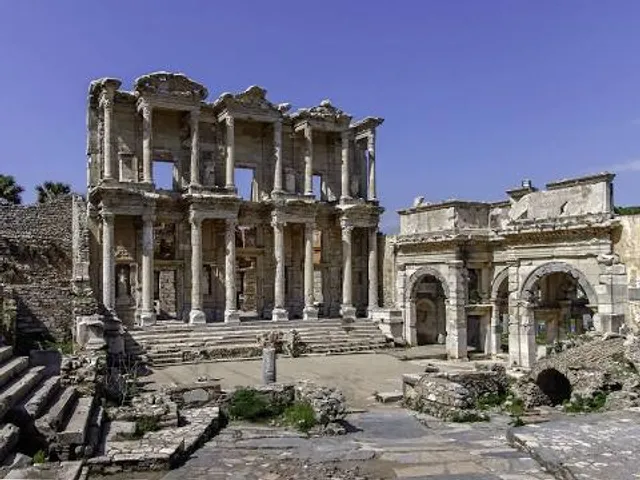
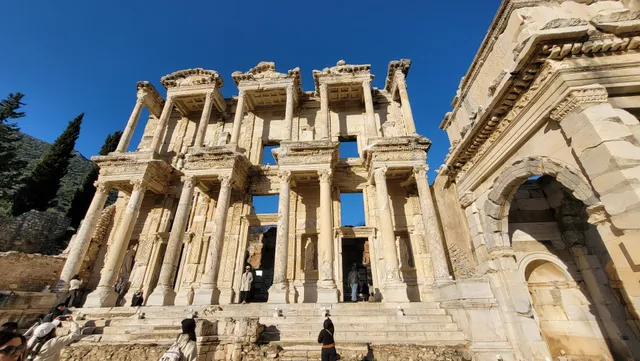
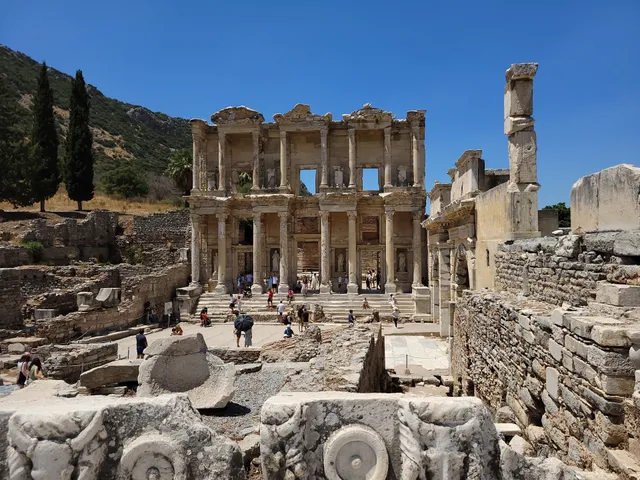
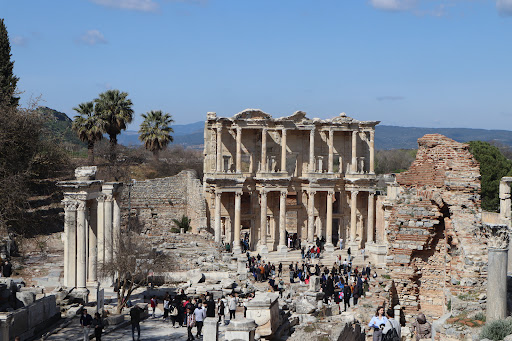
The Library of Celsus in Ephesus is not only the most striking building in the city but also one of the landmarks of Turkey, too. Taking photographs is a nightmare as everyone wants a picture in front of it. Visitors are enchanted by the fine marble work of the ornamented facade as it shines brightly under the baking Aegean Sun.
The library is located at the very heart of the city, attached to the monumental Gate of Mazeus and Mithridates that opens to Commercial Agora.
What is interesting about this building is it is not only a library but a mausoleum as well, as it consists of the tomb of Gaius Julius Celsus Polemaeanus who had been consul in 92 AD and who was the governor of the province of Asia in 115. After his death, his son, Consul Gaius Julius Aquila had the library built in his father’s honor as we read from the inscription on the building’s front staircase. The library was completed in 135 AD and Celsus’ body was put in a white marble sarcophagus which was placed in a crypt beneath the building. When you enter the main hall, you will see an apse right in front of you and beneath the apse, one can see the burial room that contains the sarcophagus.
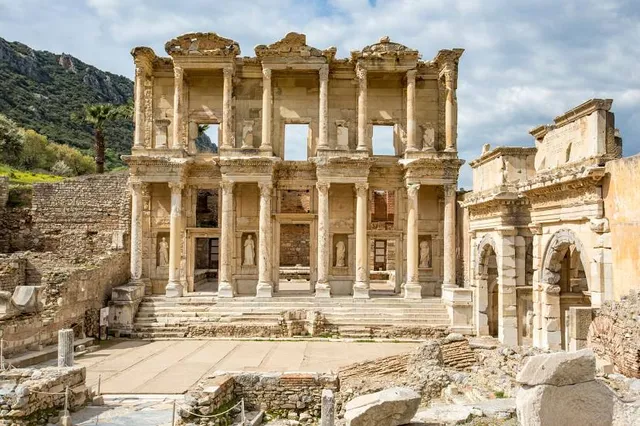
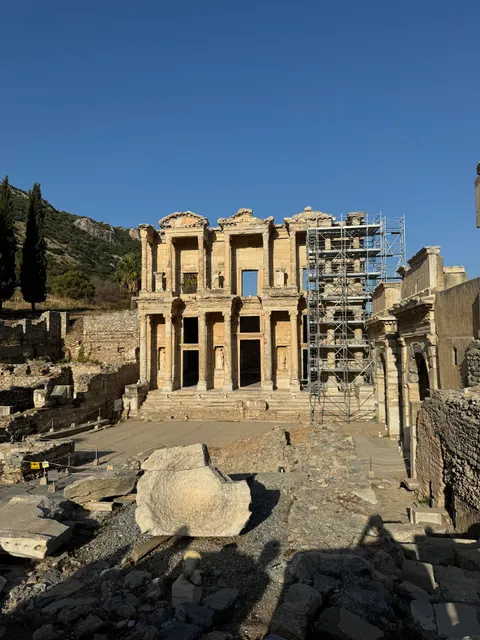
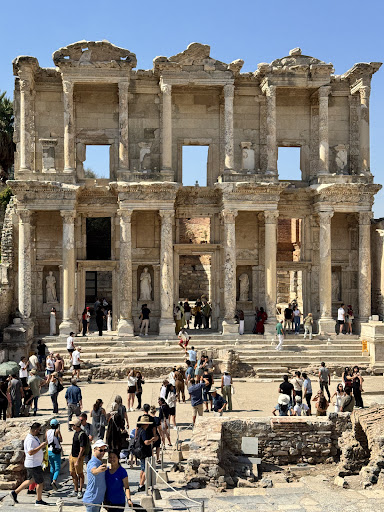
Two storied façade is intensely ornated with 16 columns arranged in pairs. Columns at the center of the façade are shorter than the others which is an optical illusion giving the impression of greater size. A staircase with 9 steps leads to the facade of the Library. Lace-like marble work of the façade’s ceiling can be seen after climbing the staircase that takes you to the interior. The columns were richly decorated with the motifs of vegetation and mythological figures: Bellerophon riding Pegasus, a couple of Eros and Psyche darting from acanthus leaves, and the scenes of the life of Apollo and Dionysus.
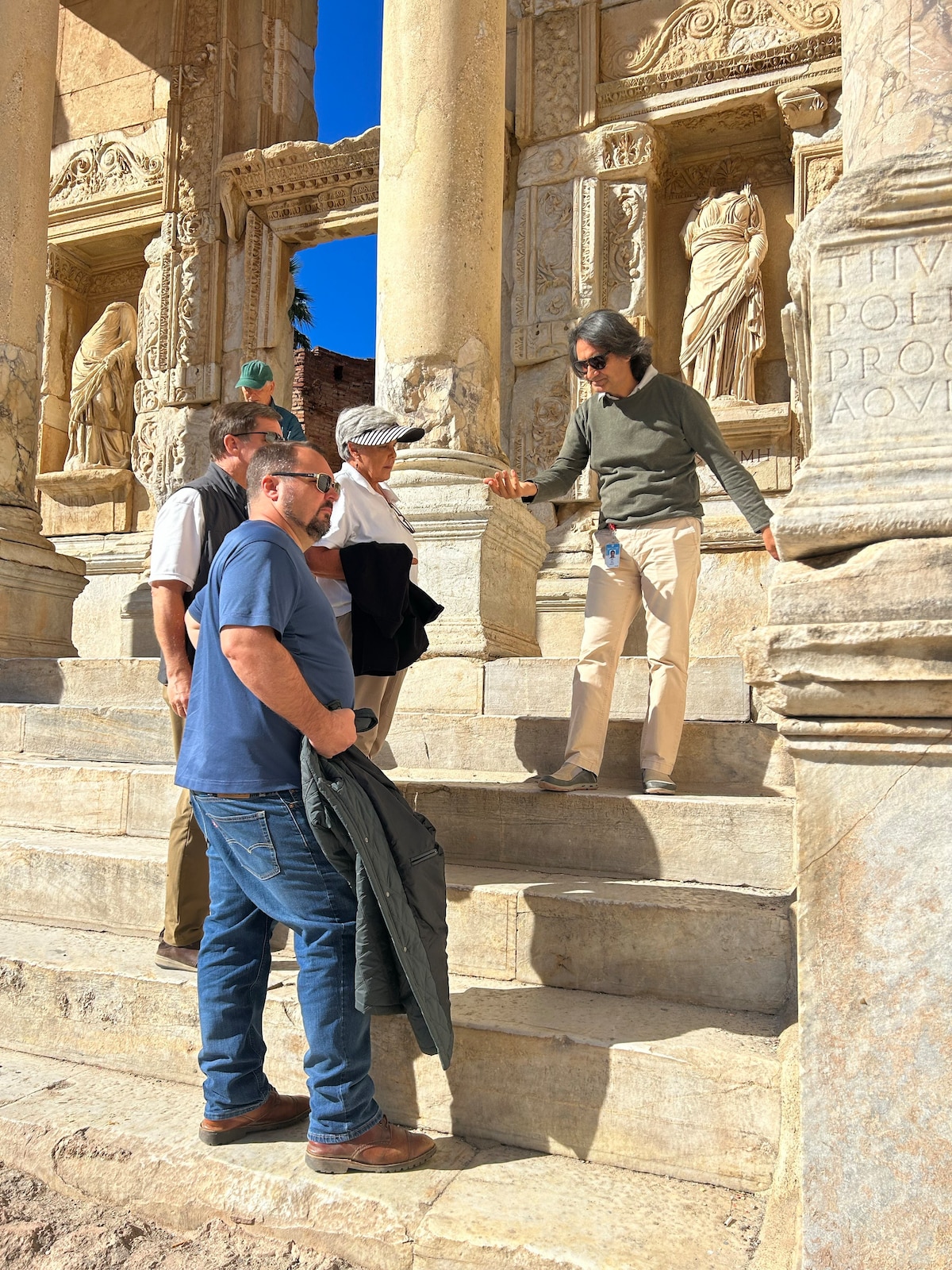
Besides, four female statues placed in the façade’s niches are also remarkable. They represent abstract concepts and under the statues are Greek inscriptions giving information about their characters of them. From left to the right are Sofia (Wisdom’), Arete (‘Virtue’), Ennoia (‘Insight’), and Episteme (‘Knowledge’). They are personifications of the virtues of Celsus but also of the virtues the life of high Roman officials should have had. The library was restored with the aid of the Austrian Archaeological Institute and the originals of the statues were taken to Ephesus Museum in...
Read moreThe Library of Celsus, located in the ancient city of Ephesus near Selçuk, İzmir, Turkey, is an architectural marvel and one of the most iconic landmarks of the Roman era. Built between 115 and 117 AD as a tribute to Tiberius Julius Celsus Polemaeanus, a former proconsul of Asia, it was designed to house around 12,000 to 12,500 scrolls, making it one of the largest libraries in the ancient world.
The library's façade is richly decorated with statues of the four Virtues: Wisdom, Justice, Courage, and Temperance. Although the interior was destroyed by fire in 262 AD, the façade was restored between 1970 and 1978, showcasing its grandeur and historical significance.
The library rests on a nine-stepped podium, leading to three main entrances framed by Composite columns on pedestals. Above these are Corinthian columns supporting architraves and pediments. The lower level features niches containing statues symbolizing virtues such as wisdom (Sophia), knowledge (Episteme), intelligence (Ennoia), and excellence (Arete). These statues emphasize the library’s dual purpose as both a repository of knowledge and a mausoleum honoring Tiberius Julius Celsus Polemaeanus.
To visit the Library of Celsus, travelers can fly into Izmir Adnan Menderes Airport and then take a taxi, shuttle, or rent a car to reach Selçuk. From there, it's a short ride to Ephesus by taxi or minibus. The site offers a glimpse into ancient Roman and Greek cultures, with its blend of architectural styles and historical significance.
It is a must-visit destination for anyone interested in history, architecture, or cultural heritage. The library also hosts cultural events, such as classical music recitals and theater performances, which add to its allure as a tourist destination.
Mustafa Kemal Atatürk, the founder of modern Turkey, is not directly associated with the Library of Celsus but is a significant figure in Turkish history. His legacy is celebrated throughout Turkey, but his connection to the Library of Celsus is indirect, as it is a historical site from...
Read morePart of the extraordinary Ephesus experience. For students of the classical world, not to be missed. For the details given below, I am indebted to Selahattin Erdemgil, archaelogist and Director of the Ephesus Museum at the date of his publcation "Ephesus". In 92A.D., Tiberius Julius Celsus Polemanaeanus was a consul in Rome and was in charge of all the public buildings. During the period 105 to 107 he was proconsul (governor) of the Asian province, the capital of which was Ephesus. When he died in 114 at the age of 70 his son Tiberius Julius Aquila built the library as an heroon (mausoleum) for his father. It is assumed that the construction of the library was completed in 117. The sarcophagus of Celsus is located in a tomb under the apsidal wall in the library and is made of high quality marble and decorated with the figures of Eros, Nike, rosettes and garlands in relief. The building reflects the characteristics of the age of Emperor Hadrian. The facade is two storeyed; on the lower story, the columns with Corinthian capitals are placed upon a 21 metre long podium reached by nine steps. The columns are arranged in in pairs and between them there are three doors with richly decorated frames.The door in the middle is wider and taller than the other two. Statues in the niches between the doors are copies of the originals which were taken to Vienna during the years the library was being excavated.The inscriptions on the bases of the statues indicate the wisdom (sophia), knowledge (episteme), intelligence(ennoia) and virtue(arete) of Celsus. The columns of the upper storey are smaller than the lower ones and support the triangular and semi-circular frontals. There is a window below each frontal. (Selahattin Erdemgil,...
Read more