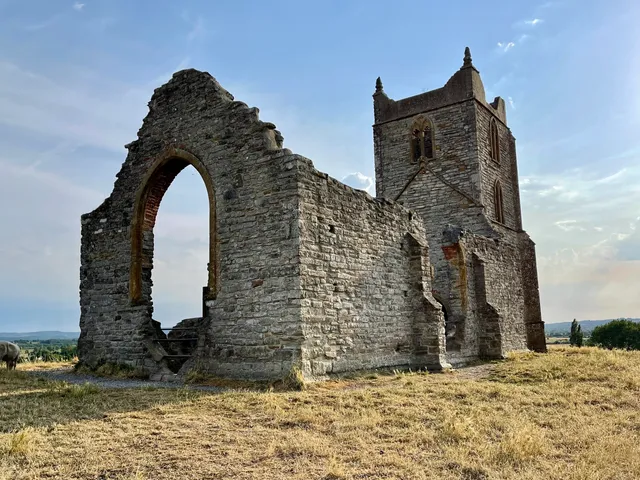
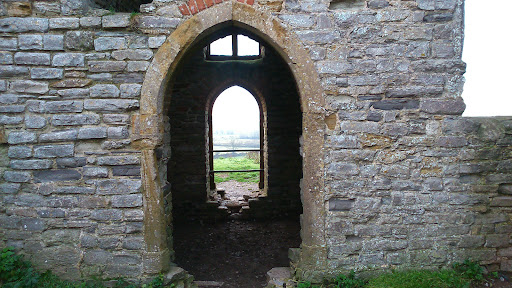
Barrow Mump is an isolated conical hill that rises just over 70 feet above the flat somerset lands and on top of this hill is a church named St Michaelâs Church. Interestingly enough the name of this church is of the same as the church that stands on Glastonbury Tor, just 10 miles away, but they are both different in ages.
The church on Barrow Mump was said to be built in the 15th century by the Romans but rebuilt on top of around 1793, as dated on the church itself. It is believed that it was built as a religious site dedicated to Saint Micheal but due to ongoing financial problems, the building suffered and as you can see by the structure it was never actually finished.
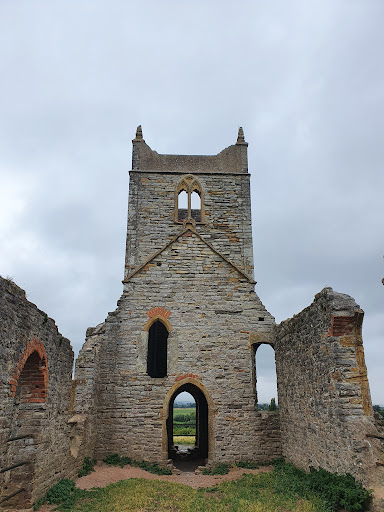
In photos, the church doesnât have a roof, but you can see the structure of the arched windows, the front of the tower and the high walls. We think there is something so photogenic about this hilltop church.
With its odd position on top of a steep hill, the local community wanted their church to be more easily accessible, so a replacement was built in the village and the hilltop site was abandoned around the 1840âs. Nowadays the ruined church and the hill are dedicated as a memorial to Somerset soldiers killed in both the first and second world wars.
The site is free to enter but has a charity box near the entrance with an ask to donate towards the national trust and keeping these historic sites open and free for us to visit all year round.
Our one bit of advice is to make sure you walk the hill carefully as it can be quite slippy and make sure you do this on your way down unless you follow the gradient and take your time. Overall, the site only took us 15-20 minutes but it really is an interesting part of history and there is something so beautiful about how it stands proudly on top of the hill.
You can follow our journey and what we are getting up to on our Instagram and Youtube below:
Youtube: Pinned on Places Instagram: ...
   Read moreTaking a short cut detour on a return journey from Glastonbury, we were heading for Taunton to catch a train. The Sun was low in the sky, obscured by foreboding clouds. Cruising gracefully through the Somerset levels, now drenched and partially flooded reflecting the time of year. It was a misty, damp day, and really surprising to stumble over Burrow Mump. I say stumble but by no means is The Mump small enough to trip over, but in any case, tripping over this oddly named rarity just had to be done.
As you can see from the photos, conquering this little gem is a rewarding trip. Perhaps, it must be said that, you'll need a decent set of shoes to make it to the top but if you try it'll be worth the effort. Known locally as 'Mini Glastonbury' and sporting significant similar features, it could be considered a little brother or sister but the relationship is endearingly intriguing. This would indeed be a place to run should the water levels rise but something bleak from the uppermost viewpoint interjects a contrasting view. This, after all is the land of myths and legends, a place where strength can be found from the stones.
Still reading? Good, then you'll know I wasn't talking about The Rolling Stones in that last paragraph. If you happen to be near this place, just passing through or blessed with a little time to kill, you'd find a new perspective if you made the brief yet enchanting trip over...
   Read moreâď¸âď¸âď¸âď¸âď¸ Stunning views and a peaceful slice of history Burrow Mump is a hidden gem in the Somerset Levelsâan absolutely beautiful spot thatâs well worth the climb. The ruins at the top are hauntingly atmospheric, and the 360-degree views over the surrounding countryside are simply breathtaking, especially at sunset.
Itâs a short, steep walk but totally manageable, and once youâre up there, it feels like youâre standing on top of the world. Great for a peaceful walk, a thoughtful moment, or just taking in the landscape.
Thereâs a small car park nearby and itâs free to visit, which makes it an easy and rewarding stop if youâre exploring the area. Highly recommended for photographers, walkers, or anyone who loves history and nature...
   Read more