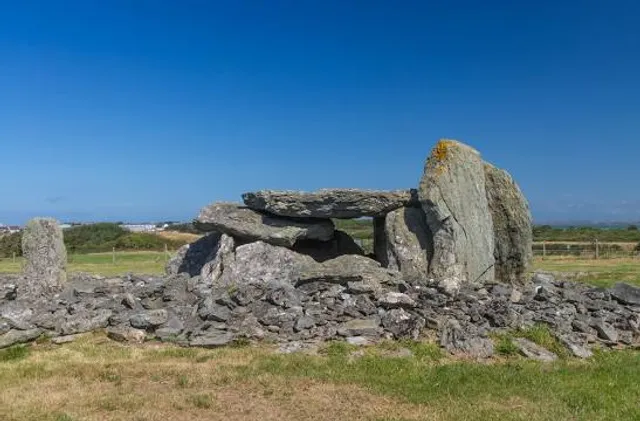
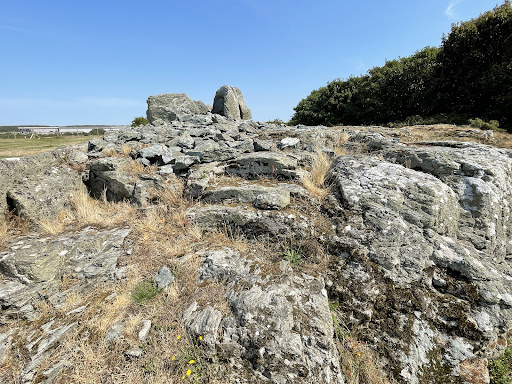
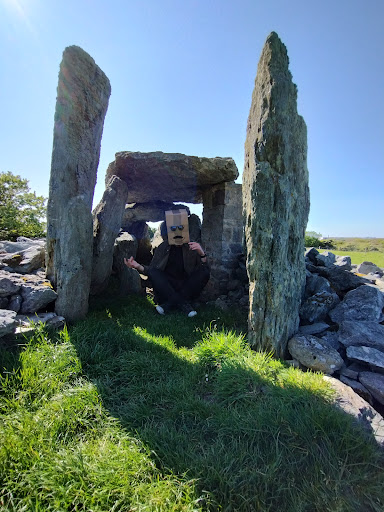
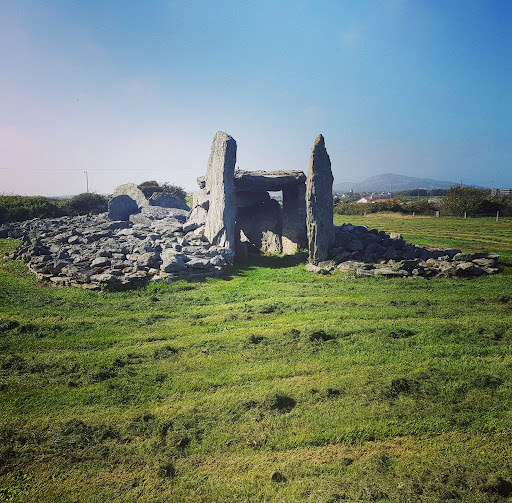
This trio of Neolithic passage tombs is, for me personally, one of the best and must see sights on Anglesey if you have any love of history or a fascination with Neolithic cultures and their customs and beliefs. The three tombs are adjacent to one another with the oldest tomb being nearest to the stepped entrance wall of the site and it's boxed structure is still evident. The second chamber is next to this and has sadly collapsed but still incorporates rocks of some size whereas the third and newest tomb is linked to the second and is in quite superb condition with two splendid two metre high portal stones marking it's entrance and the capstone and supporting stones stand proud. With all the remaining cairn stones providing dramatic volume and dimension to the site it truly is a jaw dropping spectacle to behold especially if you know what you are looking at thanks to the small information board 20 meters or so downhill from the chambers. The chambers were used over a 1500 year time period between circa 3750 to 2250BC and as impressive as they are today it is sad to think that the monument was heavily dismantled and damaged in 1870 before being excavated between 1977 and 1979 and then sympathetically restored for public viewing. There is parking on a flattened firm grassed area just to the back of a cycle path some 50 metres from the marked entrance to the site and this area has a small passageway to cut through to the site but there are other places to park nearby. Free to view and truly a fascinating impressive monument. A real gem but there truly is zero signposting to this monument which...
   Read moreTrefignath is a multi-phase Neolithic burial chamber on Holy Island, off Anglesey in North Wales. Located on a rocky knoll, likely created by glacial movement, the tombs were originally surrounded by peatbogs (since drained for the construction of the railway). Analysis of charcoal excavated at the site dates the occupation of the area before the tombs was built to 3100BCE. Flint and chert tools were also found in the excavations as well as early Neolithic pottery, both local and from Ireland or Scotland. The first tomb is at the west end of the trio, a square chamber lacking a capstone. It is thought to be the oldest, but Peterborough-ware pottery found in the tomb indicate it may have been used continuously into the late Neolithic. The second tomb has collapsed but would have been similar to the first. The two tombs would have been encased in an earth and stone cairn, edged with drystone walls. The entrance to the second chamber was blocked by the construction of the third. The third tomb is the most impressive. Two upright stones mark the entrance to the chamber, the largest and most complete of the three. Once constructed, it too was likely enveloped in earth and rocks to create a long cairn. Late neolithic pottery was also found in...
   Read moreTrefignath Burial Chambers (Information taken from website and onsite information board) Once upon a time this rocky outcrop was a place of the living, but 5500 years ago it was given over to the dead. During the next thousand years two more tombs were added. The mound covering them grew and turned to embrace the morning sun.
Neolithic pottery and flint tools found underneath these structures show that Anglesey's first farmers occupied this spot before they set up the first of these monumental tombs.
The earliest chamber at the site’s western end is a simple box-like structure surrounded by a cairn of boulders. The chamber in the middle (both in terms of its age and location) has now collapsed, with only a few of its stones still standing. At the site’s eastern side, the third and most recent tomb remains almost intact, with its original capstones and two impressive portal stones at its entrance.
Excavations suggest that the site was in use for as many as 1,500 years, demonstrating how significant these monuments must have been to our...
   Read more