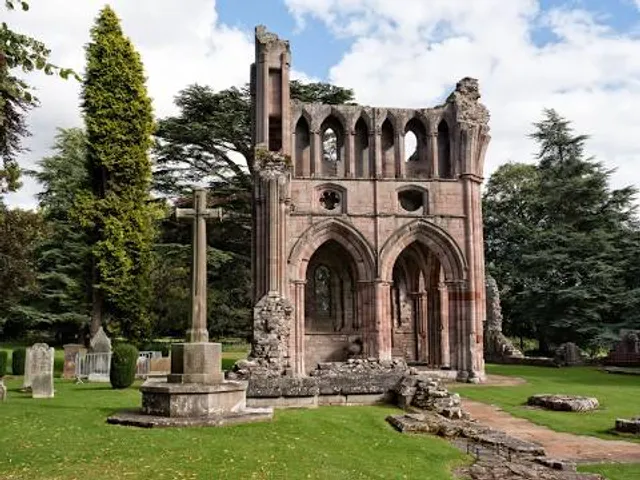
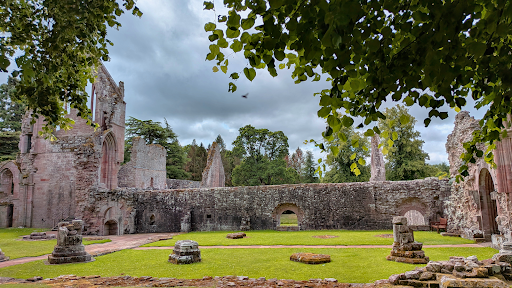
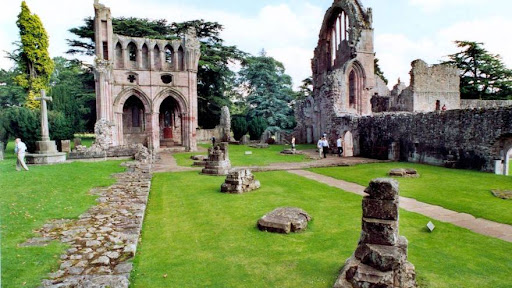
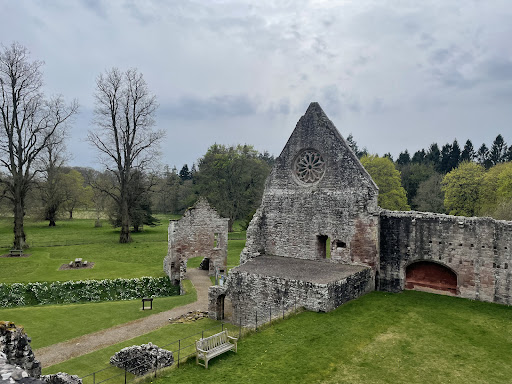
We visited around 10:30am on a Wednesday and there were 4 other groups of visitors at the abbey. The area is very peaceful and as expected, the signboards were very informative. It was great to wander around this romantic ruin and discover display of stone mason work, as well as hearing the music in one of the cloisters (which really shows off the acoustics). . We were lucky to visit on a very sunner summer's day, I can imagine if it was drizzly/windy/wet it may not have been as exciting due to slippery surfaces and the area is quite open. However, I believe this is well worth a visit. I think it would suit older people, adults, young adults and families with older children. There is not much in the way of 'entertainment' for younger children, and it is a quiet place, which may not suit their needs. . The toilet block is located away from the small gift shop, we initially got a bit lost as we used the toilets first and there was no sign back to the abbey entrance. There is a footpath next to the toilets that leads under an avenue of trees and (I assume) down to the river, but there is a sign saying 'no dogs allowed' so we couldn't find out... this is the only reason we realised it wasn't the correct way to the entrance! . Accessibility: The toilet block was very small and I am not sure where the disabled loo was located. There is a ramp coming in and out of the gift shop/reception and the main paths around are covered in small fine gravel. There are slight slopes down to reach the abbey, but it is fairly flat. The only bits I can envisage a person with restricted mobility missing out on are a couple of the cloisters as they are down some stone steps, and also the raised area above the cloisters. Most of the site is open as you can see...
Read moreOne of the finest monasteries in the Scottish Borders area of Scotland and the picturesque situation on the banks of The River Tweed makes it even more breathtaking and beautiful. The ruins themselves are spectacular and amazing where there are parts you can wander inside of such as the Chapter House where you can marvel at the brilliant architecture and also you can wander into the tiny stone museum and see the beautiful stone markings, which do make for exquisite viewing that have been recovered from the Abbey and learn some interesting information about them on the display board that is available. There are information display boards dotted around the site which are interesting & informative detailing the different features and also how the monks lived. There is a lovely walk down to the River Tweed walking you see some lovely spectacular picturesque view of the River in its natural environment. You can also wander up onto the area above the Chapter House and take in further views of the Abbey in its spectacular picturesque setting. The Abbey is also the home of where the famous local writer Sir Walter Scott is laid to rest and you can see his grave along with that of two of his family members and there is an interesting informative information display board to complement it detailing about him and the two other family members. Again in the area where Sir Walter Scott has been laid to rest you can marvel at the beautiful architecture on the ceiling above, which makes for an outstanding viewing. Overall this is a pleasurable and pleasant day out to see some marvellous Abbey ruins in a spectacular picturesque and makes for a pleasant quiet walk around for...
Read moreA very historic part of the Borders, one of the 3 ruined Borders Abbeys, the others being Melrose and Jedburgh. Lovely part of the world and well worth visiting the 3 Abbeys
Dryburgh Abbey, near Dryburgh on the banks of the River Tweed in the Scottish Borders, was nominally founded on 10 November (Martinmas) 1150 in an agreement between Hugh de Morville, Constable of Scotland, and the Premonstratensian canons regular from Alnwick Abbey in Northumberland. The arrival of the canons along with their first abbot, Roger, took place on 13 December 1152. It was burned by English troops in 1322, after which it was restored only to be again burned by Richard II in 1385, but it flourished in the fifteenth century. It was finally destroyed in 1544, briefly to survive until the Scottish Reformation, when it was given to the Earl of Mar by James VI of Scotland. It is now a designated scheduled monument and the surrounding landscape is included in the Inventory of Gardens and Designed Landscapes in Scotland. David Steuart Erskine, 11th Earl of Buchan Earl of Buchan bought the land in 1786. Sir Walter Scott and Douglas Haig are buried in its grounds. Their respective tomb and headstone, along with other memorials, are collectively designated a Category A...
Read more