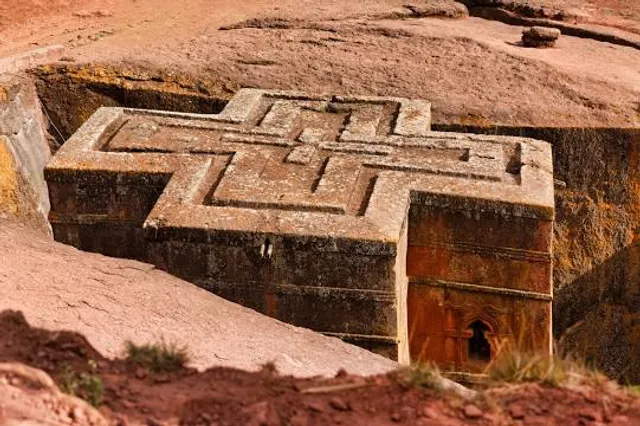
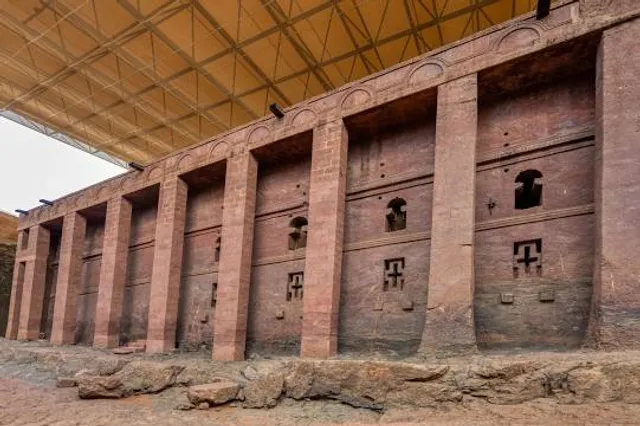
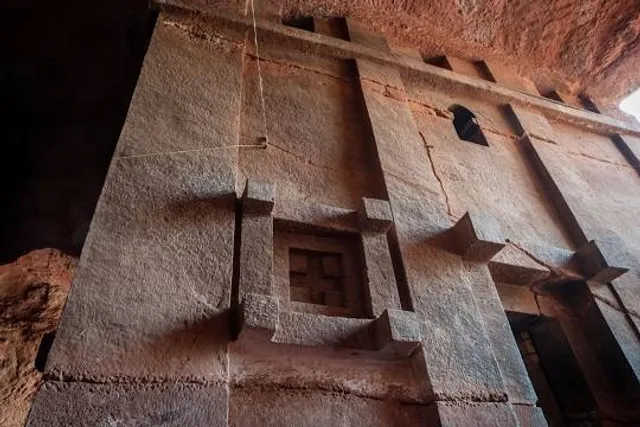
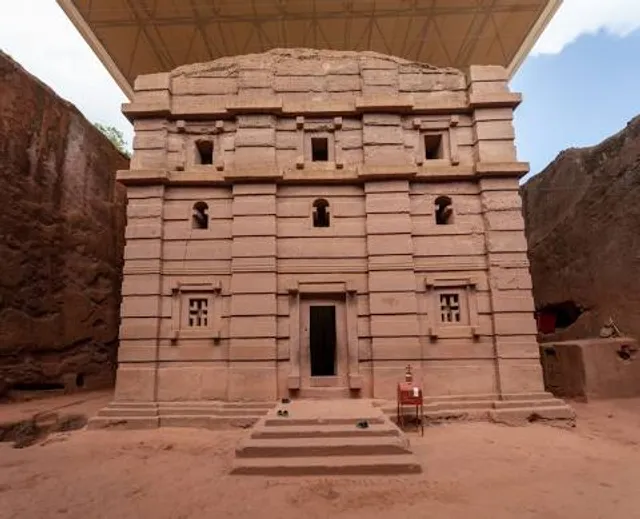
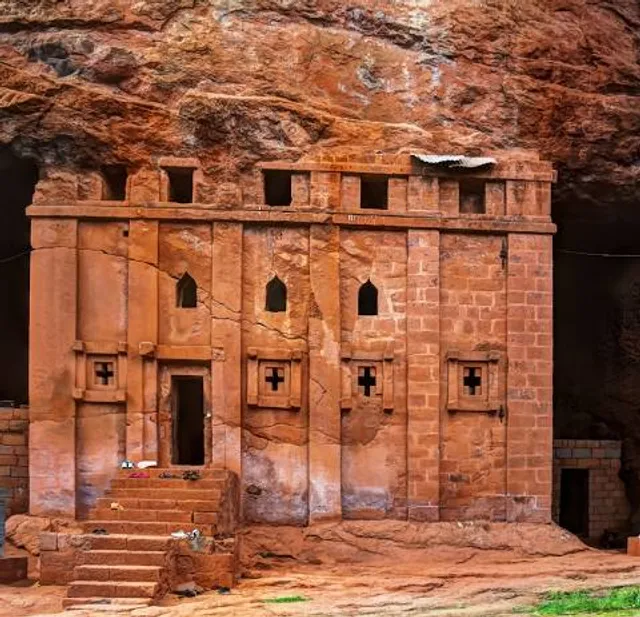
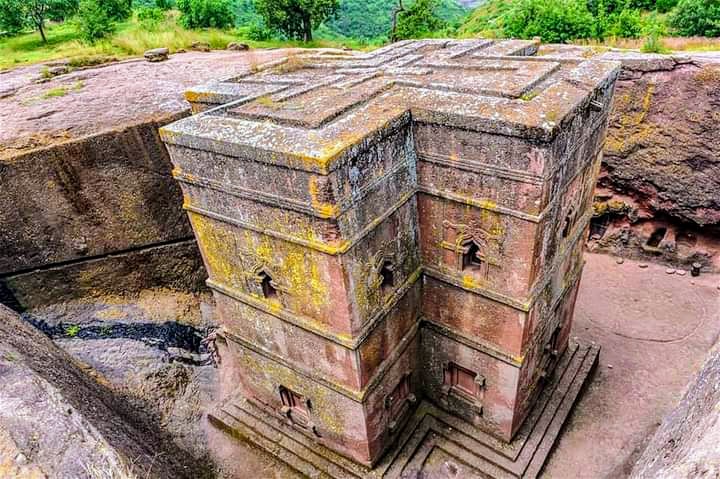
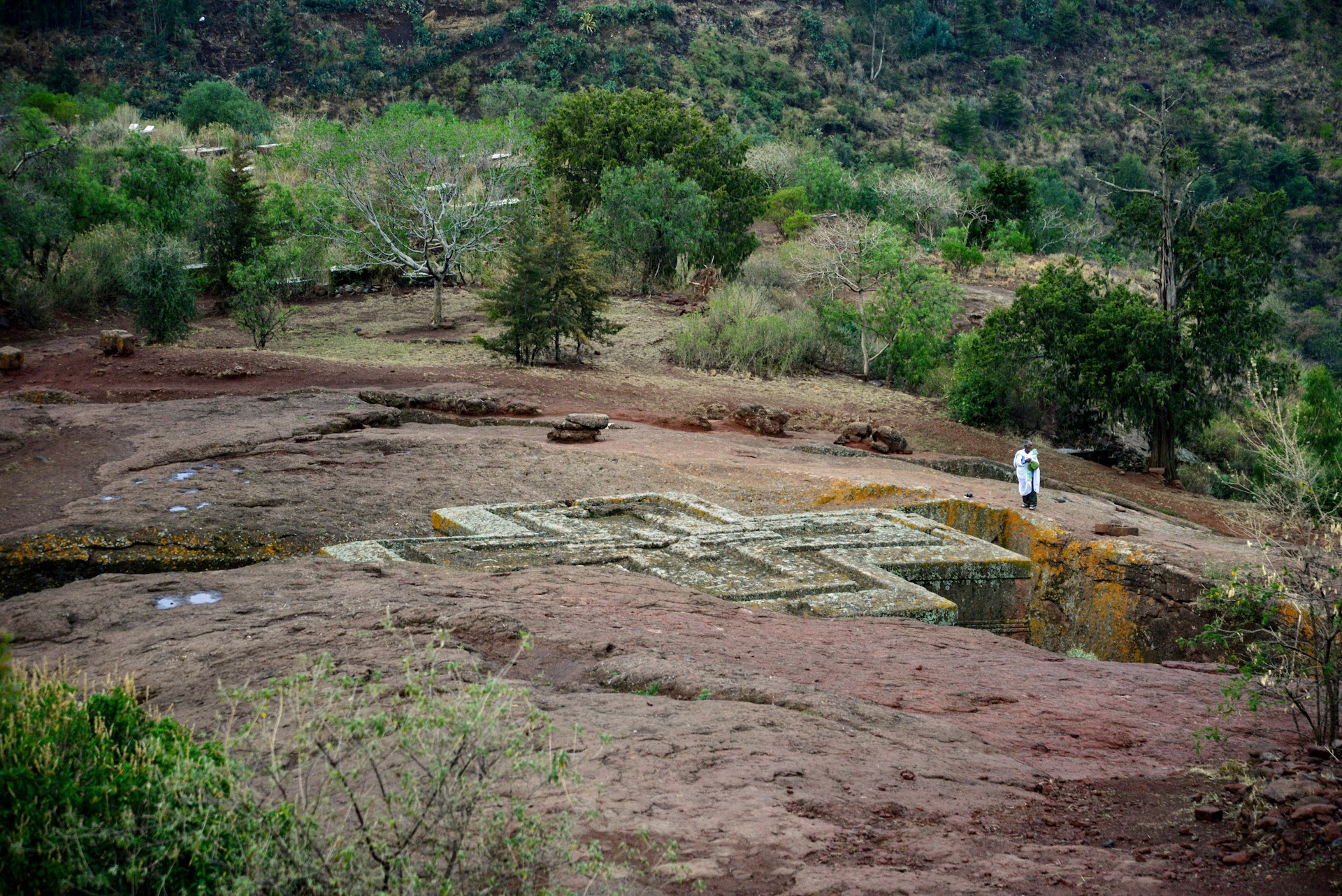
The Church of Saint George (Amharic: Bete Giyorgis) is one of eleven rock-hewn monolithic churches in Lalibela, a town in the Amhara Region of Ethiopia. Originally named Roha (Warwar), the historical and religious site was named Lalibela after the King Gebre Mesqel Lalibela of the Zagwe dynasty, who commissioned its construction. He is regarded as a saint by the Ethiopian Orthodox Tewahedo Church. The Church of Saint George was carved downwards from a type of volcanic tuff. This is the sole architectural material that was used in the structure. It has been dated to the late 12th or early 13th century AD, and thought to have been constructed during the reign of King Gebre Mesqel Lalibela, of the late Zagwe dynasty.1] It is among the best known and last built of the eleven churches in the Lalibela area, and has been referred to as the "Eighth Wonder of the World".[2] Lalibela, King of Ethiopia, sought to recreate Jerusalem, and structured the churches' landscape and religious sites in such a way as to achieve such a feat. “The churches at Lalibela are clustered in two major groups, one representing the earthly Jerusalem, and the other representing the heavenly Jerusalem. Located directly between them is a trench representing the River Jordan”. The dimensions of the trench are 25 meters by 25 meters by 30 meters,[3] and there is a small baptismal pool outside the church, which stands in an artificial trench.
According to Ethiopian cultural history, Bete Giyorgis was built after King Gebre Mesqel Lalibela of the Zagwe dynasty had a vision in which he was instructed to construct the church; Saint George[4 and God[2] have both been referred to as the one who gave him the instructions.
Lalibela is a pilgrimage site for members of the Ethiopian Orthodox Tewahedo Church; the church itself is part of the UNESCO World Heritage Site "Rock-Hewn Churches, Lalibela".[6]
On first approach the site appears wholly inaccessible, with sheer drops on every side and no access bridge. It is accessed via a very narrow man-made canyon, spiralling downwards, which changes to a tunnel close to the church, to further conceal its presence.
Pilgrims who died after reaching the site are placed in a simple open tomb on the outer walls.[citation needed]
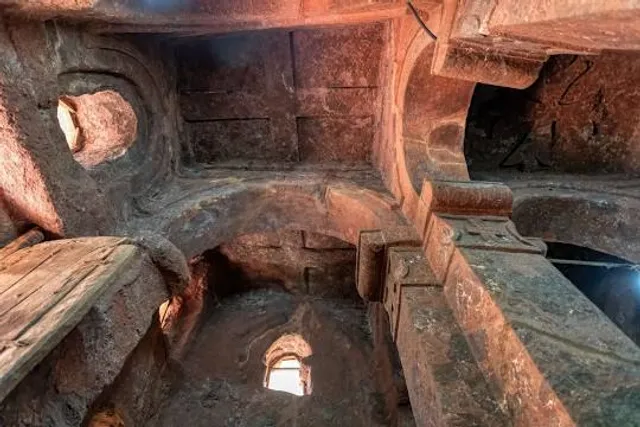
The hollowed interior contains a simple shrine to St. George and, behind a curtain (forbidden to view apart from priests) lies a replica of the Ark of the Covenant.
Bete Giyorgis was spatially...
Read moreChurches at Lalibela is Ethiopia's equivalent of Petra in Jordan. Surrounded on all sades by rugged and forbidding mountains to the north of the modern province of Wollo, Lalibela gives the unpression that you've landed in a kingdom centuries past. The 11 medieval, monolithic churches of Cus thirteenth-century "New Jerusalem' are Ethiopia's top auraction, and they inspire awe, regardless of whether you are nterested in religion or religious architecture. Perched at 2,630 m (8,629 ft), the monastic settlement of Lalibela is a desolate, isolated pace, a centre of pilgrimage to its mary antwal visitors. Located in the heart of Ethiopia near a traditional village with circular dwellings, the Churches of Lalibela are cut straight from bedrock so their roof's are at ground level. All 11 chhurches were built within a rentary - according to legend, with the help of angels Close examination is required In appreciate the full extent of this achievement as some lie almost completely hidden in deep trenches, while others stand in open quarried caves. A complex labyrinth of tunnels and narrow passageways with offset crypts, grottoes and galleries connects them all. It's a damp and silent subterranean world, apart from the echoing sounds of the chanting faithful, that needs to be experienced to be fully understood. Once the thriving and populous capital city of a medieval dynasty, the passing centuries have redured Lalibela to a village. The churches have been kept alive by generations of priests who guard their treasures of ornamented crosses, illuminated Bibles and illustrated manuscripts From the road below, it remains nearly invisible against A horizon dominated by the 4,200-m (13,780-ft) peak of Mount...
Read moreThe rock-hewn churches of Lalibela will forever remain a 5-star attraction. They are marvellous constructions, testifying to the rich Christian history of Ethiopia - and the whole world, for that matter.
However, the entrance fee is not something to rejoice about. The last time I was there (2017), it had increased to more than 1000 Ethiopian birr (USD 50). It is too much. I decided not to enter, but gave in on the second day and paid the fee to see the treasures inside. What you then get, is a self-appointed "guide" who waits for you behind the fence and demands another 300 birr or so, plus access to a small visitors' centre and toilet facilities which are so-so. I'm sorry to see this happening, because it damages Ethiopia's reputation as a destination. Who are the people who arrive here? They are "normal" people like you and me - backpackers, missionaries and relief workers, friends and family of missionaries and relief workers, and people who have a particular interest in Christian history. Not the typical cruise traveller, probably. It would have been good if visitors could have access to these churches for a reasonable fee.
That said, the churches of Lalibela are a must-see. Bete Giyorgis is perhaps the most perfect of them, but they are all wonderful. The best, of course, is to observe that the churches are still in use. To be there with masses of white-dressed people gathering on the rocks of Bete Giyorgis for a Sunday service is...
Read more