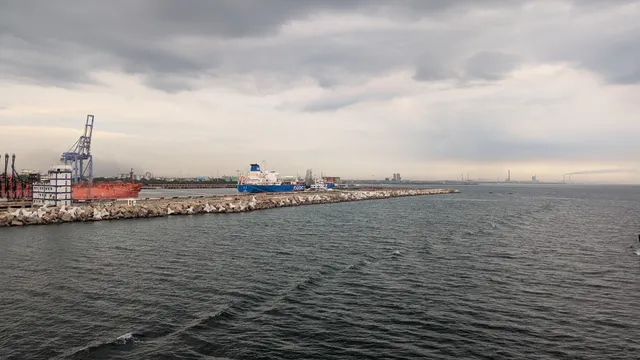
Post-Independence, the development of the port gained momentum. In 1959, a passenger station on the first floor of the transit shed at north quay was commissioned. In 1961, construction of signal station at north quay was completed. In the same year, the port's Jawahar Dock was inaugurated by the then prime minister of India, Lal Bahadur Shastri. In 1964, the Jawahar dock with capacity to berth 6 vessels to handle dry bulk cargoes such as coal, iron ore, fertiliser and non-hazardous liquid cargoes was created on the southern side changing the topography of the port. To handle vessels with as much as 16.2 m (53 ft) draft, the port developed the outer harbour, named Bharathi Dock, for handling petroleum in 1972 and for mechanised handling of iron ore in 1974. In 1972, the first oil jetty was constructed at Bharathi Dock-I capable of handling tankers up to 100,000 DWT to handle imports of crude oil destined for the Manali Oil Refinery (later named the Chennai Petroleum Corporation Limited).In 1974, the iron ore berth was added to the port for exports to Japan and other countries in the Far East. The second oil jetty was added at Bharathi Dock-III in 1986 capable of handling tankers up to 140,000 DWT to meet increasing demands for crude oil and petroleum products.The iron ore terminal is equipped with mechanised ore-handling plant commissioned in 1977 at Bharathi Dock-II capable of handling ore carriers of maximum size 1,45,000 DWT, one of the three such facility in the country, with a capacity of handling 8 million tonnes and a loading rate of 6,000 tonnes per hour.The port's share of iron ore export from India is 12 per cent. The dedicated facility for oil led to the development of oil refinery in the hinterland. This oil terminal is capable of handling Suezmax vessels.
In the 1970s, containerisation started in India in a limited way with the creation of interim container handling facilities at Mumbai and Cochin ports in 1973. During the same period, Chennai Port began handling containerised cargoes. In 1983, a container terminal was built at the Bharathi Dock with a 380-metre (1,250 ft) quay, a 51,000-square-metre (550,000 sq ft) container yard, and a 6,000-square-metre (65,000 sq ft) container freight station, which was commissioned by the then prime minister Indira Gandhi on 18 December 1983 as the country's first dedicated container terminal facility. The terminal was provided with tow-shore cranes and other shore facilities. In 1991, the port's container terminal quay was lengthened by 220 m (720 ft) with two additional tow shore cranes. In November 2001, the container terminal and back-up area was privatised through a 30-year concession with Chennai Container Terminal Private Limited. Continually increasing container traffic resulted in another 285-metre (935 ft) extension of the quay in 2002, bringing the total berth length to 885-metre (2,904 ft).During 2008–09, the port recorded a 17.2% share of container traffic in India. Having the capability of handling fourth-generation vessels, the terminal is ranked among the top 100 container ports in the world. To meet the demand in container handling, the port is added with the second container terminal with a capacity to handle 1.5 million TEUs. The port is also planning a mega container terminal, capable of handling 4 million TEUs per annum expected to be operational from 2013, when the first phase of the project will be completed. The full project will be completed by 2017.
When the city of Madras was renamed as Chennai in 1996, the Madras Port Trust followed suit and was renamed as Chennai Port Trust. In 2000, the port began to handle pure-car-carrier shipments of automobiles. In 2003, the 200 m naval berth was given for 30-year lease.The 2004 tsunami devastated the shores of the port, taking many lives and permanently altering...
Read moreThe Chennai Port, formerly known as Madras Port, is one of India's oldest and most significant artificial ports, operating since 1881. It is a vital economic hub for South India and the largest port in the Bay of Bengal. Overview and status Rankings: It is the second-largest container port in India after Mumbai's Jawaharlal Nehru Port Trust (JNPT) and was ranked 80th globally in 2024. Terminal facilities: The port has two container terminals run by private operators, PSA International and DP World, with a combined capacity of around 2.8 million TEUs per year. It is also the only port on India's east coast with a dedicated cruise terminal. Infrastructure: The port features three docks and 26 berths. It also operates its own railway network, with 41 kilometers of track and eight sidings inside the harbor to handle different types of cargo. Cargo handling The Chennai Port handles a diverse range of cargo, including: Automobiles: It serves as a major hub for the automotive industry, facilitating both the import of steel and the export of finished vehicles. Bulk cargo: This includes items like coal, iron ore, granite, and fertilizers. Liquid cargo: The port handles petroleum products, with crude oil being transported from tankers via a pipeline. Containers: It manages a significant volume of containerized goods, both domestic and international. Capacity and volume Total capacity: As of 2022–23, the port had a cargo handling capacity of 136 million tonnes per annum (MTPA). Recent performance: In the fiscal year 2024–25, the port handled 54.96 million tonnes of cargo. This included 1,818,017 TEUs (Twenty-foot Equivalent Units), a notable increase from the...
Read moreThe artificial harbour is situated on the coromandel coast SE of India and has facilities to import and export most of cargoes. The port's principle imports are mineral oils, vehicles, machinery, food grains, chemical fertilisers and exports includes granite, textile,leather goods, sugar, food grain and general cargo. The port handles nearly about 2,000 ships and 3,000 passengers annually and has got facilities to supply bunkers, freshwater and stores. The port even has a hospital to provide medical assistance & the seafarers club is a just a walk away. The port can be easily reached through public transportation (road...
Read more