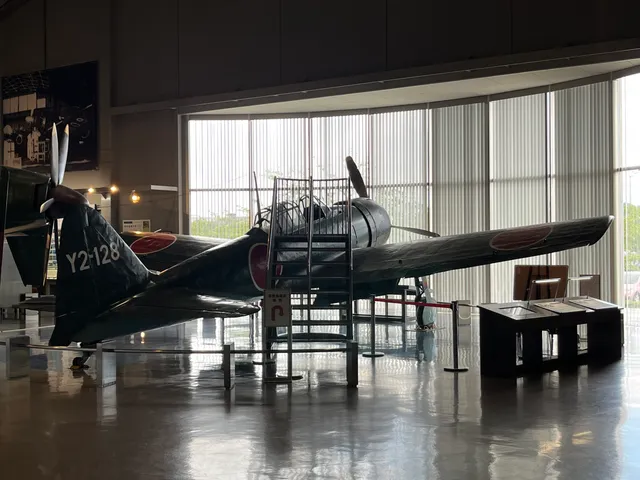
Tachiarai Peace Memorial Museum is one of three facilities on Kyushu ( including Chiran and Bansei in Kagoshima) dedicated to the memory of the Japan Imperial Army Special Attack Force aka "Kamikaze" suicide pilots. Tachiarai was the former location of the Imperial Army's pilot academy that by 1944 became a center for the rapid training and dispatch of suicide pilots. The museum is notable for its display of a Type Zero fighter aircraft and a Type K27, which was restored after being recovered from the bottom of Hakata Bay, in the main exhibit hall. The remainder of the exhibits are mostly portrait photos of the special attack pilots, their final letters to family, and artifacts. The museum would be more properly called a "war memorial" rather than peace memorial, as there is no context presented regarding the sacrifice of the pilots, soldiers and civilians that were killed in the final months of the war. The museum theater tells the unfortunate story of the local village, which greatly prospered when the army aviation academy was established. As the war progressed and turned against Japan, the academy became a training center for suicide pilots and that caused the base to become a target for a massive B-29 bombing raid at the end of March 1945. The raid damaged the airbase, but also devastated the village including the death of many civilians, including children. There is no context presented as to why despite being an obvious target, the town was not evacuated and there is no context presented on the situation in Japan which allowed senior commanders to send boys to their death on one way suicide missions. The exhibition shows that the average age of the pilots was about 23, with many 18-22 years old. They knew nothing but war almost their entire lives. Most of the boys were quickly trained to reach a minimal skill level, then waited for their special orders. Almost all the missions failed. The few that were successful caused terrible, but inconsequential damage on the US Navy. The museum presents the results in the light of success, which is not historically accurate. It would be much more interesting if all of the Kyushu peace museums included context including the responsibility of the leaders whose failures resulted in the tragic deaths of the pilots and civilians. After looking at so many striking portrait photographs of the pilots (they had photographs taken in pilot gear or had portraits created post mortem) the question remains were the 3,898 suicide pilots heroes or victims? My view is they are both, and were needlessly wasted in the prime of the their youth by the senior commanders. They are tragic heroic victims. But one consolation, is the pilots get their photos and biography recorded and presented in a beautiful museum, while the many other millions of victims of WWII do not get that privilege. A visit to the Tachiarai Peace Memorial Museum shows the dark side of war. It's well worth a visit, even without the context and the restored Type Zero fighter is a gem. Access is by car or the super cute Amagi Railroad. A short walk from the...
Read moreA portion of most signs were in English. I felt the museum did an excellent job of conveying that Tachiarai Airfield started in 1919 and was an airfield that had commercial service as well as military purposes. That Tachiarai grew from nothing to a decent sized town along with the airfield. That they had exceptional engineering and were proud of their their craft. This where the lack of English signs grew challenging because they seem to allude that those engineers went on to design the shinkansen bullet train, but there were only pictures, no English. Then there are 1/200 scale airplane models, and old uniforms and gear next to the zero fighter. They had information and maps about the seven times the airfield was bombed in 1945. They had pictures of women and children along side 11 American airmen, and around 100 or more Japanese soldiers and airmen killed presumably around the airfield as a reminder to the importance of peace. Also near the entrance they had an origami bird that Barrack Obama had folded with Carolyn Kennedy in the White House with two excellent letters he had written to various Japanese to explain reinforcing the importance of peace. The reason for four stars was that you can only take pictures of the zero fighter. They did have wonderful docent with a translation to point out the B29 silhouette on the ceiling, the map of the airfield on the floor, and there were more exhibits on the second floor and on the other side of the entrance. It was a great experience. One that will stick with me more than most of my...
Read moreThe Tachiarai Peace Memorial Museum is a must-visit for anyone interested in World War II history. Located on the former site of Tachiarai Airfield—once the largest military airfield in East Asia—the museum offers a powerful and sobering look into Japan’s wartime aviation legacy. The airfield played a crucial role in training Japanese Army pilots and later became a major dispatch point for kamikaze missions during the final stages of the war. It was heavily bombed and largely destroyed by U.S. B-29 bombers in March 1945.
The museum features a range of excellent exhibits, including two standout aircraft:
Nakajima Ki-27 "Type 97" Fighter – the only surviving example in the world, recovered from Hakata Bay and restored in 1996. This model was used in kamikaze missions.
Mitsubishi A6M3 Zero (Model 32) – the only surviving example of this iconic fighter, a symbol of Japanese air power during the war.
One of the more striking displays is a silhouette of a B-29 bomber suspended from the ceiling. Seeing it overhead gives a real sense of the aircraft’s massive scale—both impressive and deeply sobering.
While the exhibits have minimal English translations, using Google Translate helps capture the essence of the displays. Despite the language barrier, the museum’s historical significance and powerful presentation make it highly recommended for visitors seeking a deeper understanding of Japan’s...
Read more