
🏛️✨ A Journey to Rothko Chapel: A Sanctuary of Art and Spirit 🎨🌌
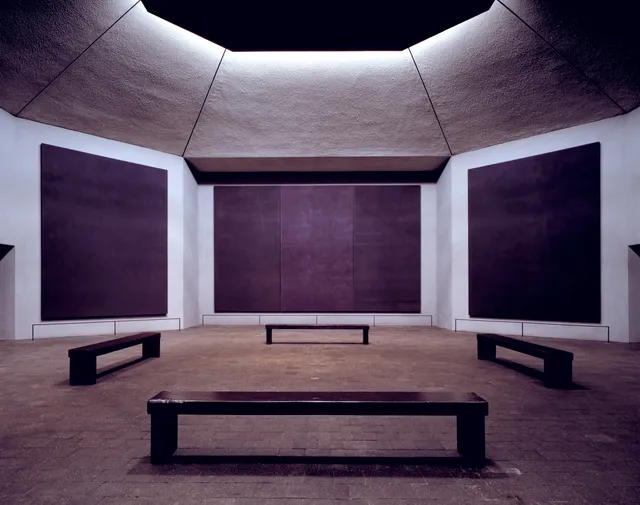
In Houston, Texas, nestled within the Menil Collection’s serene campus, lies a small yet profound structure—the Rothko Chapel. Designed and built by the tragic American Abstract Expressionist painter Mark Rothko at the invitation of the Menil (Dominique and John de Menil), this chapel is a masterpiece where art, architecture, and spirituality converge. Rothko envisioned this space as a meditative haven, where 14 monochromatic gradient paintings merge seamlessly with the building’s architecture. Visitors are enveloped in a dramatic sea of blackness, creating a secular yet deeply spiritual experience—a hallmark of American contemporary architecture. 🔍 Three Must-See Highlights of Rothko Chapel 1️⃣ The Chapel Itself: An octagonal brick-and-concrete structure, simple yet majestic. 2️⃣ Rothko’s 14 Abstract Murals: Custom-painted for this space, they form a cohesive whole. 3️⃣ Barnett Newman’s “Broken Obelisk” (Fig. 4): A towering sculpture rising from a reflecting pool in front of the chapel, symbolizing a “hardened reflection” in the calm waters. 🚶♀️ My Visit: Discovering the Hidden Gem Last Sunday afternoon, after touring the Menil Collection’s main galleries, we followed staff directions to find the Rothko Chapel. Approaching Fig. 1—a modest building—we spotted a small sign: “Rothko Chapel.” But where was the grand church we’d imagined? 🤔 We circled the structure until we found the subtle entrances (Figs. 2-3). Pushing open the heavy black door, we stepped into a space that defied expectations—a non-traditional chapel like no other. Inside, Rothko’s 14 massive canvases adorn the eight walls: North wall: A triptych (three connected panels) mirroring the chapel’s semicircular niche. South wall: A single vertical painting. East and West walls: Another triptych each. Four diagonal walls: Large standalone works. Rothko didn’t create these paintings to decorate the chapel or elevate its architecture—he aimed for a holistic, non-religious spiritual experience. 🌌 A Church Without Icons: Inclusivity Through Absence Unlike traditional churches, Rothko Chapel has no religious icons. This “imageless” design makes it more inclusive than any religious space. Rothko’s dark, abstract works express raw inner emotions, crafting an aesthetic environment like nightfall. As he once said, “Night is my most beautiful creation”—and these murals embody that, resembling a starry sky, sincere and breathtaking. 🌍 A Global Destination for All Beliefs Opened to the public free of charge in 1971, the Rothko Chapel instantly became a modern art landmark. It blurs boundaries between architecture, art, philosophy, and religion, serving as a global pilgrimage site for art lovers and spiritual seekers alike. 📸 Note on Photos Photography is prohibited inside the Menil Collection and Rothko Chapel. Figs. 5-8 are downloaded from the internet: Fig. 5: Rothko with patron Dominique de Menil. Figs. 6-8: Interior views of the chapel. Fig. 9: Me, stepping out of the chapel, feeling light as air. 💫 #Houston #RothkoChapel #UrbanRomance 🏙️🎨