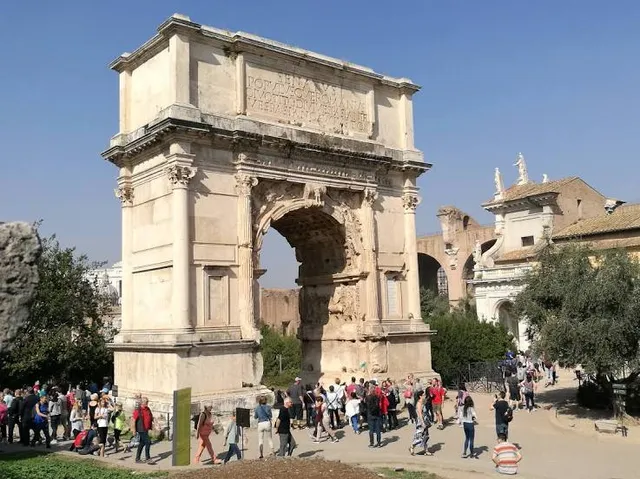

This Triumphal Arch Inspired Paris’ Arc de Triomphe
The Arch of Titus (Italian: Arco di Tito; Latin: Arcus Titi) is a single-arch marble triumphal arch located on the Sacra Via in the southeast of the Roman Forum, Rome, Italy. Built in 81 AD by Emperor Domitian shortly after his brother Titus’ death, it commemorates Titus’ conquest and destruction of Jerusalem in 70 AD, which ended the First Jewish-Roman War that began in 66 AD. The panels on the arch depict the triumphal procession celebrating Rome’s victory and Jerusalem’s fall in 71 AD. It has become a symbol of the Jewish Diaspora, and the menorah depicted on the arch also served as the prototype for the menorah on Israel’s national emblem. 🕍 The Arch of Titus became a model for many triumphal arches after the 16th century—and it is the inspiration behind the most famous one: Paris’ Arc de Triomphe. 🇫🇷 Inscription on the Lintel (Rough Translation) “The Senate and the Roman People (S.P.Q.R.) dedicate this to Titus the Divine, son of Vespasian the Divine Augustus.” The arch stands on the Velia Hill, between the Palatine and Esquiline Hills, in the southeast of the Roman Forum. The Arch of Titus itself is 13.50 meters wide, 15.40 meters high, and 4.75 meters deep; the inner opening is 8.30 meters high and 5.36 meters wide. It was constructed using Pentelic marble. 🪨 The arch features the only surviving depictions of artifacts from the Second Temple of Jerusalem, clearly showing the menorah, trumpets, and possibly the Table of Showbread . Due to its depictions of the destruction of Jerusalem and the desecration of the Temple, many Jews refused to pass under the arch—even after Rome later adopted Christianity. However, after the founding of the State of Israel in 1948, large crowds from Rome’s Jewish community passed through the Arch of Titus in the opposite direction of the ancient Roman triumphal processions. 🇮🇱 The image of the 7-branched menorah from the Second Temple, as depicted on the Arch of Titus, is used on Israel’s national emblem. The capitals of the columns flanking the arch’s opening also mark the first use of the Composite order in Rome. Restoration of the Arch In the Middle Ages, the arch was enclosed by adjacent houses and city walls. From the 16th century onward, it underwent multiple restorations and was even incorporated into the Monastery of Santa Francesca Romana. Between 1821 and 1823, the Arch of Titus was dismantled stone by stone to free it from the medieval palace that had trapped it, then rebuilt in its original form—overseen by Raffaele Stern and Giuseppe Valadier in 1823. Further restoration work was carried out in 1901–1902, including lowering the surrounding road level to expose the arch’s foundations. This method of restoring architectural heritage to match its appearance from a specific period is known as “stylistic restoration.” This concept influenced Italy’s architectural heritage restoration work until the pre-WWII era and was particularly prevalent during Benito Mussolini’s fascist dictatorship—lasting until Cesare Brandi proposed his “restoration theory” in the mid-20th century. 🔨 #TriumphalArch #HistoricalArchitecture #CulturalAttractionShare #ArcDeTriompheParis #ArchitecturalPhotography #TiltShiftPhotography #ArchitecturalHeritage #Canon5DMarkIII #CanonTSE24 #AncientRome