

HTML SitemapExplore

Traces of Washington: Eisenhower Executive Office Building 🏛️✨

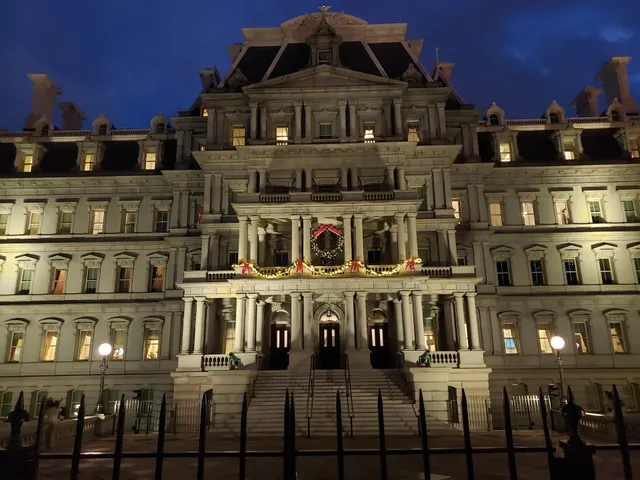
The Eisenhower Executive Office Building (EEOB), located just west of the White House, stands as one of the most iconic historic structures of the U.S. federal government. Construction began in 1871 and took 17 years to complete 🏗️. Originally named the State, War, and Navy Building, it once housed three major government departments. Designed in the French Second Empire style, the EEOB is known for its grand presence and intricate ornamentation—often called a “palace of the state.” Yet its bold, eclectic look wasn’t always loved: Mark Twain once mocked it as an “architectural disaster” 😅. Today, however, it’s celebrated as a masterpiece of American government architecture. The building was designed by Alfred B. Mullett, who embraced the then-popular Second Empire style 🏰—characterized by mansard roofs, lavish details, and strong symmetry—to project power and national prestige. It was a dramatic departure from the more restrained Neoclassical buildings common in Washington. Beyond the majestic exterior, the EEOB’s interiors are equally stunning. Inside, you’ll find winding parquet corridors, decorative cast-iron staircases, gilded chandeliers, and soaring domes 💫. One highlight is the Indian Treaty Room, adorned with gold, blue, and green mosaic tiles and elaborate inlaid wooden floors—a peak example of 19th-century public art and craftsmanship. By the mid-20th century, departments like State and War had moved out, and the building was repurposed to house executive offices closely tied to the presidency 👨💼. Today, it’s home to the Vice President’s office, the National Security Council, and other key White House units. In 1977, it was renamed in honor of President Dwight D. Eisenhower. More than a century after its completion, the EEOB remains a vital part of U.S. governance—preserving history while continuing to serve the nation. A true blend of power, politics, and art! 🇺🇸 Have you seen the EEOB in person? What’s your favorite historic building in DC? Share below! 👇 #Architecture #HistoricPreservation #WashingtonDC #WashingtonDCTravel #EEOB #WhiteHouse #GovernmentBuildings #FrenchArchitecture #DCHistory #UrbanExploration
Related posts
Museums – Freer Gallery of Art 🏛️🎨🇺🇸 DMV’s BEST Uyghur Food – A Taste of Xinjiang in Washington!USA | The White House Exterior Visit & Reservation Guide Maroon Bells – A Million-Dollar Autumn View 🍂📅 10/01/2025Pitango Gelato in DC 🍦|A Must-Try Italian Gelato Spot! 🇮🇹✨Dining Diary|DC|Spanish Cuisine Discovery During Restaurant Week 🌟
Jessie Ashford
Jessie Ashford
3 months ago
Jessie Ashford
Jessie Ashford
3 months ago
no-comment

No one has commented yet...

Traces of Washington: Eisenhower Executive Office Building 🏛️✨

The Eisenhower Executive Office Building (EEOB), located just west of the White House, stands as one of the most iconic historic structures of the U.S. federal government. Construction began in 1871 and took 17 years to complete 🏗️. Originally named the State, War, and Navy Building, it once housed three major government departments. Designed in the French Second Empire style, the EEOB is known for its grand presence and intricate ornamentation—often called a “palace of the state.” Yet its bold, eclectic look wasn’t always loved: Mark Twain once mocked it as an “architectural disaster” 😅. Today, however, it’s celebrated as a masterpiece of American government architecture. The building was designed by Alfred B. Mullett, who embraced the then-popular Second Empire style 🏰—characterized by mansard roofs, lavish details, and strong symmetry—to project power and national prestige. It was a dramatic departure from the more restrained Neoclassical buildings common in Washington. Beyond the majestic exterior, the EEOB’s interiors are equally stunning. Inside, you’ll find winding parquet corridors, decorative cast-iron staircases, gilded chandeliers, and soaring domes 💫. One highlight is the Indian Treaty Room, adorned with gold, blue, and green mosaic tiles and elaborate inlaid wooden floors—a peak example of 19th-century public art and craftsmanship. By the mid-20th century, departments like State and War had moved out, and the building was repurposed to house executive offices closely tied to the presidency 👨💼. Today, it’s home to the Vice President’s office, the National Security Council, and other key White House units. In 1977, it was renamed in honor of President Dwight D. Eisenhower. More than a century after its completion, the EEOB remains a vital part of U.S. governance—preserving history while continuing to serve the nation. A true blend of power, politics, and art! 🇺🇸 Have you seen the EEOB in person? What’s your favorite historic building in DC? Share below! 👇 #Architecture #HistoricPreservation #WashingtonDC #WashingtonDCTravel #EEOB #WhiteHouse #GovernmentBuildings #FrenchArchitecture #DCHistory #UrbanExploration

Washington
Eisenhower Executive Office Building
Eisenhower Executive Office BuildingEisenhower Executive Office Building