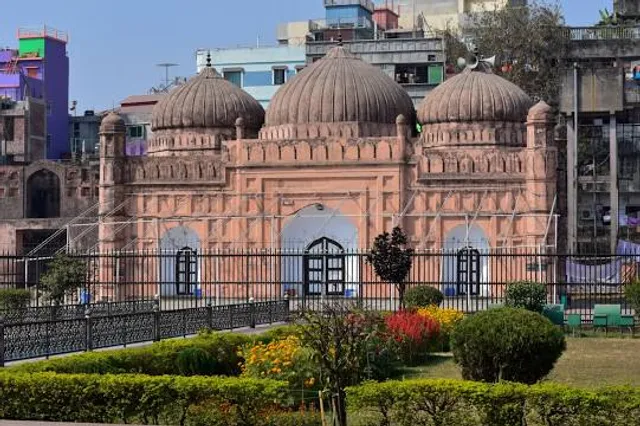
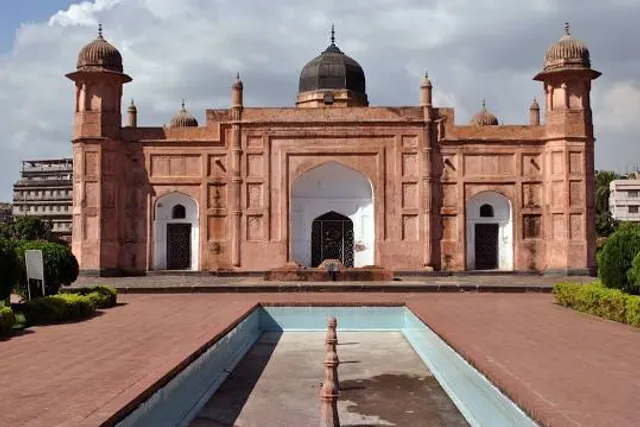
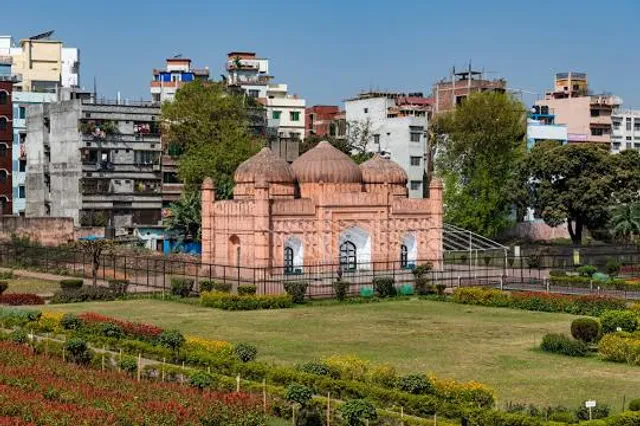
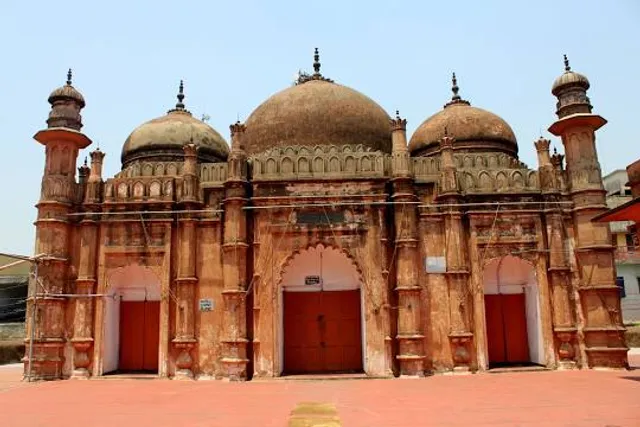
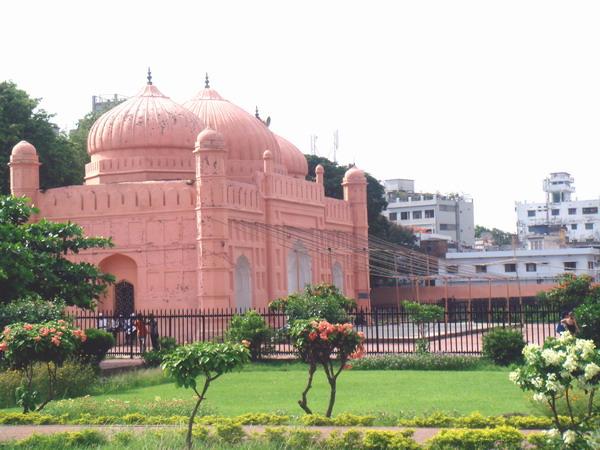
Main attraction of the complex is the mosque which stands about 170 feet from the tomb of Pari Bibi. As per history, the mosque was constructed by Prince Azam around 1679, probably to use at is a prayer site for the residents of the fort. It has to be mentioned that Prince Azam was supposed to be betrothed to Pari Bibi.
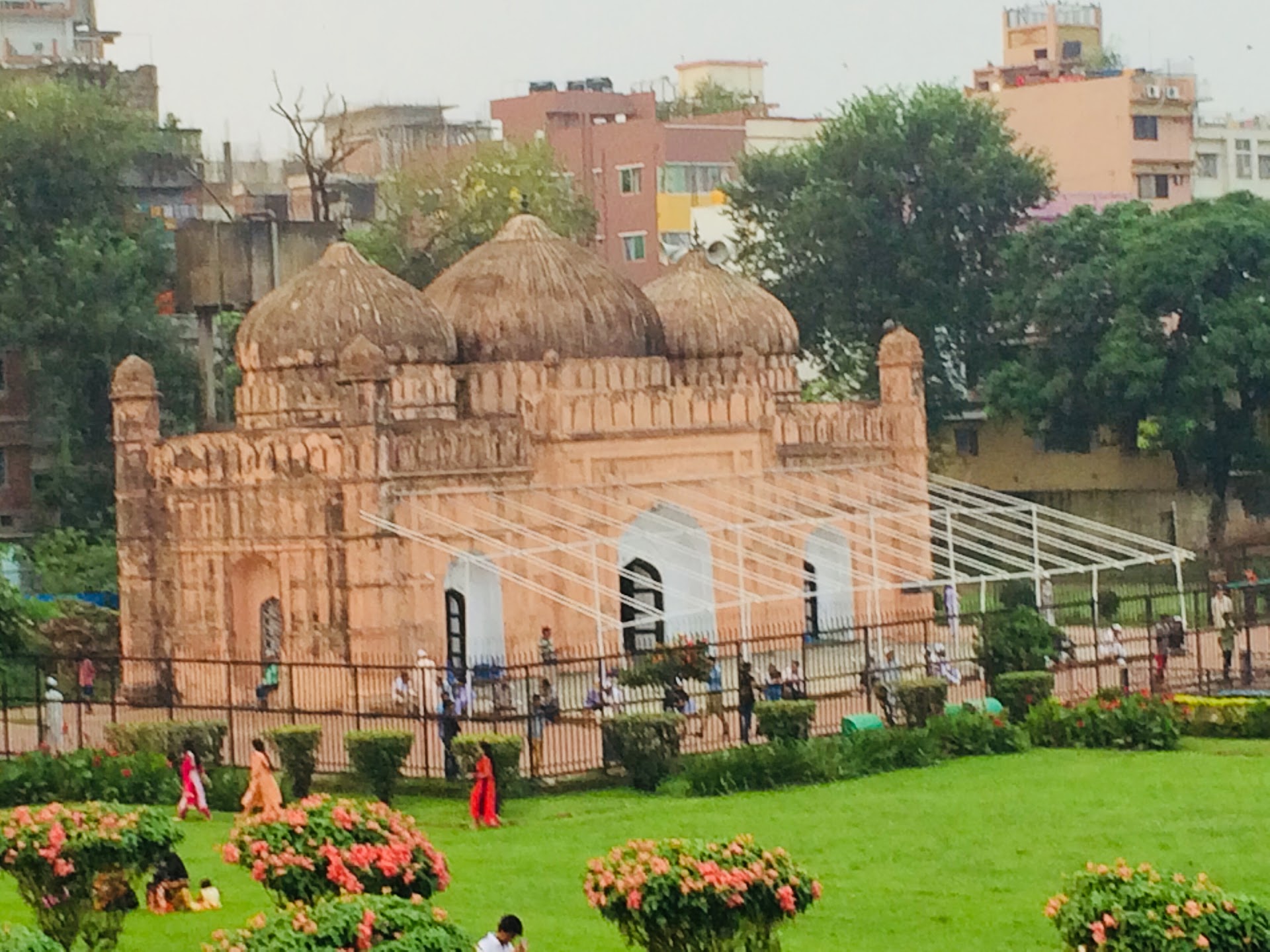
The basic of the mosque is the oblong 3-domed shape, measuring 65’x33’, stands at the back of an elevated platform. It has four octagonal corner minarets covered with plaster kiosks, and the eastern walls or façade are pierced with 3 arched openings, of which the central one is bigger than the other two, and framed within slightly projected rectangular fronton and flanked by willowy minarets. All the three openings are set below multi-cusped arches with soffit of their half domes, relieved in plaster network. The entire outer surfaces of the walls are profusely relieved with plastered panels and the cornice decorated with battlemented cresting. Of the three inverted cup-shaped domes, the central one and springs form an octagonal drum. The flanking domes are slightly bulbous in shape, but beautifully fluted with basal leaf design. Recently, a patch of plaster from the apical underside of the central and northern domes peeled off when the Department of Archaeology was carrying out annual maintenance work. It exposed, to the surprise of the repairers, beautiful floral paintings under the later encrustation of plaster work. There are two inscriptions incised on plaster inside the mosque, one of which reads: Allah, Muhammad, Abu Bakr, Umar, Usman, Ali 1059 A.M./1649 A.D. “Muhammad of Arabia is held in great esteem in both worlds. One who is not the dust of his doorsteps, dust be upon his head.” The second one reads: “Allah, Muhammad, Abu Bakr, Umar, Usman, Ali, may Allah forgive its writer Abd-al-Kabir. An earth on which is the footprint shall be a place of prostration to the onlookers for the years to come.”
Lalbagh’s situation started to decline due to the unexpected departure of Nawab Shaista Khan, and later it became an abandoned place when the capital was shifted to Mushidabad in 1717. After the liberation war of 1971, the government took the responsibility of salvaging of whatever was left of the complex. However, the mosque was excluded from this project, because even though the whole complex was abandoned, the local residents would still say their daily prayers in that mosque, and maybe for that reason, the mosque survived better than the rest of the structures inside the complex. Still some of the designs of the ceiling and the Mihrab are in the shapes that it was in the earlier stages. Even today, people still go to the mosque that has managed to survive over 300...
Read moreLalbagh Fort (also Fort Aurangabad) is an incomplete 17th century Mughal fort complex that stands before the Buriganga River in the southwestern part of Dhaka, Bangladesh.[1] The construction was started in 1678 AD by Mughal Subahdar Muhammad Azam Shah who was son of Emperor Aurangzeb and later emperor himself. His successor, Shaista Khan, did not continue the work, though he stayed in Dhaka up to 1688.
History======Mughal prince Muhammad Azam, third son of Aurangzeb started the work of the fort in 1678 during his vice-royalty in Bengal. He stayed in Bengal for 15 months. The fort remained incomplete when he was called away by his father Aurangzeb.
Shaista Khan was the new subahdar of Dhaka in that time, and he did not complete the fort. In 1684, the daughter of Shaista Khan named Iran Dukht Pari Bibi died there. After her death, he started to think the fort as unlucky, and left the structure incomplete.[2] Among the three major parts of Lalbagh Fort, one is the tomb of Pari Bibi.
After Shaista Khan left Dhaka, it lost its popularity. The main cause was that the capital was moved from Dhaka to Murshidabad. After the end of the royal Mughal period, the fort became abandoned. In 1844, the area acquired its name as Lalbagh replacing Aurangabad, and the fort became Lalbagh Fort..
Structures====For long the fort was considered to be a combination of three buildings (the mosque, the tomb of Bibi Pari and the Diwan-i-Aam), with two gateways and a portion of the partly damaged fortification wall. Recent excavations carried out by the Department of Archaeology of Bangladesh have revealed the existence of other structures.
The southern fortification wall has a huge bastion in the southwestern corner. On the north of the south fortification wall were the utility buildings, stable, administration block, and its western part accommodated a beautiful roof-garden with arrangements for fountains and a water reservoir. The residential part was located on the east of the west fortification wall, mainly to the southwest of the mosque.
The fortification wall on the south had five bastions at regular intervals two stories in height, and the western wall had two bastions; the biggest one is near the main southern gate. The bastions had an underground tunnel.
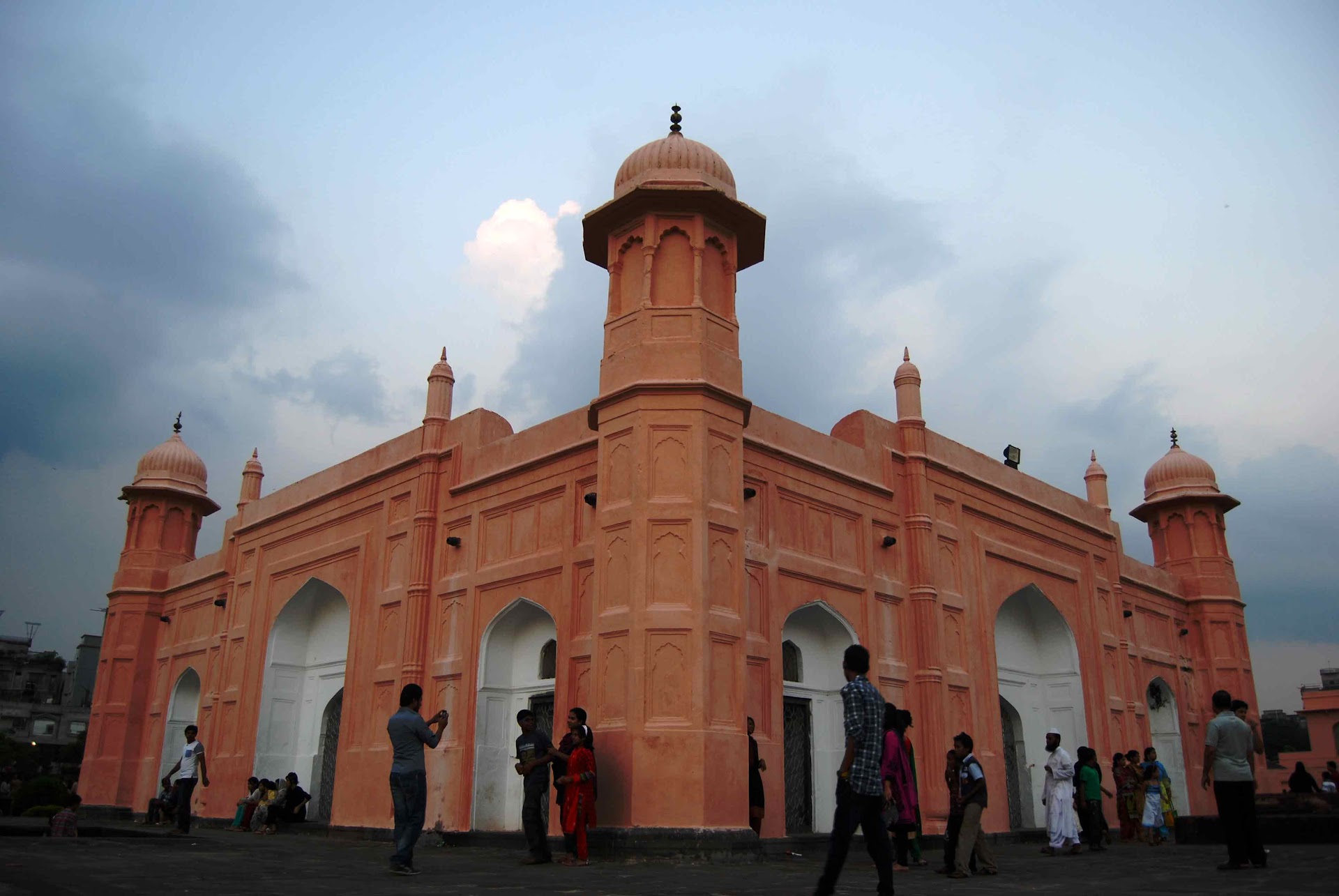
The central area of the fort is occupied by three buildings - the Diwan-i-Aam and the hammam on its east, the Mosque on the west and the Tomb of Pari Bibi in between the two - in one line, but not at an equal distance. A water channel with fountains at regular intervals connects the three buildings from east to west and...
Read moreThe date of construction this rectangular three-domed mosque inside the Lalbagh fort is problematic. Traditionally it is considered to be contemporary with the Lalbagh Fort, constructed by Muhammad Azam in 1678-79. However, recent exploration identified it as 1649, with a further restoration of 1780 (Hasan, 2007). The fort complex named Lalbagh stands before the Buriganga River in the southwestern part of Dhaka, Bangladesh.
This mosque, part of the Lalbagh Fort Complex and built under the rule of Governor Shaista Khan, is situated in the western part of the complex, aligned with the tomb of Bibi Pari. The Lalbagh Fort mosque is a typical Bengali Mughal type (Asher, 1984); that is, a rectangular structure crowned with three-domes. It is one of the finest examples of its kind, where the central dome is larger (Islam & Noblea, 1998).
The mosque has an oblong plan of 66'9" x 33'6" externally and 53'8" x 20'2" internally. The structure is divided into three equal interior bays, roofed over by three fluted, bulbous domes, resting on drums. The proportionately smaller lateral domes are placed on the equal size bays by splitting each dome into a half-dome and placing it on a pendentive. Stylistically this kind is known as Shaista Khani architecture, commonly found in and around Dhaka.
The rectangular structure is buttressed by four corner octagonal turrets, capped by plastered cupolas. These turrets rise slightly above the parapet walls and ribbed in typical Bengali fashion. Parapets are straight instead of the curvilinear cornice of pre-Mughal types. The eastern or main facade is visually divided into three sections. Each section contains an entrance doorway that correspond to the three domes above and adorned by cusped arches. The middle section is emphasized by a frame of slender, engaged columns, a raised cornice, and a larger dome. The Lalbagh Fort Mosque's north and south interior walls are divided into a series of horizontal panels, reflecting the motifs on the exterior. The three mihrabs contain faceted stucco work similar to that on the entrances.
The mosque was restored and repaired by the Department of Archaeology, Bangladesh, and is now a...
Read more