HTML SitemapExplore
logo
Find Things to DoFind The Best Restaurants

Abu Simbel Temples — Attraction in Abu Simbel City

Name
Abu Simbel Temples
Description
Abu Simbel is a historic site comprising two massive rock-cut temples in the village of Abu Simbel, Aswan Governorate, Upper Egypt, near the border with Sudan. It is situated on the western bank of Lake Nasser, about 230 km southwest of Aswan.
Nearby attractions
Temple of Nefertari
8JQG+3M8, Abu Simbel, Aswan Governorate 1211501, Egypt
Nearby restaurants
Nearby hotels
تويا
Ramsis, Abu Simbel, Aswan Governorate 1211123, Egypt
Related posts
Egypt Free & Easy|2 Days in Aswan is More Than Enough! 💫Abu Simbel Temples 🌅🏛️ - A Desert Pilgrimage to Ramses the Great!Egypt's Must-Visit 9 Ancient Wonders Luxor Souvenir Shopping: Find This Boss! 👆🛍️Aswan One-Day Itinerary: Abu Simbel + Philae Temple + Nubian VillageCrossing 600 km in a day just to catch a glimpse of Abu Simbel
Keywords
Abu Simbel Temples tourism.Abu Simbel Temples hotels.Abu Simbel Temples bed and breakfast. flights to Abu Simbel Temples.Abu Simbel Temples attractions.Abu Simbel Temples restaurants.Abu Simbel Temples travel.Abu Simbel Temples travel guide.Abu Simbel Temples travel blog.Abu Simbel Temples pictures.Abu Simbel Temples photos.Abu Simbel Temples travel tips.Abu Simbel Temples maps.Abu Simbel Temples things to do.
Abu Simbel Temples things to do, attractions, restaurants, events info and trip planning
Abu Simbel Temples
EgyptAswanAbu Simbel CityAbu Simbel Temples

Basic Info

Abu Simbel Temples

Abu Simbel, Aswan Governorate 1211501, Egypt
4.8(7.8K)
Open 24 hours
Save
spot

Ratings & Description

Info

Abu Simbel is a historic site comprising two massive rock-cut temples in the village of Abu Simbel, Aswan Governorate, Upper Egypt, near the border with Sudan. It is situated on the western bank of Lake Nasser, about 230 km southwest of Aswan.

Cultural
Scenic
Accessibility
attractions: Temple of Nefertari, restaurants:
logoLearn more insights from Wanderboat AI.
Website
egymonuments.gov.eg

Plan your stay

hotel
Pet-friendly Hotels in Abu Simbel City
Find a cozy hotel nearby and make it a full experience.
hotel
Affordable Hotels in Abu Simbel City
Find a cozy hotel nearby and make it a full experience.
hotel
The Coolest Hotels You Haven't Heard Of (Yet)
Find a cozy hotel nearby and make it a full experience.
hotel
Trending Stays Worth the Hype in Abu Simbel City
Find a cozy hotel nearby and make it a full experience.

Reviews

Nearby attractions of Abu Simbel Temples

Temple of Nefertari

Temple of Nefertari

Temple of Nefertari

4.8

(354)

Open 24 hours
Click for details
Get the Appoverlay
Get the AppOne tap to find yournext favorite spots!
Wanderboat LogoWanderboat

Your everyday Al companion for getaway ideas

CompanyAbout Us
InformationAI Trip PlannerSitemap
SocialXInstagramTiktokLinkedin
LegalTerms of ServicePrivacy Policy

Get the app

© 2025 Wanderboat. All rights reserved.
logo

Reviews of Abu Simbel Temples

4.8
(7,805)
avatar
5.0
5y

The Abu Simbel temples are two massive rock temples at Abu Simbel (Arabic: أبو سمبل‎), a village in Aswan Governorate, Upper Egypt, near the border with Sudan. They are situated on the western bank of Lake Nasser, about 230 km (140 mi) southwest of Aswan (about 300 km (190 mi) by road). The complex is part of the UNESCO World Heritage Site known as the "Nubian Monuments",1] which run from Abu Simbel downriver to Philae (near Aswan). The twin temples were originally carved out of the mountainside in the 13th century BC, during the 19th dynasty reign of the Pharaoh Ramesses II. They serve as a lasting monument to the king and his queen Nefertari, and commemorate his victory at the Battle of Kadesh. Their huge external rock relief figures have become iconic.

The complex was relocated in its entirety in 1968 under the supervision of a Polish archaeologist, Kazimierz Michałowski from the Polish Centre of Mediterranean Archaeology University of Warsaw,[2] on an artificial hill made from a domed structure, high above the Aswan High Dam reservoir. The relocation of the temples was necessary or they would have been submerged during the creation of Lake Nasser, the massive artificial water reservoir formed after the building of the Aswan High Dam on the River Nile. The project was carried out as part of the UNESCO Nubian Salvage Campaign.[1 Construction Geneva architect, Jean Jacquet, a Unesco expert, makes an architectural survey of the Great Temple of Rameses II ( 1290 - 1223 B.C.). Genevese architect Jean Jacquet, a UNESCO expert, makes an architectural survey of the Great Temple of Rameses II (1290–1223 BC) During his reign, Ramesses II embarked on an extensive building program throughout Egypt and Nubia, which Egypt controlled. Nubia was very important to the Egyptians because it was a source of gold and many other precious trade goods. He, therefore, built several grand temples there in order to impress upon the Nubians Egypt's might and Egyptianize the people of Nubia.3 The most prominent temples are the rock-cut temples near the modern village of Abu Simbel, at the Second Nile Cataract, the border between Lower Nubia and Upper Nubia.[4] There are two temples, the Great Temple, dedicated to Ramesses II himself, and the Small Temple, dedicated to his chief wife Queen Nefertari.

Construction of the temple complex started in approximately 1264 BC and lasted for about 20 years, until 1244 BC. It was known as the "Temple of Ramesses, beloved by Amun". Rediscovery With the passage of time, the temples fell into disuse and eventually became covered by sand. By the 6th century BC, the sand already covered the statues of the main temple up to their knees. The temple was forgotten until 1813, when Swiss orientalist Johann Ludwig Burckhardt found the top frieze of the main temple. Burckhardt talked about his discovery with Italian explorer Giovanni Belzoni, who travelled to the site, but was unable to dig out an entry to the temple. Belzoni returned in 1817, this time succeeding in his attempt to enter the complex. A detailed early description of the temples, together with contemporaneous line drawings, can be found in Edward William Lane's Description of Egypt (1825–1828).[5]

Relocation In 1959, an international donations campaign to save the monuments of Nubia began: the southernmost relics of this ancient human civilization were under threat from the rising waters of the Nile that were about to result from the construction of the Aswan High Dam.

One scheme to save the temples was based on an idea by William MacQuitty to build a clear freshwater dam around the temples, with the water inside kept at the same height as the Nile. There were to be underwater viewing chambers. In 1962 the idea was made into a proposal by architects Jane Drew and Maxwell Fry and civil engineer Ove Arup.[6] They considered that raising the temples ignored the effect of erosion of the sandstone by desert winds. However, the proposal, though acknowledged to be extremely elegant,...

   Read more
avatar
5.0
6y

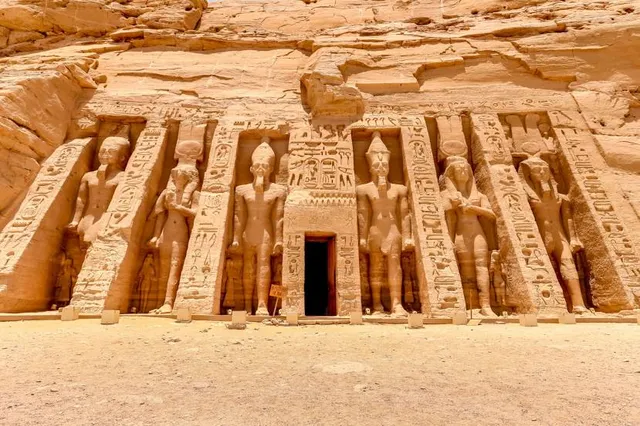
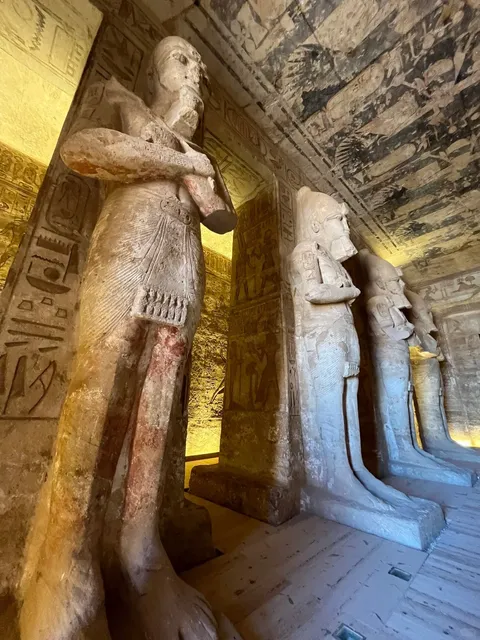
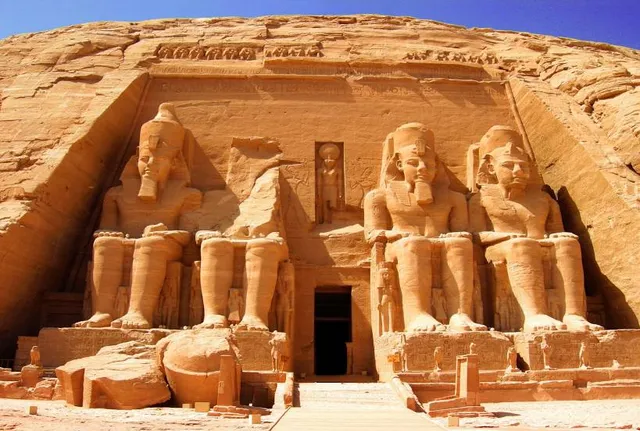
Abu Simbel Temples were first noticed in 1813. Excavations Began on 1817. There after these temples carved on to solid Rock, became the largest and most famous in all of Egypt. When work began on Aswan Dam these were in danger of being submerged under water. Work began to save them by shifting them to a higher and safre place. Both the temples were cut into huge blocks of up to 20 to tons and reassembled 65 meters higher and 200 meters further back. This was then covered by huge and massive concrete dome which in turn was covered by rubble and sand to give it are appearance of a mountain. The UN assisted work was started on 1964. Temple thrown open to public on 1968. The whole project is considered archaeological and engineering miracle. Greater Temple - Temple of Ramses II. Also known as Ramses II Temple by archaeologists and historians. It is dedicated to Gods Amun, Ra-Horakhty, Ptah and to Ramses himself. As in effect by constructing this temple he had defied and declared himself as God. Entrance door to temple is located in the centre of 30 meter high facade. Door is flanked by four 20 meters high colossal statues, two on either side of the entrance. Between the feet of the statues are smaller figures of the Ramses II family members. Ascending ramp leads to the entrance. On either side of the ramp are high walls of platform of the facade below the colossal statues. Right hand wall has Hieroglyphics showing Syrian prisoners being lead with ropes around their necks and with their hands tied behind their back. Left hand wall has Hieroglyphics showing Hittites prisoners being lead with ropes around their necks and with their hands tied behind their back. You step in hypo style hall through the entrance. Hypo style hall is technical name of a big room whose roof is supported by large number of columns. Hypo style hall is divided in three portions by four huge square columns these have 10 meter high Orisis figures of Pharaohs. Middle portion is twice as big a the portions on either side. Hypo style hall has eight side chambers, four on each side. These were issued as treasure rooms or storage rooms. The walls on both side portions depicts the war scenes of a famous battles and wars faught by Ramses II. Ramses worshipping and making various offerings to the Gods. From hypo style hall you enter another smaller come column hall. This has beautiful statues and carvings of Ramses II and Nefratari worshipping and making offerings to the Gods. Lastly the inner most chamber. This has four idols of Gods Gods Amun, Ra-Horakhty, Ptah and Ramses II. On 22 February every year morning Sun Rays fall directly on statues of these four Gods at the deepest wall of Abu Simbel Temple. Happens only on this day once in a year. Smaller Temple - Temple of Hathor. It is located to the North of Temple of RamsesII. The Temple of dedicated to Goddess Hathor, Goddess of love and Nefratari, favourite wife of Ramses II. Facade of about 12 meters is hewn In the solid rock. The facade has six colossal statues about 10 meters tall. Two statues on extreme left and right are those of King Ramses II and Queen Nefratari. Smaller statues near the l their feet are those of family member's. Two statues on either side of the gate at of Ramses. On the left he is shown wearing crown of Upper Egypt. On the right he is wearing double crown of Upper and Lower Egypt. Inner construction is similar to that of greater temple. Square sized Hypo style hall is debited in three portions by six pillars supporting the roof. These have statues of Hathor depicted with cow ears and of King, Queen and other deities. The walls have Hieroglyphics and bass reliefs of King Ramses and Queen Nefratari in various activities. There are two side rooms and finally the sanctuary. The walls have King and Queen worshipping or making offerings to various Gods. Back wall has a niche contains Goodness Hathor in the...

   Read more
avatar
5.0
1y

The Abu Simbel temples, located in southern Egypt near the border with Sudan, are two massive rock temples originally carved out of the mountainside during the reign of Pharaoh Ramesses II in the 13th century BCE. These temples are part of the UNESCO World Heritage Site known as the "Nubian Monuments," which run from Abu Simbel downriver to Philae.

The larger of the two temples, known as the Great Temple, is dedicated to the gods Amun, Ra-Horakhty, and Ptah, as well as to the deified Ramesses II himself. The facade of the Great Temple is dominated by four colossal statues of Ramesses II, each standing over 20 meters (66 feet) tall. Between the legs of these statues are smaller statues of Ramesses' family members, including his queen Nefertari and some of his children. The interior of the temple is equally impressive, with a series of halls and rooms adorned with intricate carvings and hieroglyphics depicting the pharaoh's military victories, divine status, and offerings to the gods.

The smaller temple, often referred to as the Temple of Hathor and Nefertari, is dedicated to the goddess Hathor and Ramesses' chief consort, Queen Nefertari. This temple's facade features six statues, four of Ramesses II and two of Nefertari, all standing at about 10 meters (33 feet) tall. The interior is similarly decorated with elaborate carvings and scenes of the queen participating in religious rituals.

In the 1960s, the temples faced submersion due to the construction of the Aswan High Dam and the creation of Lake Nasser. An international campaign led by UNESCO was launched to save the monuments. In an incredible feat of engineering, the temples were cut into large blocks, dismantled, and reassembled on higher ground, where they stand today.

The relocation project took several years and involved meticulous planning and precision to ensure the temples were preserved as accurately as possible. Today, Abu Simbel remains one of Egypt's most iconic archaeological sites, attracting thousands of visitors annually and standing as a testament to ancient Egyptian engineering and modern...

   Read more
Page 1 of 7
Previous
Next

Posts

Egypt Free & Easy|2 Days in Aswan is More Than Enough! 💫
Violet SofiaViolet Sofia
Egypt Free & Easy|2 Days in Aswan is More Than Enough! 💫
Abu Simbel Temples 🌅🏛️ - A Desert Pilgrimage to Ramses the Great!
Hazel LilyHazel Lily
Abu Simbel Temples 🌅🏛️ - A Desert Pilgrimage to Ramses the Great!
Egypt's Must-Visit 9 Ancient Wonders
Emma EliseEmma Elise
Egypt's Must-Visit 9 Ancient Wonders
See more posts
See more posts
hotel
Find your stay

Pet-friendly Hotels in Abu Simbel City

Find a cozy hotel nearby and make it a full experience.

Egypt Free & Easy|2 Days in Aswan is More Than Enough! 💫
Violet Sofia

Violet Sofia

hotel
Find your stay

Affordable Hotels in Abu Simbel City

Find a cozy hotel nearby and make it a full experience.

Get the Appoverlay
Get the AppOne tap to find yournext favorite spots!
Abu Simbel Temples 🌅🏛️ - A Desert Pilgrimage to Ramses the Great!
Hazel Lily

Hazel Lily

hotel
Find your stay

The Coolest Hotels You Haven't Heard Of (Yet)

Find a cozy hotel nearby and make it a full experience.

hotel
Find your stay

Trending Stays Worth the Hype in Abu Simbel City

Find a cozy hotel nearby and make it a full experience.

Egypt's Must-Visit 9 Ancient Wonders
Emma Elise

Emma Elise

See more posts
See more posts