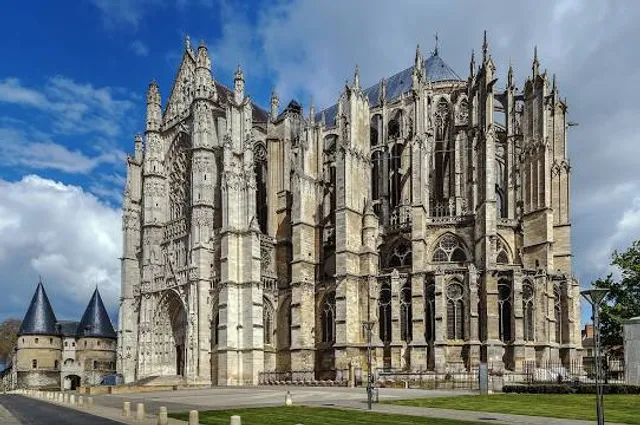
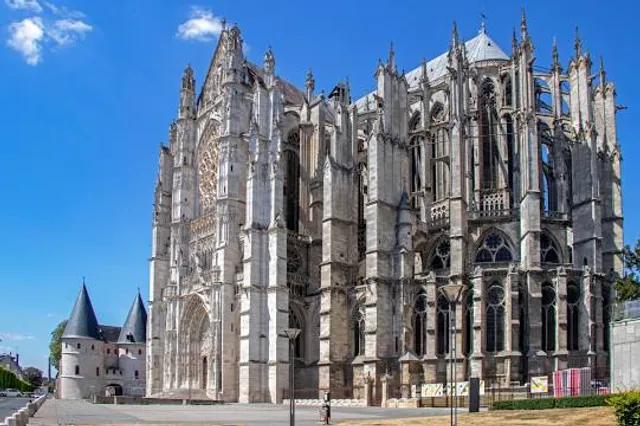
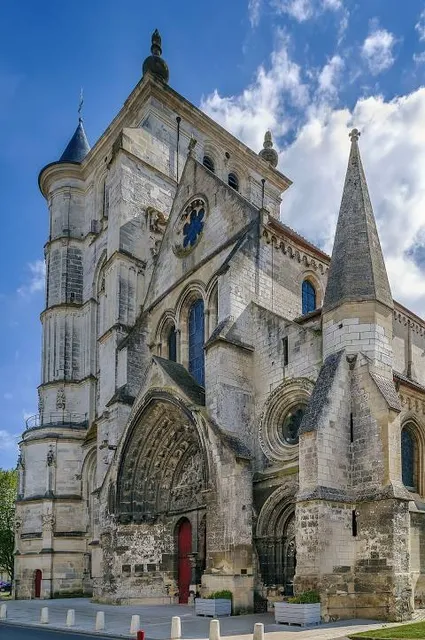
A world treasure of architecture that should be a UNESCO World Heritage site. If you can, read up a bit on Gothic architecture before visiting this glorious space. You will appreciate even more how Gothic architecture exploited the innovation of the pointed arch to make these gorgeous creations a celebration of light.
And indeed, this is a celebration of light .The windows are glowing jewels. About half are original --!almost 800 years old -- and the other half are contemporary because German bombing in WWII destroyed many windows along with a great deal of the town.
A poignant sculpture is more recent than the others: a 1930s statue of Joan of Arc, with the bishop of Beauvais kneelng before her, begging forgiveness for the act of his predecessor. That bishop of Beauvais is the cleric who condemned her to death by fire for the sin of 'refusing to submit.' Although this condemnation of her was recanted 10 years after her death, St. Joan was not canonized until the 1920s. This lovely sculpture was made about 10 years later.
Don't just visit the extraordinary astronomical clock, which is thoughtfully provided with a grouping of chairs where you can relax and fully appreciated the operation of the clock.
Be sure to walk around the ambulatory, lined with chapels including, most especially, the chapel of the Virgin with its 13th-century windows.
In the central space with the main altar (choir), notice the decorations on the columns, including gargoyles and one that might be a ghost.
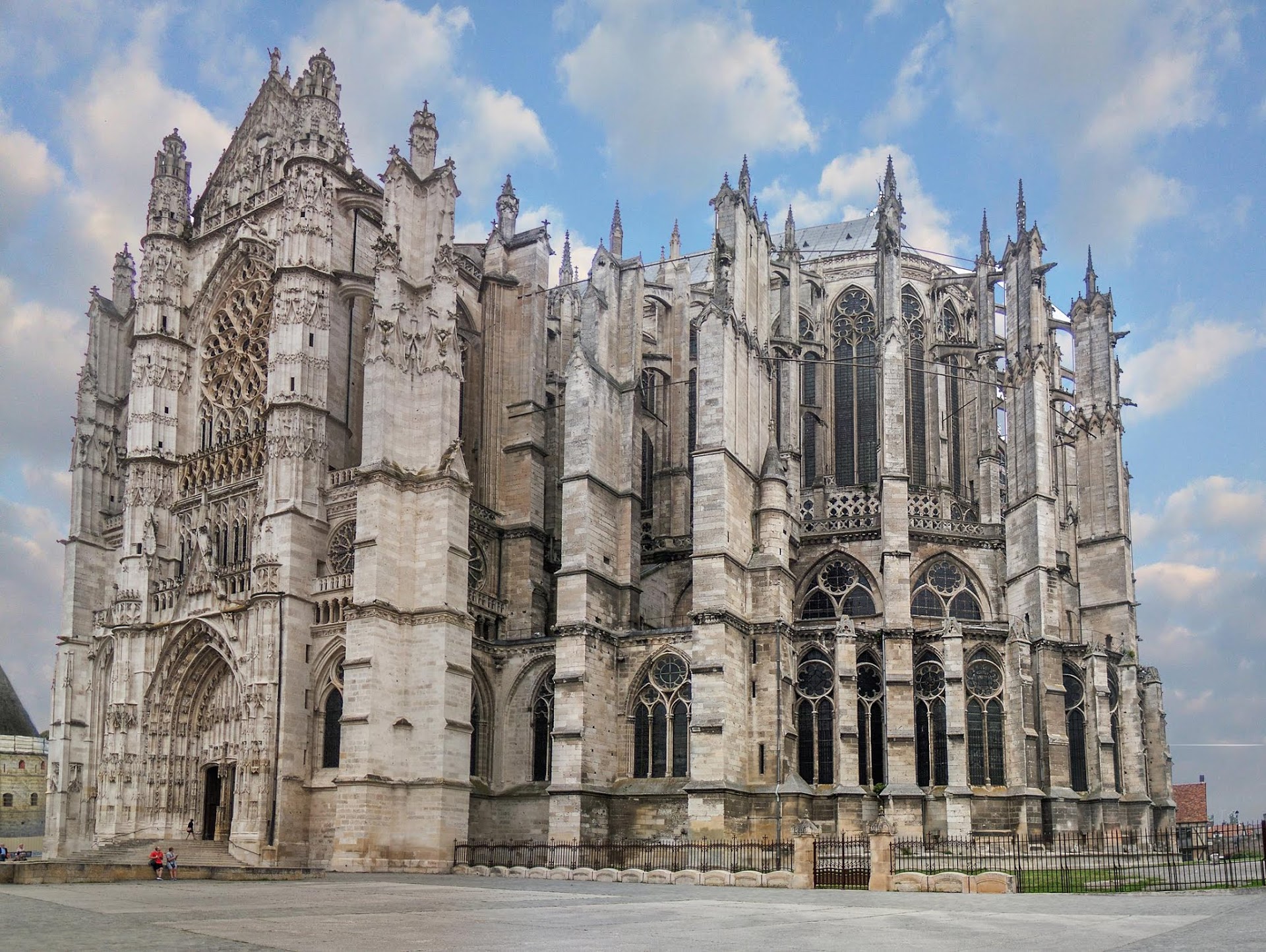
The elegant tracery on the external decoration is the most delicate and organic that I have ever seen.
I am so grateful to the people who work hard despite what seems to be very limited funds to make this accessible to us. Most of the world treasures that I visit as a frequent traveler are in better shape, and this one clearly shows that is is supported as much by...
Read moreDiese Kathedrale besitzt das das HÖCHSTE KIRCHENGEWÖLBE DER WELT. Wie kam es dazu? Nicht erst der frühere Limburger Bischof Tebartz-van Elst hatte das Bedürfnis, sein Ego durch überdimensionale Bauten aufzupolieren, was immense Kosten verursachte. Auch in Beauvais gab es im Mittelalter einen solchen Bischof mit dem Hang zum Grössenwahn: Milon de Nanteuil. Allerdings finanzierte dieser den Bau der Kathedrale zunächst aus eigenen Mitteln - bis ihm der König 1232 sein Einkommen entzog. Aber auch andere Kirchenvertreter waren an einem monumentalen Bauwerk interessiert, das alles andere in den Schatten stellen sollte.
1247 wurde der Bau wieder aufgenommen, indem man Chor und Chorumgang baute. Und zwar sehr hoch und mit enormem Abstand der Pfeiler, um eine besonders lichte Konstruktion zu erreichen. Die Kirche sollte die größte und höchste der gesamten Christenheit werden! Zu hoch gegriffen, denn 1284, neun Jahre nach der Fertigstellung des Chors, STÜRZTE EIN TEIL DES CHORGEWÖLBES EIN. - Beim aufwändigen Wiederaufbau verkleinerte man den Chor und verbesserte die Statik. Trotzdem erreichte der Chor eine endgültige Höhe von 46,77 Metern - was noch heute einen Rekord darstellt.
Ab 1347 kamen die Bauarbeiten durch den 100-jährigen Krieg mit England zum Stillstand, erst 1500-1548 konnte das Querschiff errichtet werden. Sein Gewölbe wurde sogar noch vier Meter höher als der Chor. Doch der nächste Crash stand bevor: 1569 hatte man den Vierungsturm vollendet - dieser war mit einer Turmhöhe von 153 Metern fast vier Jahre lang das höchste christliche Bauwerk. Man erkannte, dass die Statik unsicher war und errichtete zusätzliche Stützen. Doch vergeblich: Die Stützpfeiler barsten und auch dieser TURM STÜRZTE EIN, wieder wurden Chor und Querhaus beschädigt. Glücklicherweise hatte die Gemeinde kurz vor dem Sturz das Gebäude verlassen.
Man reparierte Gewölbe und Dach, hatte aber nun kein Geld mehr für die Vollendung der Kathedrale. Gotische Bauten waren zudem inzwischen unmodern geworden.
Die Kathedrale steht heute also ohne Turm da. Das Gebäude ist 72,5 m lang (davon 47 m der Chor) und 67 m hoch. Mit einer inneren Höhe von 48,50 Metern (im südlichen Querhaus) ist sie wie gesagt das höchste Kirchengewölbe der Welt. Der fünfschiffige Chor besitzt extrem hohe Fenster und sieben Seitenkapellen, z.T. mit mittelalterlichen Farbfenstern. An der Nordwand des Chores befindet sich eine Uhr aus dem 14.-15. Jahrhundert; daneben eine prachtvolle astronomische Uhr von 1866.
Auch heute noch ist die Statik des Kirchenschiffes bedroht; es finden gründliche Reparaturarbeiten statt.
Man sollte sich beim Betrachten mittelalterlicher Großbauwerke verdeutlichen, mit welchen Mitteln sie entstanden. Abgesehen von fehlenden Maschinen, Gerüstbautechniken etc. ist zu bedenken, dass es damals keine statischen Berechnungen gab - alle Maße beruhten allein auf Erfahrung. Von daher ist es erstaunlich, dass so viele alte Bauten noch heute stehen und zu...
Read moreLa Catedral inacabada de San Pedro. Esta catedral se empezó a construir en el año 1225 sobre una una iglesia carolingia destruida por un incendio ese mismo año. Lo de inacabada viene dado porque solo tiene construido el Coro, el Crucero y el Ábside, faltando dos de los elementos clásico en una catedral es estilo gótico, como son la Nave y el Campanario.
En un principio el encargo que se les hizo a los arquitectos por el Obispo Milón de Nantueil, era que se construyese la catedral mas alta y grande el mundo. Con esta teoría comenzó su construcción por el ábside. Sin embargo debido a las constantes amenazas de derrumbamiento se quedó la obra parada en el crucero. Tras varios intentos por continuar e intentar solventar los problemas técnicos se tuvo que parar en este punto, quedando el Coro como el mas alto de las catedrales góticas con sus 48 metros de altura. En el exterior se llega a los 67 metros, existiendo hasta 1573 que se derrumbo, una flecha que se elevaba hasta los 151 metros.
Se pueden observar una especie de alambres gruesos que unen los contrafuertes para dar mayor estabilidad a la construcción. Estos se quitaron en 1960 porque en aquel entonces se consideraron innecesarios. Sin embargo al quitarlos se observó como el viento hacía oscilar bastante la construcción. Los alambres que un principio eran de hierro fueron sustituidos por otros de acero, que al tener mayor rigidez que el hierro, ha provocado una menor elasticidad a la construcción, provocando la aparición de grietas en las paredes.
Ya en el interior lo que te deja sorprendido es la impresionante altura de la bóveda del coro con sus cincuenta metros sobre el suelo siendo dentro de las catedrales la de mayor altura. Debido a esto pudimos observar en el transepto diversas vigas de madera a diferentes alturas soportadas por estructuras metálicas para tratar de sujetas las paredes del mismo.
Aparte de diversas capillas en el ábside, lo que mas llama la atención es el reloj astronómico. Construido entre los años 1865-1868 poe Auguste-Lucien Vérité, tiene 90.000 piezas de latón y acero, 52 esferas esmaltadas y 8 autómatas. De estilo románico-bizantino, se encuentra colocado en un mueble de 12 metros de altura, 2,82 metros de profundidad y 5,12 metros de ancho. Las esferas colocadas en los laterales, dan las medidas del tiempo universal así como el ciclo solar, la hora sideral, la ecuación solar etc. Lamentablemente no vimos los autómatas en acción de la parte superior cuando el reloj marca las horas.
Muy cerca de este reloj astronómico y situado también en la pared norte, podemos observar un magnifico reloj medieval situado sobre una pequeña columna a título de púlpito que da acceso mediante unas escaleras a su mecanismo. Al parecer posee el carrillón de este tipo mas...
Read more