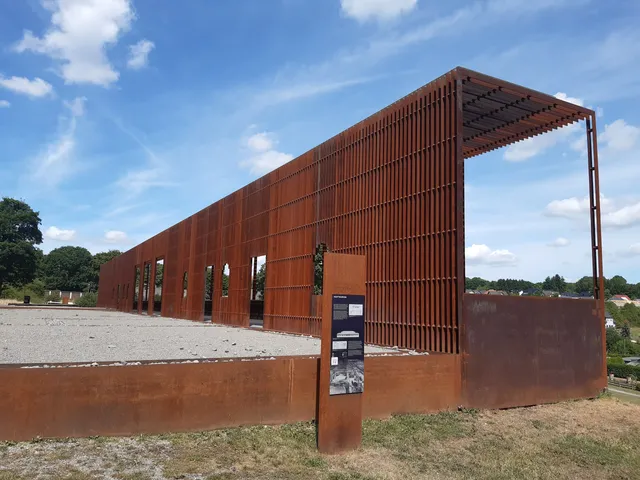
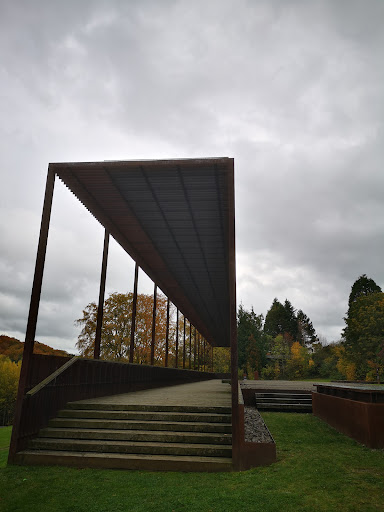
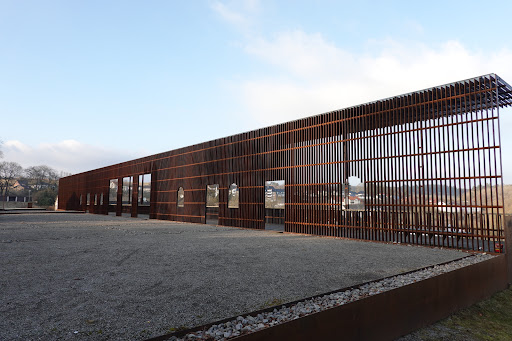
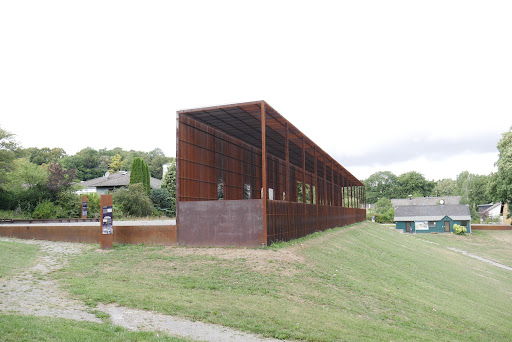
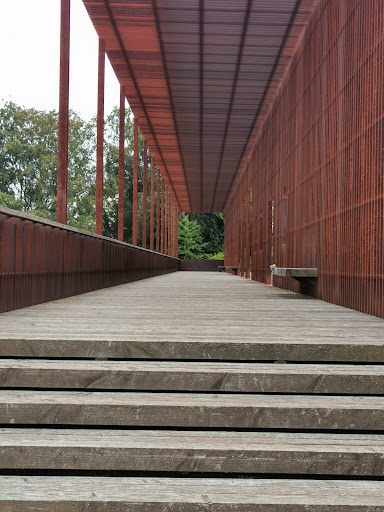
This Römervilla aka Villa Rustica in Blankenheim, is a site on the Ursprünge Blankenheim trail. Villa Rustica is a term used by the ancient Romans for countryside villa with an agricultural estate, which applies to the vast majority of Roman villas. Rustica is used to distinguish it from the rarer urban resort villa, built for leisure This villa rustica served both as the home of the landowner, his family and servants and also as a farm management centre. It includes separate buildings to accommodate farm labourers and sheds and barns for animals and crops. Archaeological excavation of the Roman villa Blankenheim, built in 1st century AD, have viewing floor plates of glass, showing the former bathing complex and the utility room. Well written steel information steles throughout the property explain the layout. The steel reconstruction of the 55mt continuous colonnade shows how impressive the villa was. This Roman villa is the only known example of an axial villa in Rhineland. A visit requires some vision and imagination. Highly...
Read moreThe Roman Villa in Blankenheim was one of the largest of its kind in the Rhineland: its porticus was almost 60 meters long (its shape was is reconstructed using metallic bars). The villa was built at the end of the 1st century AD and was occupied until the middle of the 4th century. The complex included baths, stables, barns, coach houses and servants' quarters, grouped around a spacious farm yard. The first excavations took place in 1894, then in 1914 and again in 1931. It is believed that the apparent wealth of the villa owner was also based on income from secondary income, such as the operation of quarries and the mining of ore deposits in the vicinity. The Roman villa in Blankenheim is the only known example of the axial villa in the Rhineland....
Read moreWir waren bei schlechtem Wetter in dieser ehemaligen Römervilla. Trotzdem denke ich dass man viel Phantasie braucht um sich annähernd vorzustellen wie es hier einmal ausgesehen hat. Kenntnisse vorrausgesetzt, über die ich durchaus verfüge, ist es nicht so spektakulär. Ein ehemaliger Landsirz eines reichen Römers, den er aufsuchte um das Landleben zu genießen. Sicherlich um das 1.Jh. nach Cristus ein ansehnliches Anwesen. Es wurden hier mehrmals Ausgrabungen vorgenommen, vobei die Letzte schon vor geraumer Zeit stattfand. Interessant, wenn die Scheiben nicht komplett beschlagen sind und die Sicht somit schlecht, die sehr gut erkennbare und erhaltene Hypokaustenheizung des Wohngebäudes. Die mit Material(?) bedeckten weiteren Ausrabungsfunde und mit rostig chicen( ??) Eingrenzungen geben zumindest einen Eindruck der Anlage im Grundriss und den Ausmassen. Völlig daneben ist dieser" Korridor " aus Metall. Vllt mal einen Blick nach Xanten werfen, dort ist das Ganze, auch für Laien, interessanter dargestellt. Der Eintritt ist kostenlos, man kann in der Nähe parken. Es werden auch Führungen angeboten, bitte vorher im Net darüber informieren. Alles auch gut mit Kindern zu machen, vllt etwas uninteressant für diese. Mit Rollstuhl...
Read more