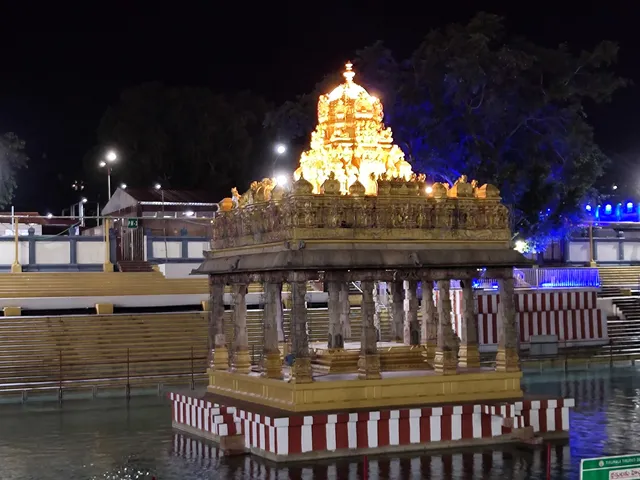
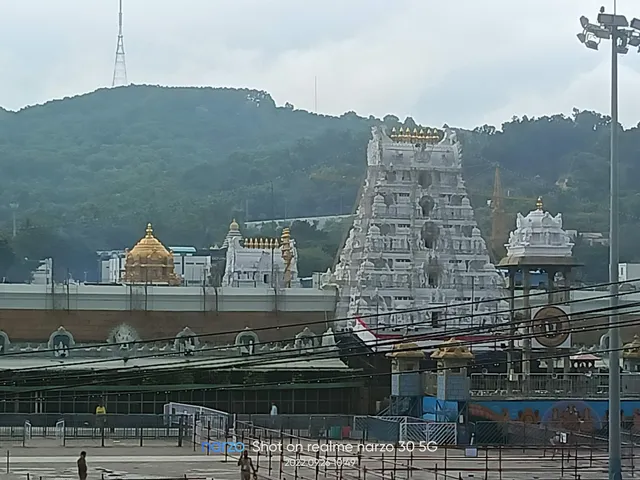
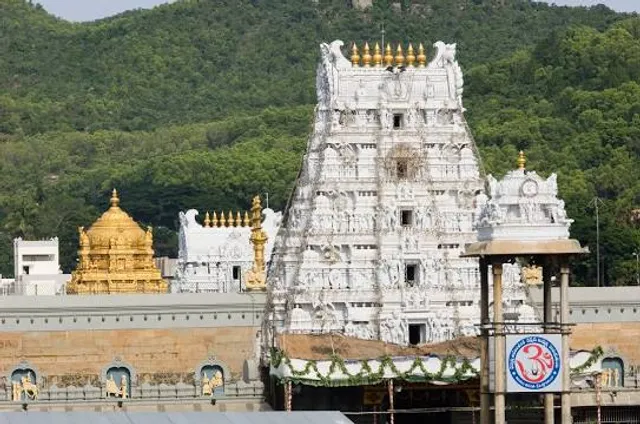
The Swami Pushkarani Harathi Puja is one of the sacred rituals performed at Tirumala every day preferably in the evenings.
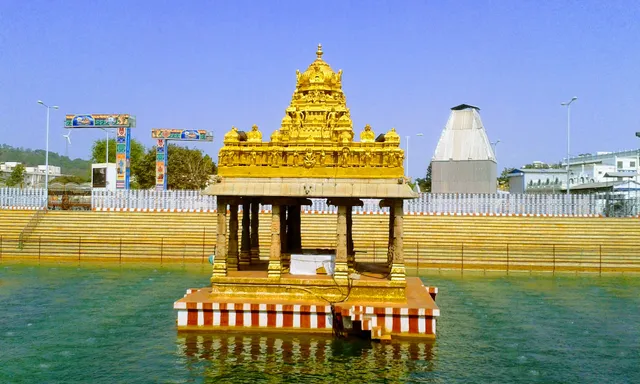
It is a ritual to pay respects to the natural spring fresh Water Lake located on the northern side of the Srivari temple.
The water of this lake is considered holy and sacred and fit for performing rituals at the Srivari Temple and on par with that of water of the holy river of Ganges. “Swami Pushkarini is significant component of the legend of Srivari temple at Tirumala and also resplendent of the hoary mythology “ says Agama advisor of TTD Sri Sundara Varada Bhattacharya.
He said the practice has been revived since two years and is a fitting tribute to the holy Gopuram amidst the lake which sanctified the waters.
Although the waters of such pushkarrini are meant for bathing purposes of the presiding deity of the Temple, more often the devotees who come across the country are also allowed to take a dip before they enter the temple at Tirumala.
The harathi or puja of the pushkarani has its roots in the inscriptions of 12th century and also that of Sri krishna Devaraya of Vijayanagara.
In the past the waters of the tank were strictly for temple purposes only-like for the God’s “bath” that is a ritual/worship, cleaning and washing the temples insides and outsides, for use inside the temples for drinking purposes kitchens (if any) and by large, by the folk that stay and live by the temple like the priests’ families and workers, for their daily uses.
The water in the Swami Pushkarini is absolutely NOT stagnant OR infected. It has a state-of-the-art recycling facility and water is treated before it gets into and recycled continuously. A bath in the Swami Pushkarini is believed to clean pilgrims of their sins and bestow temporal prosperity A bath in the holy tank purifies one’s body and soul.
The Agama Advisor said that Swami Pushkarini was a pleasure lake of Sri Maha Vishnu in Vaikuntham, and was brought and set on Earth by Garuda, for the uuse of Sri Venkateshwara and his pleasure float trips along with his consorts. The pushkarini also has another legend that kings who lost their kingdoms also regained their power after bathing in this lake. The childless Dasharatha Chakravarti also could beget Maha Vishnu (Rama) as his son after bathing in the Swami Pushkarini.
“It is only in recognition of its mythological significance and its inherent divinity that the pushkarini is worshipped with harathi every day in the evening “says Sri A V Ramana Dikshitulu, one of the three chief priests of the Srivari Temple.
On the last day of the annual brahmotsavams the utsava idols are also bathed in the Swami Pushkarini and taken into the main shrine. Countless devotees to join their beloved deity in bathing in the Pushkarini and share the joy and also its austerity.
The Pushkarini spread over one and half acres has a mandapam in the middle built by the Saluva King Narasimha Raya in 1468. Later the saint -poet Tallapaka Annamacharya was instrumental in constructing steps to the lake –mid–mandapam. New filters and state of the art drains were installed in the Pushkarini in 1972. Every year the existing water in the Pushkarini is drained at regular intervals and refilled with fresh water that emerged from its springs.
Besides the Chakrasnanam festival the other major ritual in the Swami Pushkarini is the five day long Teppotsawam performed in the month of February.“ It is in fitness of things that the Swami Pushkarini Harathi ritual is revived providing a glimpse about its hoary significance to the devotees and also other students of Agama culture and practices“, says Sri Sundara Varada...
Read moreSwami Pushkarini poond lies within the sacred premises of Main Temple.A place of utmost reverence and religious significance, it’s believed that Lord Venkateswara himself bathed in this pond along with his consorts. In fact, the lake is considered to be as holy as the mighty River Ganges.
It is very usual and highly probable to find a water tank either just beside or nearby every Hindu temple constructed during the ancient and medieval times. The waters of the tank were strictly for temple purposes only – like for the God’s “bath” that is a ritual and worship, cleaning and washing the temples insides and outsides, for use inside the temples for drinking purposes (Not in Tirumala, though), kitchens (if any) and by large, by the folk that stay and live by the temple like the priests’ families and workers, for their daily uses.
The water’s chief and famous uses are bathing and washing by the visiting pilgrims who take a dip or swim in it and, above all, for the temple’s special occasions when the divine images are taken in the temple boat, in the tank waters. The water in the Swami Pushkarini is absolutely NOT stagnant OR infected. It has a state-of-the-art recycling facility and water is treated before it gets into and recycled continuously.
A dip in this highly sacred tank adjacent to the temple is considered a custom before entering the temple. According to the legend, Swami Pushkarini was a pleasure tank of Sri Maha Vishnu in Vaikuntam, and was brought and set on Earth by Garuda, for the sport of Sri Venkateswara. It is adjacent to the Sri Venkateswara temple. A bath in the Swami Pushkarini is believed to clean pilgrims of their sins and bestow temporal prosperity. Pilgrims bath here before entering the main temple. A bath in the holy tank purifies one’s body and soul.
A bath in Swami Pushkarini is a merit bestowed on those who have done a lot of good in previous births. This provides salvation, moksha, to the devotee. The donation of Salagrama stone and a cow is recommended at this thirtha. At a distance of 1 Km from Tirumala Bus Station, Pushkarini is a huge lake adjacent to Sri Venkateswara temple. Some pilgrims bathe in Pushkarini before entering the main temple.
The Pushkarini was originally in Vaikuntam and belonged to Sri Maha Vishnu. It was set on Earth by Garuda for the sport of Sri Venkateswara. The mukkoti of Pushkarini (the merging of over three crore teerthams in Swami Pushkarini) occurs on Mukkoti Dwadasi (the twelfth day of the fortnight of Dhanur Masa). Therefore, it is believed that bathing in the Swami Pushkarini on this day, is equivalent to bathing in the holy river, Ganges.
On the western bank of the Swami Pushkarini is the Sri Varahaswami temple, while on its southern bank is the Sri Venkateswara temple. The wooden-float festival (Teppotsavam) of Lord Sri Venkateswara in the month of February/March and Avabhrudhasnanam or Chakrasnanam during Brahmotsavam takes place in...
Read moreHoly tank of srivaru near varaha swamy temple which absolves sins and grants moksha. There is a different benefit for dip in each of the 8 directions though the tank is same, the water in each direction has different powers but unfortunately its open for devotees towards only west side stretch. (I got all the info from watching Nanduri srinuvas tirupati videos. His videos helped us a lot during various temple visits. Cant be thankful enough for his invaluable knowledge and insights🙏.) Pushkarini waters have powers of viraja nadi which came down with swami varu and his parivara from vaikuntam when he descended to earth and settled on venkatachalam. So taking a dip here is equivalent to dip in vaikuntam viraja nadi itself. Centre mandapam built by saluva narasimha rayalu varu is Saraswathi theertham where the powers of saraswathi river are concentrated, gives knowledge, wisdom. Kubera theertham in north, gives wealth, financial stability, overcomes enemies and illfate. Galava theertham in north east, removes sorrows, gives happiness and prosperity. Galava maharshi thaposhakti concentrated here. Markandeya theertham in east, gives longlife. Markandeya maharshi penance powers are concentrated here. Agneya/Agni theertham in southeast, gives good health, gets rid of long term diseases. Has the concentrated powers of agnideva. Yama theertham in south, absolves one from going to hell after death if dip is done with dedication. Vasista theertham in south west, makes one loan/debt free. Vasista maharshi fused his powers here. Varuna theertham in west, cleanses of all sins, removes difficulties. Vayuvya theertham in northwest, takes us to moksha sthithi.
P.s:- Kindly be respectful of our heritage and culture, this is a holytank not a swimming pool or vacation spot. Donot take such places for granted. Maintain...
Read more