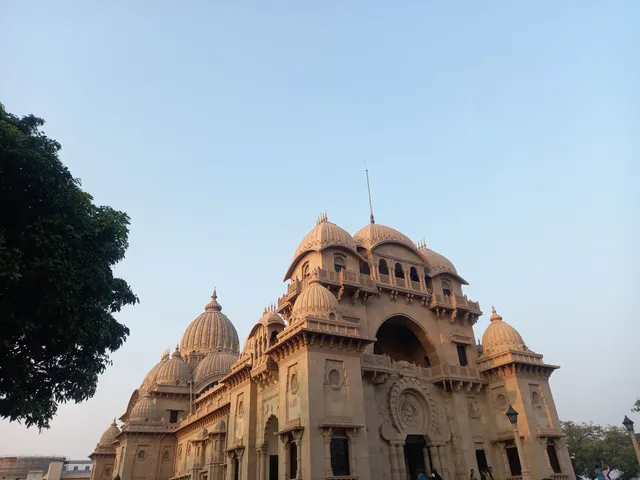
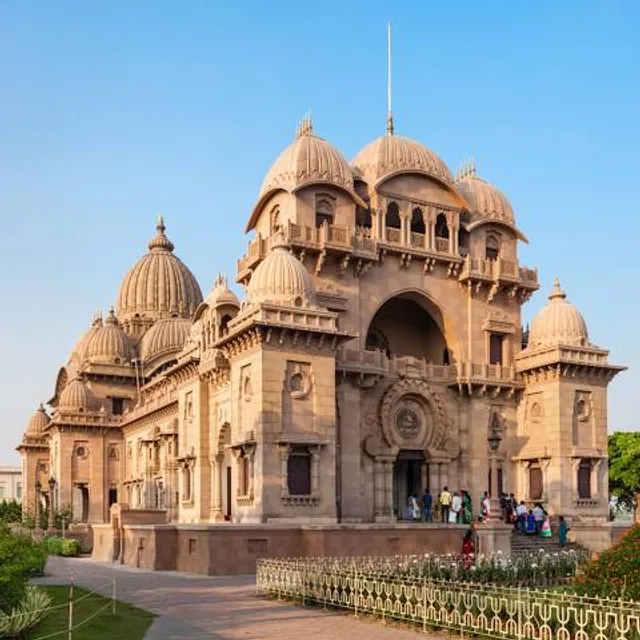
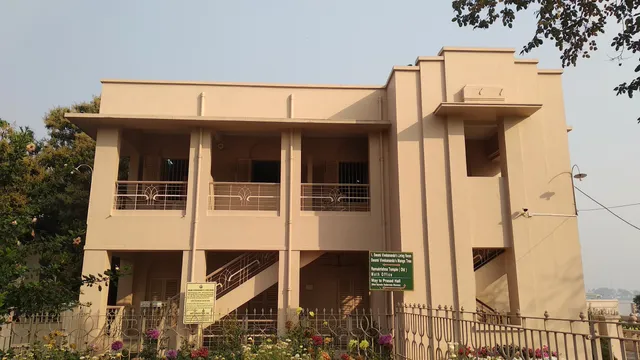
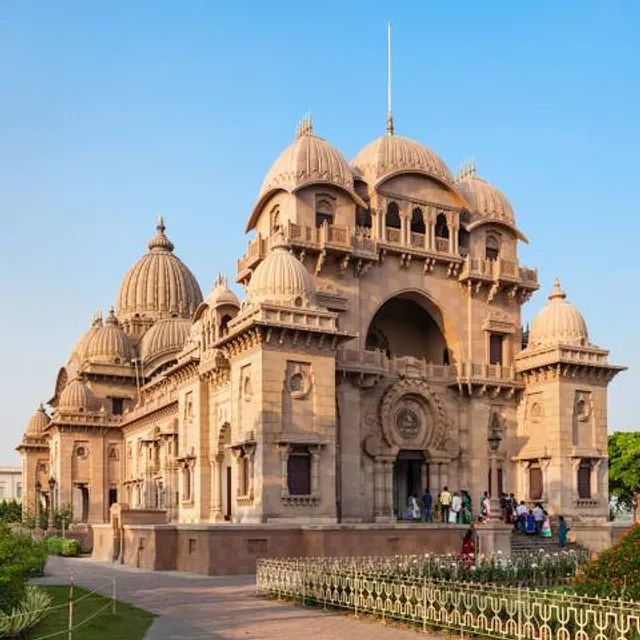
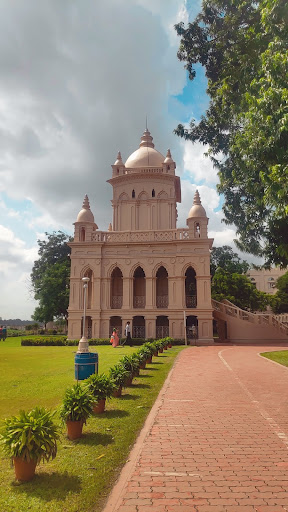
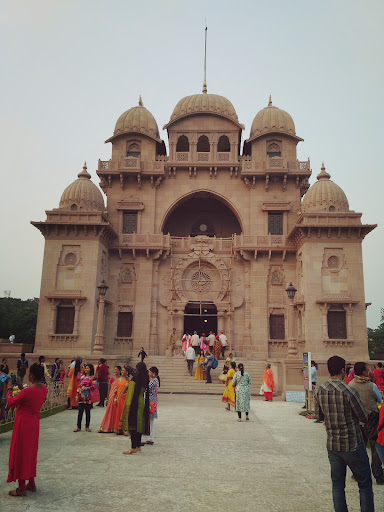
Swamiji’s temple is a two-storeyed structure: upstairs there is a shrine with a marble image of Om in Bengali and on the ground floor is Swamiji’s shrine with a marble relief of Swamiji. The shrine floor is below the ground level because that part of the land was very low when the temple was built.
This temple stands on the spot where Swamiji’s mortal remains were consigned to flames. The place was chosen by Swamiji himself. His Life records: ‘Three days before his passing away, as the Swami was walking up and down on the spacious lawn of the monastery in the afternoon with Swami Premananda, he pointed to a particular spot on the bank of the Ganga, and said to his brother-monk gravely, “When I give up the body, cremate it there!” (He passed away on 4 July 1902.) On that very spot stands today a temple in his honour.’
Strangely, the completion of Swamiji’s temple took a long time, almost twenty-one years, for want of funds despite earnest appeals sent not only within India but also abroad. The construction work could begin only in January 1907, almost five years after Swamiji’s passing away. But the progress was very slow. However, in January 1909, even when the temple construction remained incomplete, a large portrait of Swamiji was placed and beautifully decorated inside the temple on Swamiji’s birthday.
In January 1912, when it was found that the construction work had not progressed much, Swami Brahmananda wrote in Mahratta in an admonishing and painful tone: ‘Swamiji left his body ten years ago. It is needless to say that his death is a loss to the whole nation. People have expressed their grief and concern regarding that. But could we make a befitting memorial yet to this patriotic saint of modern India? This is a matter of shame and a standing testimony of the worthlessness of Indians.’ But his reprimand fell on deaf ears.
The marble relief of Swamiji installed inside the temple became possible by the efforts of Sister Nivedita, a disciple of Swamiji, and with financial contribution from Mrs Leggett, an associate of Swamiji. At first it was decided to install a smaller relief of Swamiji (than the present one). Mounting expenses did not permit anyone to conceive of a larger one. But when Mrs Leggett, the donor herself, suggested a larger marble relief, Nivedita’s joy knew no bounds. She wrote, ‘That size would be magnificent! It would make the Vivekananda temple look grander all the more and would remain an outstanding event for Ages to come!’
The marble relief was made in Jaipur. Sister Nivedita writes: ‘The sculptor had begun the work with a small puja and offering in front of the marble stone. Then he prayed intensely to Swamiji veiled in the stone: “Swamiji! Kindly manifest yourself in my hands!” He works right from 8.00 in the morning till 7.30 in the evening with a break only for his lunch. He sent me word if the work was not accomplished to the satisfaction of us, he would not accept a single rupee for the work; he would return all the money.’
Swami Vijnanananda looked after the temple construction. Before the commencement of the work, he was seen immersed in the thoughts of Swamiji. He used to talk of Swamiji constantly and meditate upon him. He was then living at the Ramakrishna Math at Allahabad. Often he visited the nearby Bharadwaj Ashram and saw the images of the Saptarshis (Seven Sages) and intently observed them, for Sri Ramakrishna had seen Swamiji as one among the seven sages of the Saptarshimandala (plane of Seven Sages). He even had an oil painting of the Saptarshi-mandala made for display in his room. He repeatedly said, ‘Swamiji is all-pervading in the universe. However, his abode is the Saptarshi-mandala.’
Sri Ramakrishna once referred to Swamiji as Shiva and himself as his Shakti. There are instances of some of his brother disciples having had the vision of Swamiji as Lord Shiva. We have seen the oval-crystal in Swamiji’s room, got made by Miss McLeod, in which Swamiji is conceived of as Lord Shiva. Symbolically, the apex of Swamiji’s temple is adorned with a nine foot...
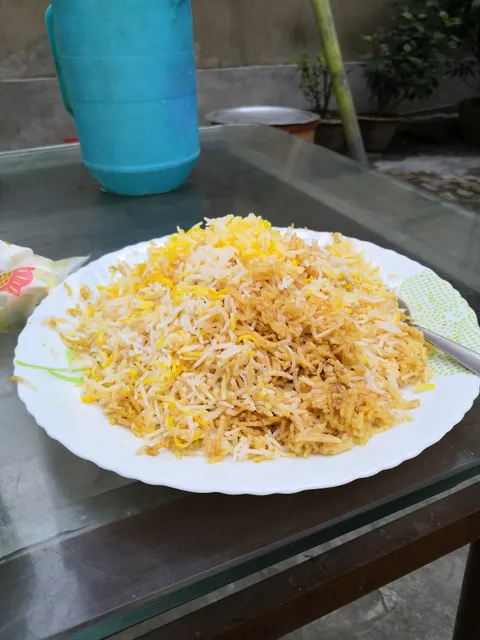
Read moreSwami Vivekananda temple means Belur math.It situated besides the Ganga river.Its a very beautiful place.If you want peace come here....The nature besides the temple is awesome.you can also see here the house and the use things of Swami Vivekananda.you can also see the tomb of Sri Sri Ramakrishna paramaonshadev.The temple basically a temple of Ramakrishna thakur.The trusty offer vage launch for all and you have to give some money to the trusty.There is no mendatory for amount of money.You can give what you want.you can visit the place with your family.In 12:30 pm the door of the temple is closed and opened in 3:30 pm.If you want to take launch basically grace of God ,you have to reach this place before 11 am.The place is located from 20 minutes away from Howrah.From dakhineshwar temple by vessel you can also visit the place.The journey of vessel is awesome.In the temple area a book store with library is opened by the trusty.you can read books of Swami Vivekananda and other s and also you can bye the books.Here you also get portrait of Swamiji.All over the historical place is awesome.I just love...
Read moreSwamiji’s temple is a two-storeyed structure: upstairs there is a shrine with a marble image of Om in Bengali and on the ground floor is Swamiji’s shrine with a marble relief of Swamiji. The shrine floor is below the ground level because that part of the land was very low when the temple was built.
This temple stands on the spot where Swamiji’s mortal remains were consigned to flames. The place was chosen by Swamiji himself. His Life records: ‘Three days before his passing away, as the Swami was walking up and down on the spacious lawn of the monastery in the afternoon with Swami Premananda, he pointed to a particular spot on the bank of the Ganga, and said to his brother-monk gravely, “When I give up the body, cremate it there!” (He passed away on 4 July 1902.) On that very spot stands today a temple in...
Read more