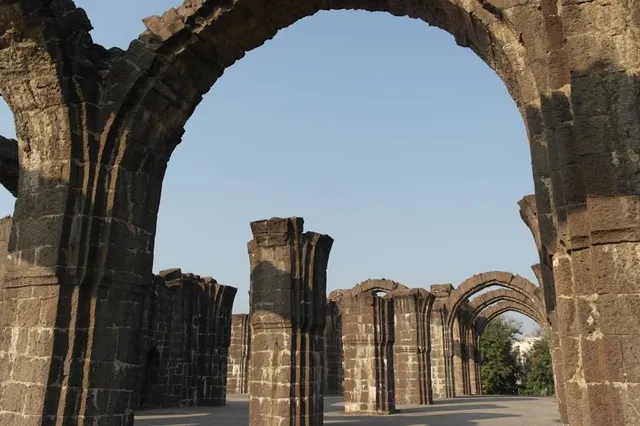
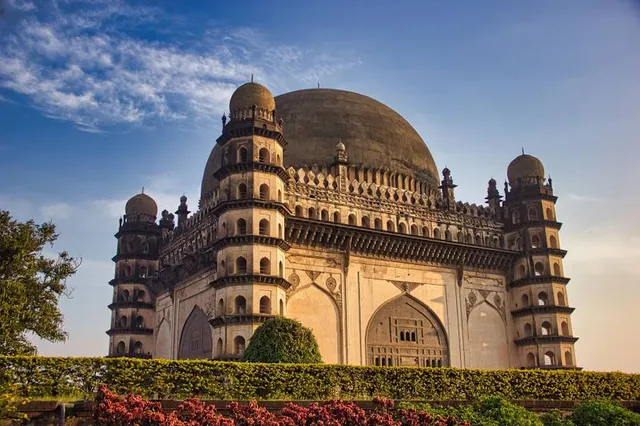
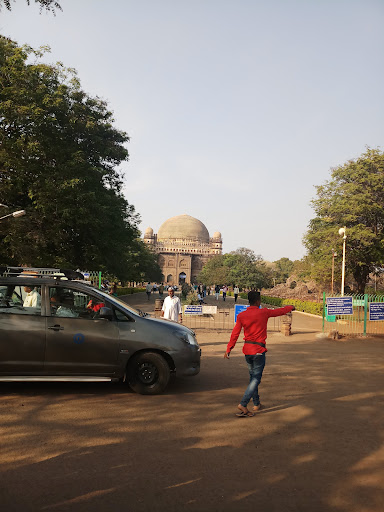
"Truely the AGRA of South India..." A Great Historical place to relive the days of architectural marvels... Bijapur (Vijaypura - The new Name...) is probably the most underrated Historical places in India... If we merely go by the numbers... There are about more than 350 historical monuments with each depicting it's uniqueness that can literally dazzle your imagination perspective to a new level... If we just take the example of Gol Gumbaz - WHICH IS "THE SECOND LARGEST DOME IN THE WORLD" and "THE LARGEST DOME IN INDIA" and yes "IT IS ALMOST 1.5 TIMES TO TWICE THE SIZE OF TAJ MAHAL" for those who don't know yet... If it was not conveniently neglected in the post independence era due to its relative lack of water supplies or the fact that it was relatively far off from the Capital city - Bengaluru then probably the designation aptly given to it during the Mughal Empire's reign - that is "THE AGRA OF SOUTH INDIA" could have been retained to represent it better, not only from the National perspective but also to Honour it's true place in the World scene perse... I hope to see this happen pretty soon... It is indeed our honour (As a resident of this City...) to welcome the International guests... Who till today have been coming here only because of their inquisitive nature about the Historical Brilliance associated with "INDIA" and their extensive research on Internet... I really appreciate their creative and inquisitive mindset... To connect everyone to this "Architectural Marvel" one can just imagine "HOW could they build such a perfect Dome - The Gol Gumbaz; which is so magnanimous in size with absolutely no central beam; pillar or structure whatsoever to hold its strength except for the walls...???!!!"... You can literally be amazed by every piece of "Art Work" that you witness in this "Land of Historical Brilliance and Architectural Excellence"... Welcome everyone... And traditionally...
Read morenice for to very Yusuf Adil Shah, son of Murad II, the Sultan of Turkey had joined the Bidar court of the sultanate in 1481 under the then Sultan Mohammed III. He had been purchased as slave by Mahmud Gavan, the Prime Minister of the Kingdom. He was later, in 1481, appointed as the Governor of Bijapur for his loyalty and bravery shown in the active defense of the sultanate. The fort and the citadel or Arkilla and the Faroukh Mahal were built by him with the skilled architects and artisans whom he had inducted into his employment from Persia, Turkey and Rome. Yusuf declared himself independent of Sultan’s rule and thus established the Adil Shahi dynasty or the Bahmani kingdom, in 1489 (in 1482, the Bahmini empire broke into five kingdoms and Bijapur sultanate was one of them).135]
Ibrahim Adil Shah, son of Yusuf Adil Shah by his Hindu wife Punji (daughter of a Maratha warrior), succeeded his father who died in 1510. Since he was a minor at the time of his father's death, there was an attempt to grab the throne, which was effectively thwarted by the timely intervention of his valiant mother fighting for her son's cause in a male attire. He then became the ruler of Bijapur Sultanate. He was instrumental in making further additions to the fort and also building the Jami Masjid within the fort.[3[5]
Ibrahim Adil Shah’s successor Ali Adil Shah I forged an alliance with other Muslim rulers of the Deccan (other Shahi kingdoms of (Ahmednagar and Bidar). Ali built several structures in the fort and the city suburbs, such as the Gagan Mahal, Ali Rauza (his own tomb), Chand Bawdi (a large well) and the...
Read moreThe Bijapur Fort (Vijapur kote) is located in the Bijapur city in Bijapur District of the Indian state of Karnataka. Bijapur fort has a plethora of historical monuments of architectural importance built during the rule of Adil Shahi dynasty.The rich history of the fort, the citadel and other structures is subsumed in the history of Bijapur city, which was established in the 10th–11th centuries by the Kalyani Chalukyas. It was then known as Vijayapura (city of victory). The city came under the influence of the Khalji Sultanate in Delhi by the late 13th century. In 1347, the area was conquered by the Bahmani Sultanate of Gulbarga. By this time, the city was being referred as Vijapur or Bijapur.The fort precinct is studded with the historical fort, palaces, mosques, tombs and gardens built by the Adil Shahis with their deep interest in architecture (in Persian, Ottoman Turkish and the allied arts. Some ruins of ancient temples, predating the Adilshahi period, are also seen. The most striking structures, in the order of their importance, are the Citadel or Arkilla, the Jamia Masjid (or Jumma masjid), the Gagan Mahal palace, the tomb of Ali Rauza or Ibrahim Roza (tomb of Ibrahim Adil Shah I), Chand Bawdi or Taj Bavdi (a large well), Mahatar Mahal (Dilkusha Mahal), Malikah-e-Jahan Mosque, Jal Mahal, and also an innocuous well in the vicinity of the fort with a legend of a tragedy linked to a brave but jealous general of the dynasty. It is said that the Adilshahis, during their reign of 200 years, built over 50 mosques, 20 tombs and 20 palaces. Bijapur has, therefore, been called...
Read more