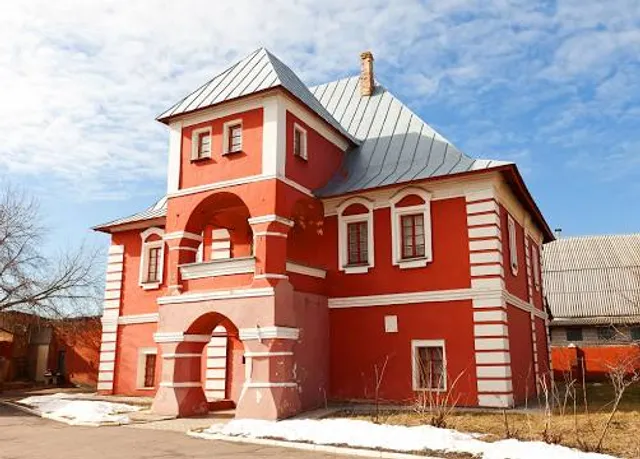
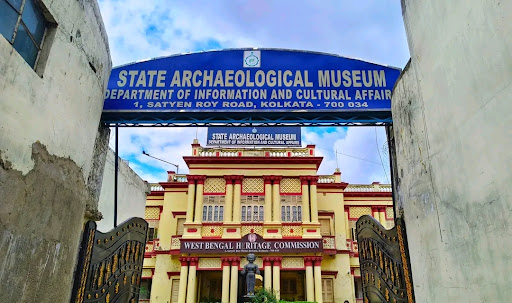
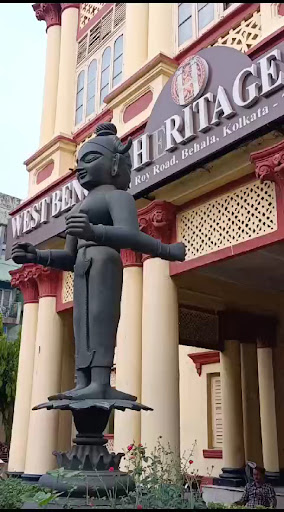
The State Archaeological Museum, West Bengal was initially inaugurated by the honourable Chief Minister Sri Jyoti Basu in 1980 in an important palatial building at l Satyen Roy Road, Behala in the southern suburbs of the city of Kolkata. The Museum grew out of the collection mainly made by the officials of the directorate in course of excavations and explorations, though some of the materials were collected through purchase and as gift.
Gradually, as the collection grew over the years the old building of the Museum was felt inadequate for a modern and scientific display of its holding. Accordingly, a new four—storied building was planned to be constructed in the premises of the old building. The first two floors of this new annexe building with five modern display galleries were completed and inaugurated on 3 August 2006 by the Governor of West Bengal in a ceremony presided over by the Chief Minister of West Bengal.
The new building of the Museum where the exhibits for public viewing are shifted have five galleries, Gallery One: Sites and Sights. Gallery Two: Paintings of Bengal. Gallery Three: Sculptures of Bengal. Gallery Four: Nandadirghi Vihara: Jagjivanpur Gallery Five: West Bengal: Early Historic Period. Gallery Six : Showcasing metal sculptures. It is now ready for public viewing.
Apart from these galleries, three more new galleries will be laid in the second floor of the building within the end of the coming year. The proposed galleries are: l. Prehistory and Protohistory, Ethnic Art, Numismatics: Coinage in Bengal.
Moreover, a new small gallery will be opened as a temporary exhibition in first floor where excavated artifacts, recovered through the recent excavation (2007—2008) at Hatpara in Murshidabad will be displayed.
The Museum gives us a glimpse into the cultural milieu of Bengal and the evolution of Bengat’s culture from pre—protohistoric through historic periods upto the colonial time. The Museum has a rich collection of antiquities like stone artifacts appertaining to all stages of development of Stone Age in Bengal discovered from sites like Susunia and Kankradara (Bankura District). Gopiballabpur and its neighbourhood in the Suvarnarekha valley (West Midnapore District), Palaeolithic and Neolithic artifacts from different sites in the districts of Purulia, Bankura, Birbhum and Burdwan. Neolithic artifacts from Kalimpong region in Darjeeling district and Bagridihi in West Midnapore district; shouldered celts, enigmatic rings of copper and other copper artifacts associated with Copper Hoard Culture from different sites lying in the districts of West Midnapore, Bankura and Purulia. Chalcolithic artifacts and antiquities collected by exploration from different sites in the district of Burdwan, Birbhum and Bankura and by excavation at Pandu Rajar Dhibi (1962-65, 1985) and Baneswardanga (1974) (both in Burdwan district); archaic (pre—Mauryan) terracottas envisaging Mother Goddess from Farakka in Murshidabad district, early historic terracOttas from different sites in the lower Gangetic Valley (especially from Chandraketugarh in the North 24 Parganas district); late Gupta stucco head of female deity from Karnasuyarna (Murshidabad district) and othe comparable terracottas from Panna in the Midnapore district; silver punch—marked coins from Chandraketugarh and Lohapur (Birbhum district); Gupta gold coins mostly from the...
Read moreKolkata’s West Bengal State Archeological Museum is located in Behala - even my colleagues, residents of Behala from ages, are not aware of existence of this museum.
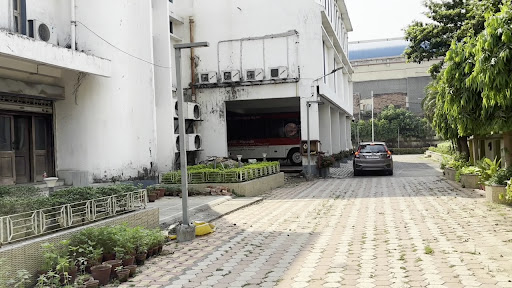
We visited on a Saturday early afternoon; it took us about almost 2 hours. The front entrance right next to the metro station is closed in Apr ‘25. So we had to use the side entrance. There’s ample parking space inside. And there were zero other visitors while we were there. I just hope that Govt. of West Bengal promote this gem of a museum more objectively and visibly to attract visitors to Kolkata.
The old building has now been transformed to an administrative office. The new building houses all the galleries now. One needs to buy tickets (20 per head?) At the lobby and proceed to the couple of galleries downstairs. And then there are 4-5 galleries at the first floor.
I liked and spend most time in the sculpture gallery and then the painting gallery.
The museum shop at the lobby is dated and does not seem to have any clue what exactly would they be looking for in such a museum shop. The books and literature are dated and are needed critical review...
Read moreState Archaeological Museum, West Bengal in Kolkata, West Bengal, is an archeological museum founded in 1962 and has collections including rare tools of the Early, Middle and the Late Stone Ages from Susunia (Bankura) and other sites, proto-historic antiquities from Pandu Rajar Dhibi (Burdwan), terracottas, sculptures, stone and stucco from the Gupta, Maurya, Shunga, Kushana, Pala and Medieval times. It is located at the vicinity of Behala Bazar Metro on Diamond Harbour Road and Nafar Chandra Das Road at Behala behind Siddeshwari Kali TempleThere is also a section on ‘Historical Art’ opened in 1963 which displays large number of old terracottas, bronzes, wood-carvings, textiles and manuscripts. Sells several card-sets and other publications; activities include explorations and excavations of historical sites. The present palatial building was donated by the family of Satyendranath Roy, second son of Rai Bahadur Ambika Charan Roy 1827-1902, especially at the initiative of Rabindranath Roy in the early 1970s. The museum charges Rs.20 per person as the entry fee. It remains open from Wednesday to Sunday from...
Read more