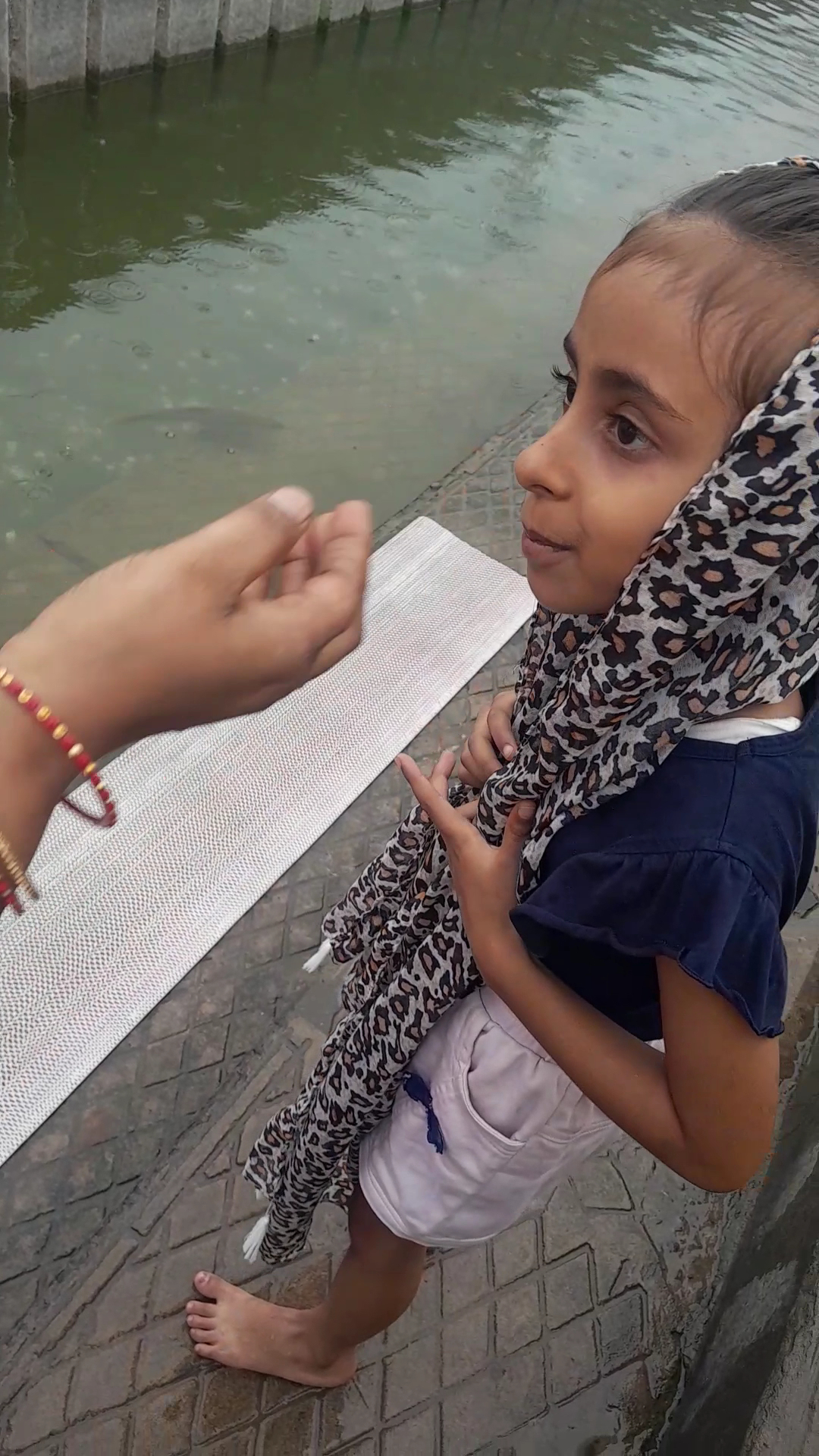
Gurdwara Shri Dukh Niwaran Sahib Patiala the holy shrine of Sikhism and is situated at Sirhind Road Patiala (earlier Lehal Village) which is in close proximity of Patiala Bus Stand and Patiala Railway Station. As per and old handwritten document which is still present in the Gurdwara, a villager named Bhag Ram of Lehal went to the neighboring town of Saifabad (currently Bahadurgarh) and requested Shri Guru Sri Tegh Bahadur Ji to visit Lehal village and bless that area which was captivated by a deadly and mysterious disease. After hearing this, Shri Guru Sri Tegh Bahadur Ji went to Lehal village on Magh Sudi 5, 1728 Bikram i.e. 24th January 1672. Guru ji spent some time alongside the village pond by preaching and meditating under a Banyan tree. Shortly thereafter the village got rid of that deadly disease. Dukniwaran Sahib was the name given to the place where Guru Ji sat which literally means the ‘eradicator of suffering’. The pond became famous for its curing virtues.
This Sikh shrine is located in the small village of Lehal which is now a part of Patiala city. A local tradition says that one Bhag Ram, a villager of the jhivar caste from Lehal village, went to the nearby town of Saifabad (now Bahadurgarh) to meet the visiting Sikh Guru Teg Bahadur. He pleaded with the Guru to visit and bless Lehal village so that its inhabitants could get rid of a mysterious sickness which had been plaguing the village for a long time. Shortly thereafter, the Guru visited the village and often sat meditating and preaching under a banyan tree by the side of the village pond. The village was soon rid
of the sickness. The place where the Guru sat came to be known as Dukh Nivaran, meaning the eradicator of suffering. Devotees visiting the shrine have great faith in the healing qualities of the water in the sacred tank (sarovar) by the gurdwara.
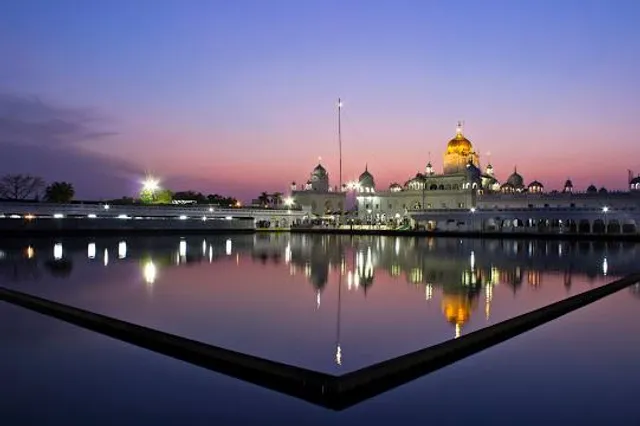
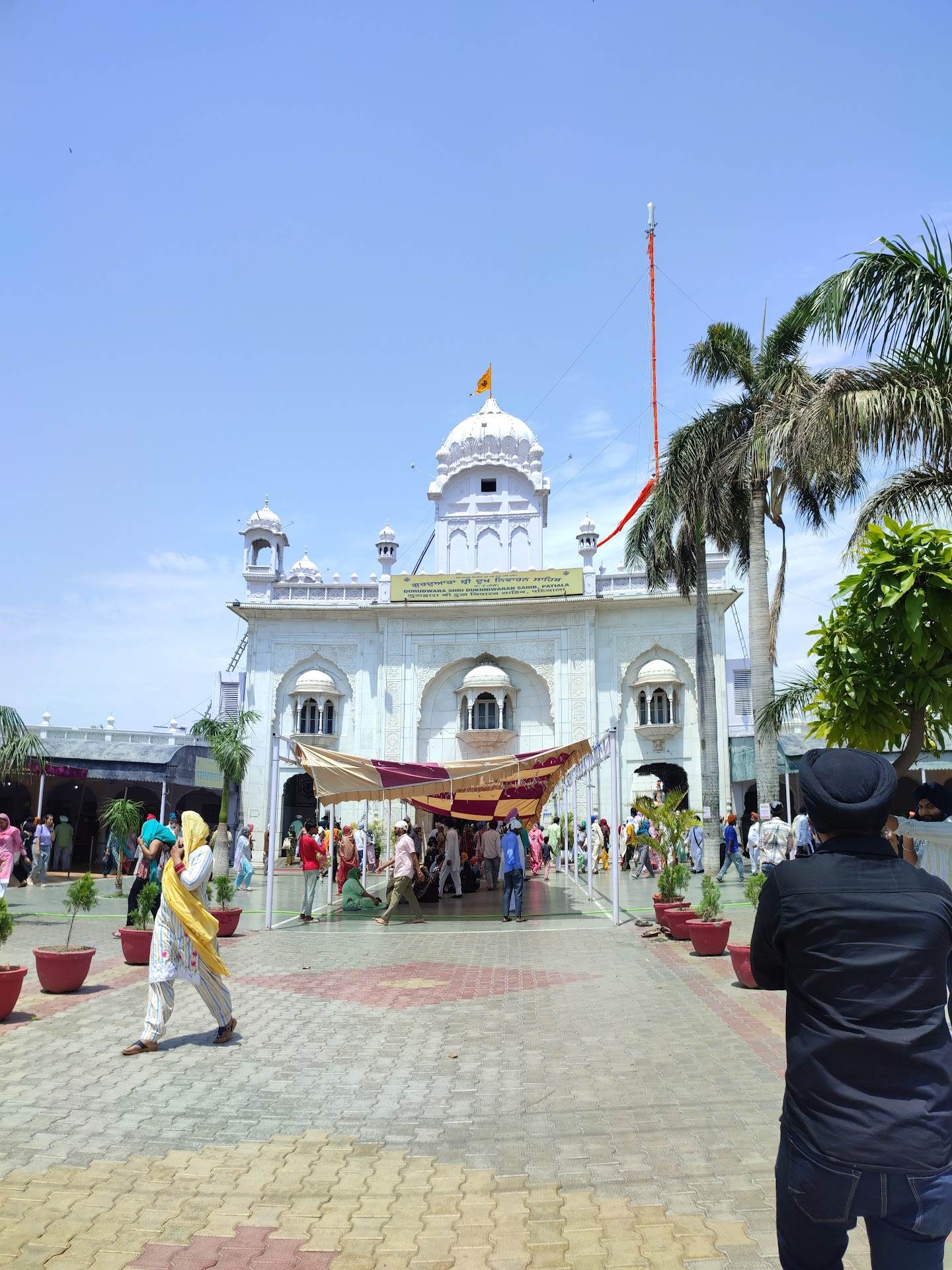
Apart from the shrine and the sacred tank, there is huge building complex spread over several acres. It now also has a big multistoried rest house where devotees can stay overnight for a few days. The shrine now has a two-storey gateway with beautiful mirror work on its inner walls and a black and white marble floor. On the left of the pathway leading to the main building of the shrine is a small ornate glass case marking the site where Guru Tegh Bahadur once sat under the banyan tree. The central two-storey building has a domed pavilion on its top, and is built on a raised base with a domed chamber at each of its four corners. The lotus dome on the top is pinnacled and has a round sun window on each side. There are domed pavilions at the corners. The floor in interior of the hall is paved with marble slabs in grey and white. The ceiling has stucco work in floral design while the walls are covered with white marble. The sacred book of the Sikhs, the Guru Granth Sahib is placed under a richly decorated cloth canopy at the end of the main hall. To the right is the sacred tank for the pilgrims to bathe in. Just before sunset, the main building of the shrine with its gold-plated domes and the water of the sacred tank reflecting the changing colours of the evening sky in the backdrop, present an unforgettable sight. Devotees can be seen sitting here for hours listening to the soft sounds of ‘kirtan’ (hymns) being played on the loudspeakers.
On the left of the shrine is a massive hall called the Guru ka Langar (the Guru’s community kitchen), where visitors of all castes and religions can enjoy free meals several times a day. The shrine now has underground as well as overground parking lots for the vehicles of the visitors which can even accommodate buses and trucks. On the fifth day of the light half of each lunar month, a large number of devotees throng the shrine to pay obeisance and have a dip in the sacred tank for the festival of Basant Panchami which is held every year to mark the visit of Guru Tegh Bahadur Ji.
The shrine is being administered by the Shiromani Gurdwara Parbandhak Committee, a mini-parliament of the Sikhs based in...
Read moreGurdwara Dukh Nivaran Sahib is situated in what used to be the village of Lehal, now part of Patiala city.
According to local tradition, supported by an old handwritten document preserved in the Gurudwara, one Bhag Ram, a jhivar of Lehal, waited upon ninth guru of Sikhs Guru Tegh Bahadur during his sojourn at Saifabad (now Bahadurgarh), and made the request that he might be pleased to visit and bless his village so that its inhabitants could be rid of a serious and mysterious sickness which had been their bane for a long time.
The Guru visited Lehal on Magh sudi 5, 1728 Bikram/24 January 1672 and stayed under a banyan tree by the side of a pond.[1] The sickness in the village subsided. The site where Guru Tegh Bahadur had sat came to be known as Dukh Nivaran, literally meaning eradicator of suffering. Devotees have faith in the healing qualities of water in the sarovar attached to the shrine.
Raja Amar Singh of Patiala (1748–82) had a garden laid out on the site as a memorial which he entrusted to Nihang Sikhs. Records of a court case in 1870 mention a Guru's garden and a Nihangs' well being in existence here. In 1920, during a survey for the proposed construction of Sirhind-Patiala-Jakhal railway line, it appeared that the banyan tree under which had sat Guru Tegh Bahadur would have to be removed. But men charged with felling it refused to touch it.
Ultimately, Maharaja Bhupinder Singh ordered cancellation of the entire project. No gurudwara building had, however, been raised. It was only in 1930 that a committee was formed to collect funds and commence construction and was completed twelve years later in the year 1942. Maharaja Yadavindra Singh who was a devout Sikh built the present building and sarovar.[2] The Gurdwara when completed passed under the administrative control of the Patiala state government. It was later transferred to the Dharam Arth Board of the Patiala and East Punjab States Union and eventually to the Shiromani Gurudwara Prabandhak Committee.
The building complex sprawls over several acres. The two storey gateway has a collapsible iron gate and black and white marble floor. On the left of the pathway leading to the principal building is a small marble shrine marking the site where Guru Teg Bahadur had sat under the banyan tree. The central two storey building, with a domed pavilion on top, is on a raised base having an octagonal domed chamber at each corner. The pinnacled lotus dome on top has a round sun-window on each side with a curved coping, projected horizontally at the ends. There are decorative domed pavilions at the corners and lotus blossoms in leaf in the middle on top of the walls.
The interior is paved with marble slabs in white and grey against black and white of the outer platform. The walls and pillars are also panelled with white marble slabs. The ceiling is decorated with stucco work in floral design. The Guru Granth Sahib is seated under a square canopy at the far end. The 75metre square sarovar, since considerably extended, is on the right and Guru ka Langar on the left as one enters. The Gurdwara is administered by the Shiromani Gurdwara Parbandhak Committee. A big gathering is held on the fifth day of the light half of each lunar month. The festival of the year is Basant Panchmi which marks the day of Guru Tegh...
Read moreTitle: A Tranquil Haven of Spiritual Serenity: Gurudwara Dukh Niwaran Sahib
Review:
Gurudwara Dukh Niwaran Sahib stands as a testament to the profound spiritual heritage of the Sikh religion. From the moment you step foot into its sacred premises, you are enveloped in an atmosphere of tranquility and purity that leaves an indelible mark on your soul.
Located in the holy city of Patiala, Punjab, Gurudwara Dukh Niwaran Sahib holds immense religious significance for Sikhs around the world. It is believed to possess the power to alleviate the suffering of those who visit with a sincere heart and devote themselves to prayer and contemplation.
The first thing that strikes you upon entering the gurudwara is its awe-inspiring architecture. The magnificent white marble structure adorned with intricate glasswork and frescoes creates a sense of ethereal beauty. As you make your way through the entrance gate, the serenity of the place engulfs you, transporting you to a realm of peace and devotion.
Inside, you are greeted by the melodious strains of Gurbani (Sikh devotional hymns) resonating through the air. The melodic chants, accompanied by the soothing sound of the harmonium and tabla, evoke a sense of spiritual transcendence and fill your heart with devotion. The rhythmic recitation of the Guru Granth Sahib, the holy scripture of Sikhism, further enhances the atmosphere of reverence and sanctity.
One of the most cherished aspects of the Gurudwara Dukh Niwaran Sahib experience is the langar, a community kitchen where free meals are served to all visitors, regardless of their caste, creed, or social status. The langar epitomizes the core Sikh value of selfless service and equality. Sitting alongside fellow devotees and partaking in the simple yet delicious vegetarian meal creates a sense of unity and brotherhood that is truly humbling.
The gurudwara's serene Sarovar (holy pool) serves as a focal point for reflection and purification. Devotees partake in the sacred ritual of Karah Parshad, a sweet offering distributed to all as a blessing. Walking around the Sarovar, absorbing its tranquil ambiance and witnessing the devotion of pilgrims taking a dip in its holy waters, one cannot help but feel a deep connection to the divine.
The spiritual experience at Gurudwara Dukh Niwaran Sahib is not limited to Sikhs alone; people from all walks of life are welcomed with open arms. Whether seeking solace, spiritual guidance, or simply a respite from the chaos of the outside world, this gurudwara offers a sanctuary where one can find inner peace and rejuvenation.
In conclusion, a visit to Gurudwara Dukh Niwaran Sahib is an enriching and purifying experience that leaves an everlasting impression on your spirit. Its serene ambiance, soul-stirring devotional music, selfless service through langar, and the profound religious respect it holds in the Sikh faith make it a must-visit destination for anyone seeking solace and spiritual...
Read more