The history of Dindigul is centered on the fort over the small rock hill and fort. Dindigul region was the border of the three prominent kingdoms of South India, the Cheras, Cholas and Pandyas. During the first century A.D., the Chola king Karikal Cholan captured the Pandya kingdom and Dindigul came under the Chola rule. During the sixth century, the Pallavas took over most provinces of Southern India and Dindigul was under the rule of Pallavas until Cholas regained the state in the 9th century and the Pandyas regained control by the 13th century.
In the 14th century, half of Tamil Nadu kingdoms were under the short-reigned Delhi Sultanites with Madurai Sultanate ruling this region between 1335–1378. By end of 1378, the Muslim rulers were defeated by Vijayanagara army and later established their rule.
Madurai Nayaks Edit
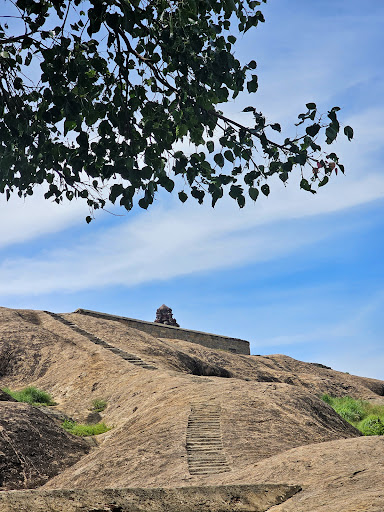
Temple atop the fort In 1559 Madurai Nayaks, till then part of Vijayanagara empire became powerful and with Dindigul became a strategic gateway to their kingdom from North . After the death of King Viswanatha Nayak in 1563, Muthukrisna Nayakka became the king of kingdom in 1602 A.D who built the strong hill fort in 1605 A.D. He also built a fort at the bottom of the hill. Muthuveerappa Nayak and Thirumalai Nayak followed Muthukrishna Nayak. Dindigul came to prominence once again during Nayaks rule of Madurai under Thirumalai Nayak. After his immediate unsuccessful successors, Rani Mangammal became the ruler of the region who ruled efficiently.1]
Under Mysore Rayas and Hyder Ali Edit In 1742, the Mysore army under the leadership of Venkata Raya conquered Dindigul. He governed Dindigul as a representative of Maharaja of Mysore. There were Eighteen Palayams (a small region consists of few villages) during his reign and all these palayams were under Dindigul Semai with Dindiguls capital. These palayams wanted to be independent and refused to pay taxes to venkatarayer.[1 In 1748, Venkatappa was made governor of the region in place of Venkatarayer, who also failed. In 1755, Mysore Maharaja sent Haider Ali to Dindigul to handle the situation. Later Haider Ali became the de facto ruler of Mysore and in 1777, he appointed Purshana Mirsaheb as governor of Dindigul. He strengthened the fort. His wife Ameer-um-Nisha-Begam died during her delivery and her tomb is now called Begambur. In 1783 British army, led by captain long invaded Dindigul. In 1784, after an agreement between the Mysore province and British army, Dindigul was restored by Mysore province. In 1788, Tipu Sultan, the Son of Haider Ali, was crowned as King of Dindigul.14
Under British Edit In 1790, James Stewart of the British army gained control over Dindigul by invading it in the second war of Mysore. In a pact made in 1792, Tipu ceded Dindigul along with the fort to the English. Dindigul is the first region to come under English rule in the Madurai District. In 1798, the British army strengthened the hill fort with cannons and built sentinel rooms in every corner. The British army, under statten stayed at Dindigul fort from 1798 to 1859. After that Madurai was made headquarters of the British army and Dindigul was attached to it as a taluk. Dindigul was under the rule of the British Until India got our Independence on 15 August 1947.1
The fort played a major role during the Polygar wars, between the Palayakarars, Tipu Sultan duo aided by the French against the British, during the last decades of the 18th century. The polygar of Virupachi, Gopal Nayak commanded the Dindugal division of Polygars, and during the wars aided the Sivaganga queen Queen Velu Nachiyar and her commanders Maruthu Pandiyar Brothers to stay the fort after permission from...
Read moreThe Dindigul Fort or Dindigul Malai Kottai is a 17th-century hill fort, built by Madurai Nayak situated in the town of Dindigul in the state of Tamilnadu in India. The fort was built by the Madurai Nayak king Muthu Krishnappa Nayak in 1605. In the 18th century the fort passed on to Kingdom of Mysore (Mysore Wodeyar). During the reign of Hyder Ali and Tipu Sultan the fort was of strategic importance. In 1799 it went to the control of the British East India Company during the Polygar Wars.
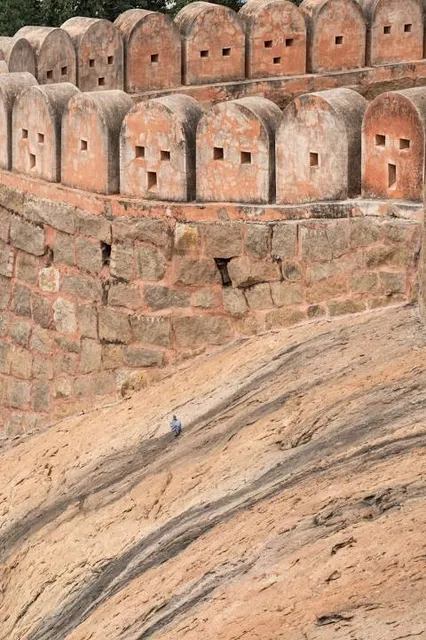
There is an abandoned temple on its peak apart from few cannons sealed with balls inside. In modern times, the fort is maintained by the Archaeological Survey of India and is open to tourists. Dindigul Fort with its indomitable presence on an isolated rock looms high over Dindigul at a height of 380 meters. The rock spreads out, looking like a pillow and is called ‘Dindu Kal’ which means pillow rock, and it is from here that Dindigul gets its name. Dindigul Fort perched atop this craggy, windswept hill looks like a crown adorning it. The fort which was built in the 17th century has a forbidding magnificence to it. The walls of the fort are made of brick and stone that crest the pinnacle of the whole rock barring the southern flank, which is so steep that it’s almost perpendicular making artificial fortification redundant.
Dindigul Fort is managed by the Archaeological Survey of India and is definitely a must visit destination if you are in the region. From the top you can enjoy some stunning views. The cannons, which are there at vantage points, can fire your imagination taking you back to a bygone era where you can picture fierce battles in your mind! The edifice underscores the resourcefulness of Indian kings in their military architecture.
Dindigul located about 400 km from Chennai, is a strategic place located overlooking the valley through which the forces from Karnataka country gained access into the Madurai in late medieval period. The Nayakas of Madurai possibly erected the first fortification on the rock, a prominent elevated place overlooking the valley, in order to defend their country from the invading Mysore army. However, Haider Ali seems to have rebuilt the fort substantially as he used this as a launching pad to attack the British in this region during the Carnatic wars.
The British finally captured the fort in 1790 and garrisoned it till 1860. The irregular curtain wall of the fort is well built of dressed and finely jointed stone blocks with brick crenulations. There are number of cells in the rampart for the use of troops. There are number of brick structures on the top, possibly built during the British period. There is a circular freestanding bastion on the top at a strategic location on which several cannons were mounted. There is one canon of English origin now preserved over the bastion.
Vijayanagara rulers as indicated by the inscription built the temples on the summit. Among them, the central shrine is noteworthy for the delicately carved architectural members and the moulded brick elements of the superstructure. The style of carving recalls the influence of dying delicate artistic traditions on soapstone of Karnataka. One of the inscriptions on a shrine records a donation by the Vijayanagara king Krishnadevaraya to the Tambiranar (the presiding deity)...
Read moreVisited: 02 October 2025 Location: Dindigul, Tamil Nadu Ticket: ₹20 for adults, free for kids below 10 Timing: 9 AM – 5 PM (last entry around 4 PM)
📜 Historical Charm: Dindigul Rock Fort is one of Tamil Nadu’s most underrated historical sites. Built in the 17th century by the Madurai Nayaks, it later came under the rule of Hyder Ali, Tipu Sultan, and eventually the British. The fort still stands tall atop a massive granite rock, symbolizing the strategic brilliance of ancient South Indian rulers. As you climb up, you can see remnants of stone walls, guard posts, storage chambers, and even cannons used during battles — each corner whispering stories of the past.
🚶♂️ The Climb & Experience: The fort has nearly 350 well-carved stone steps, moderately steep but quite manageable if you go slow. Along the way, you’ll find natural caves, small mandapams, and watchtowers that give you a glimpse of the fort’s layered defense system. It’s best to visit early morning or after 4 PM — the mid-day heat can be harsh as there’s very little shade. Carry a water bottle and a hat, as there are no vendors at the top.
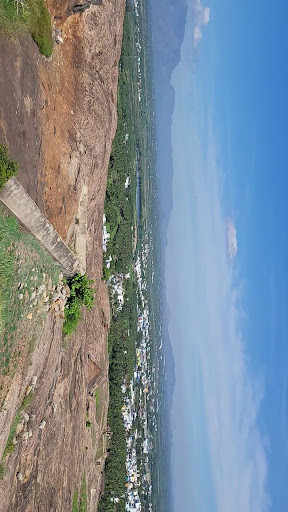
Once you reach the summit, the panoramic view of Dindigul town and surrounding hills is absolutely breathtaking — especially at sunset. From up there, you can spot the Sirumalai hills and the bustling city below. It’s a perfect place for photography and quiet reflection.
🏰 Architectural Highlights:
Strong granite walls and ancient water storage tanks built for rainwater harvesting.
Hidden passageways and cannon mounts, showing the military intelligence of that era.
The Kalahastheeswarar Temple located at the peak adds a spiritual calm to the historical atmosphere.
Ventilation holes, guard rooms, and bastions still intact despite centuries of exposure.
⚠️ Things That Could Be Better: While the fort structure itself is majestic, maintenance is minimal. Some areas have graffiti and litter. Directional signboards could be better marked, and information plaques are few and faded. Toilets are available only near the entrance, and there are no refreshments or shade along the route. The ASI or local authorities could easily make this a world-class heritage spot with a little more care.
📸 Tips for Visitors:
Visit early morning or late evening to avoid heat.
Carry water and wear comfortable shoes.
Take time to rest midway; benches are limited.
Great spot for history lovers, photographers, and trekkers.
If you’re visiting with elders, take it slow — steps can be slippery during rains.
💬 Final Thoughts: Dindigul Rock Fort isn’t just a fort — it’s a living page from Tamil Nadu’s history book. The raw granite rock, panoramic views, and the echoes of forgotten wars make it a place worth visiting at least once. Despite its flaws in upkeep, the fort retains a timeless charm that rewards every visitor who...
Read more