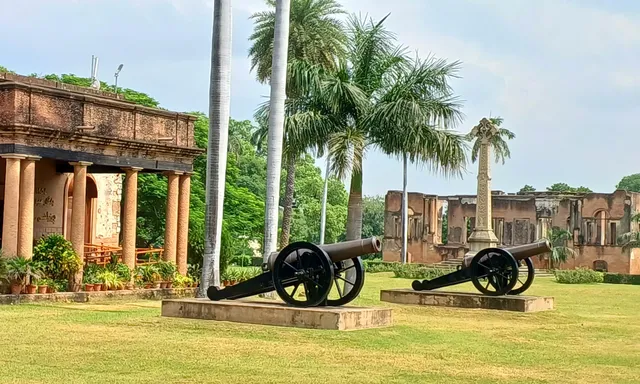
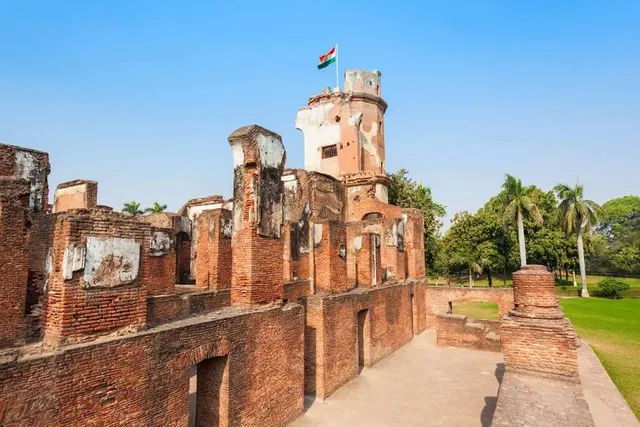
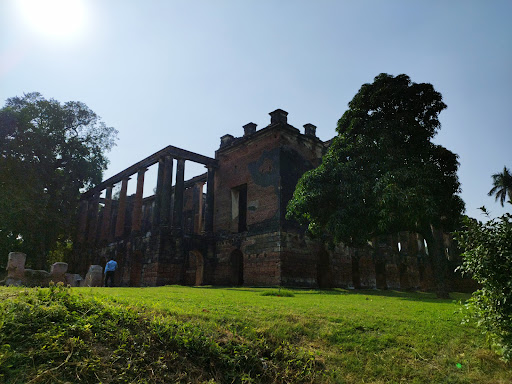
This place is well preserved memorial of the first struggle for independence 1857, wherein one can easily see the imprints of the struggle between the british army and Indian fighters. The ASI (Archaeological survey of India) has done a tremendous job to conserve the ruins of the memorial for future generations.
The evidence of the siege of the Residency in 1857 can be easily seen on the walls of each and every building of the Residency which were exposed to heavy cannonades for five months. Many of the buldings iether suffered heavy damage; or completely razed to the ground and are in ruins. Each ruin in the complex has its own story to tell about the events of 1857.
The Residency complex today consists of ruins of many buildings. During its historic siege in 1857, these buildings and the fortified posts were named usually after those who lived there. They were also named after the commanding officer of the post. We thus find names like Gubbin's Garrison, Sago's House, Dr Fayrer's House, Brigade Mess, Kanpur Battery, Sikh Square and Anderson's Post, etc.
Main Attractions -
Main Residency Building:- Originally, it was a grand building with three floors by which name this area is known. The credit of construction of this building goes to Nawab Saadat Ali Khan (1798–1814), which was used by the British Resident and Chief Commissioner of Awadh till 1857. This building with two upper floors and gardens was very beautiful. The main entrance of the building was equipped with a huge portico with double pillars on the east side. There was a huge verandah with tall pillars on the west side. The architecture of the building as a whole was neither Indian nor European. This building cannot be called satisfactory from the point of view of architecture. Henry Laurence was mortally wounded by a cannonball in his bedroom in the same building on 2 July.
Church and graveyard- In the north-west of the Residency, the remains of a church only two to three feet high exist, surrounded by a graveyard. This building was built only after 1845. It was constructed in the Gothic style. It was also used for grain storage during the siege of the Residency. The area around the church was first used as a cemetery during the siege. While unsanitary, the sheer number of casualties required the dead to be buried in a residential area. It also contains the graves of Henry Lawrence, Major Banks and General Neill.
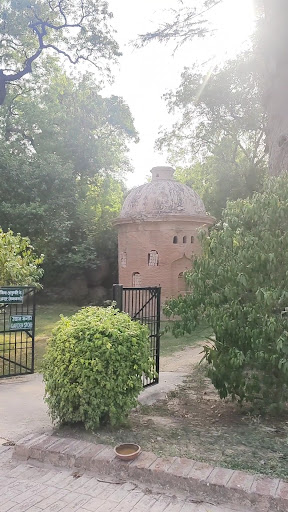
Begum kothi, mosque and Imambara - Originally, begum kothi was built by Nawab Asifuddaula. After many time sale and resale the bulding was finally transferred to John Caludon. Emperor Nasiruddin Haider's European wife, Mukhtar Alia or Vilayati Begum, was Caludon's granddaughter. After the death of Nasiruddin, Mukhtar Alia and her step-sister Asharfunnisa started living in this Kothi. Ashrafunnis built an Imambara and a mosque near Begum Kothi. Unlike other buildings of the Residency this is the only building built in the traditional architecture of Awadh. The Imambara does not have a roof, but the mosque is comparatively in good condition.
1857 Memorial Museum: The ruins of the Residency are preserved in the condition as it came under central protection in the year 1920 which still reminds us of the great uprising of 1857 in Lucknow. There is the history of the freedom struggle of 1857 inscribed on every brick of its structures. It conveys to us the feeling of patriotism and the sacrifices of the lakhs of people who participated in the freedom struggle of 1857 in the country and Awadh. It also echoes the heroic deeds and sufferings of many Britishers and natives who defended the Residency when it was besieged by the freedom fighters.
Suggestions to the visitors - It is requested to feel the heritage and historical legacy. Monuments are one of the precious gifts passed on to us by our ancestors and thus, it not only happens to be our karma but it is also our dharma to keep them protected...
Read moreThe clay model representing the buildings of the Lucknow Residency was prepared by Sir Thomas Moore in 1873. It was initially exhibited in the central hall of the main Residency building in the presence of Viceroy Lord Northbrook during his visit to Lucknow in 1873. The location and measurement of the buildings were taken from various drawings and after a careful survey, together with the description obtained from the owners and servants of the houses. The name of the structures as they existed before 1857 are plotted carefully. Surely recommend at least 10 minutes beside this model. For this reason, I have not photographed or shown it on my YouTube channel.
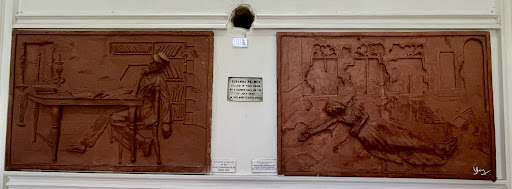
I have used a rare and grim portrait as the master picture that showcases that violence is never a solution to any problem because there will always be collateral damage leaving behind a grieving family who will work for revenge. Mahatma Gandhi said "An eye for an eye will turn the whole World Blind" The first War of independence was a result of years of suppression forcing ordinary soldiers looking to quench their hunger for their families, to take up arms. This mutiny left about 2000 people dead in Lucknow itself!
The left side of the portrait shows Henry Lawrence shot dead while seating upright on his chair. I have mentioned the incident in the earlier paragraphs too. On the right side is the portrait of Susanna Palmer a 19-year-old who went away too soon. She was hit by a canon ball in this room itself. Even a good cause can suddenly feel mindless when we analyze it in hindsight!
Photography is allowed inside the museum but...
Read moreThe 1857 Memorial Museum is inside the Lucknow Residency, a place that shows a big moment in India's fight for freedom. The Residency itself is an old building, started by Nawab Asaf-ud-Daula and finished by Nawab Saadat Ali between 1780 and 1800. The Residency is now in ruins, showing the heavy fighting that happened in 1857 when Indians in Lucknow rebelled against British rule. The ruins are kept as they were since 1920, to remember this important time. The museum was made to show how important the 1857 revolt was for India's independence. It's located in part of the main Residency building. Inside the museum, you can see :- Models of the Residency that show how the buildings used to look like. Old Photos give you a picture of what life was like back then. Written Records include inscriptions and documents. Paintings that show scenes from the fighting and daily life in the Residency. Old Weapons like guns, swords, and shields, and other military items like badges from that time. Pictures of the War include Canvas paintings and photographs that show events happened during the fighting. Visiting this museum is very important if you want to understand the history of the Lucknow Residency. Without it, you wouldn't get the full story. The 1857 Memorial Museum helps you learn about a very important part of India's history in a way that makes you feel connected...
Read more