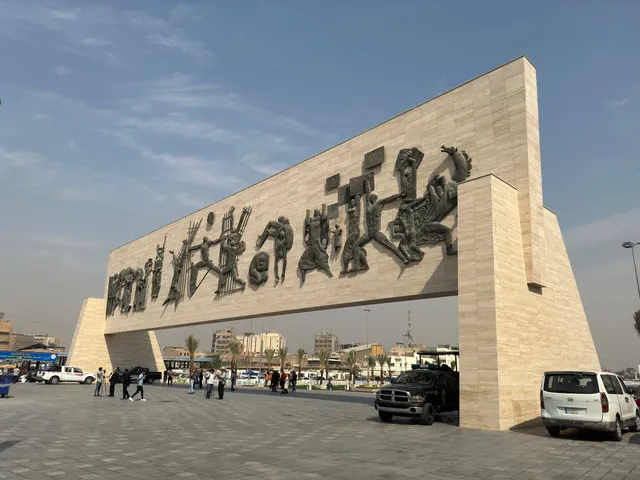
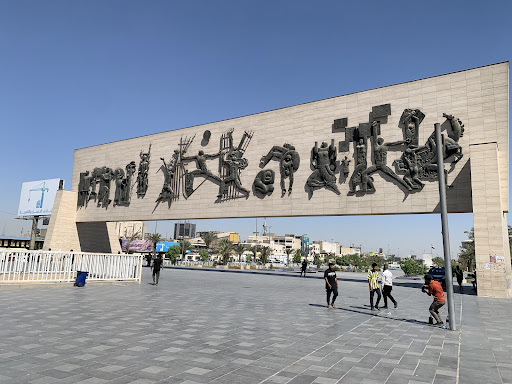
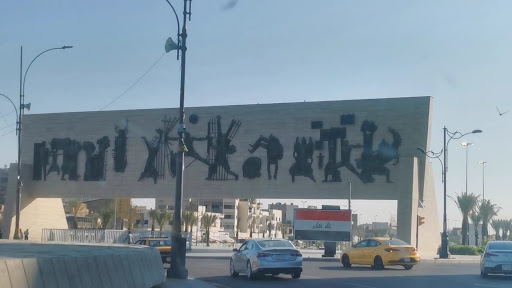
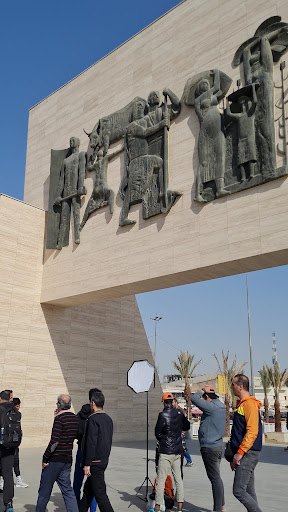
The Freedom Monument, or Nasb al-Hurriyah, stands proudly in al-Tahrir Square in Baghdad, Iraq's capital. This monument honors Iraq's declaration of independence and was crafted by the talented husband and wife sculpting team of Jawad Saleem and Lorna Selim. Its impressive design features bronze figures against a travertine wall, showcasing key moments from the 14 July Revolution, while drawing inspiration from the rich heritage of ancient Mesopotamian art.
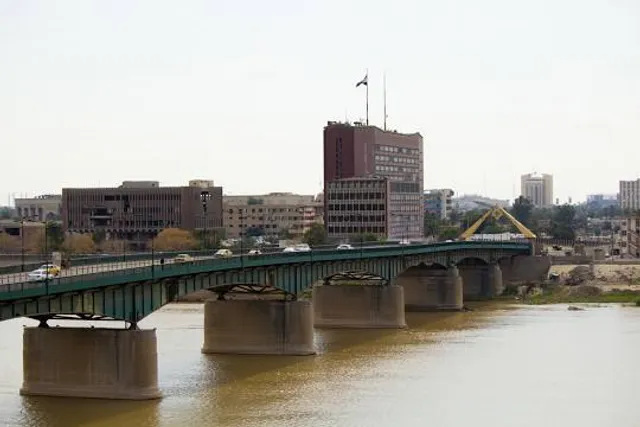
In 1959, following the establishment of the Iraqi republic, Brigadier General Abd al-Karim Qasim envisioned a monument to celebrate Iraq’s newfound independence. He commissioned top architect Rifat Chadirji to create a work that would sit at the core of Baghdad's bustling business district, with a view of al-Tahrir Square and al-Jumhuriya Bridge. Chadirji collaborated with Saleem, who was renowned for his ability to marry Iraq's ancient history with modern artistic expressions. While Qasim aimed for a representation of a new nation, Saleem opted for a design that reflected the struggles against oppression, weaving in elements from Iraq's rich artistic legacy, including Abbasid and Babylonian designs, thus creating a sculpture that blended modernity with tradition.
As construction progressed, Saleem faced numerous challenges, including pressure from Qasim to include his own likeness in the monument. Initially, Saleem envisioned positioning the sculpture at ground level. However, architect Rifat Chadirji argued for an elevated design to enhance its monumental presence. Consequently, the finished piece gazes out at the busy road rather than the pedestrians wandering through the nearby gardens.
Sadly, Saleem passed away unexpectedly in January 1961 before the monument was completed. His wife, Lorna Saleem, along with his close friend and collaborator Mohammed Ghani Hikmat, took on the responsibility of finishing the project that year. The result, known as Nasb al-Hurriyah, has become a symbol of resilience, enduring various challenges to remain one of Baghdad’s most beloved landmarks.
The monument, inaugurated in 1961 after the sculptor's passing, features 14 bronze castings that showcase 25 figures mounted on a travertine slab elevated 6 meters above the ground. Standing 10 meters tall and stretching 50 meters long, the figures are depicted in bas-relief, drawing inspiration from Babylonian, Assyrian, and Arab artistic traditions.
This powerful artwork commemorates significant historical events in Iraq leading up to the pivotal 14 July Revolution, spearheaded by Abdul Karim Qasim. This date marks the onset of Republican rule in Iraq. The monument is designed to be appreciated as a verse of Arabic poetry, read from right to left, starting with the events that preceded the revolution and culminating in a sense of unity following independence.
Its rich symbolism and multi-layered meanings have motivated Arab artists across the region to embrace artwork that reflects national identity, particularly during a time when many Arab nations were gaining independence.
In recognition of the sculptor's work, the sculpture was featured on the 250 Dinar banknote in 1995 and again on the 10,000 dinar banknote from...
Read moreBy far the most famous and iconic monument in all of Iraq.
Freedom Monument, located in al-Tahrir Square, is a monument commemorating Iraq's declaration of independence.
The monument was the work of husband and wife sculptors Jawad Saleem and Lorna Selim. It consists of bronze figures on a travertine wall, and depicts events from the 14 July Revolution. The bas-relief figures consciously reference ancient Mesopotamian art.
The monument was inaugurated in 1961, consisting of 14 bronze castings, representing 25 figures, on a travertine slab, raised 6 metres off the ground. The figures, which are in bas-relief, are intended to evoke Babylonian, Assyrian and Arab artworks.
Jawad Saleem chose to design a monument symbolizing the people's strife against tyranny and paid homage to Iraq's deep art history by including Abbasid and Babylonian wall-reliefs, producing a sculpture that was both "strikingly modern" yet also referenced tradition.
It depicts historic Iraqi events up to the 14 July Revolution led by Abdul Karim Qasim; a key date which marks the beginning of Republican rule in Iraq.
The monument is intended to be read as a verse of Arabic poetry - from right to left - beginning with events that preceded the revolution - and concluding with harmony following independence.
The multiple references and hidden layers of meaning in the work inspired Arab artists across the region and encouraged them to pursue artwork with a national identity at a time when many Arab nations were attaining independence.
It has since become a symbol of freedom for all Iraqis, and most of the protests and demonstrations take place next to the monument.
The sculpture was featured on the 250 Dinar banknote in 1995 and currently on the 10,000...
Read moreFreedom Monument (or Nasb al-Hurriyah) is located in Tahrir Square (Liberation Square) in the centre of Baghdad, is the city's most well-known and well-loved monument.
It depicts historic Iraqi events up to the 14 July Revolution led by Abdul Karim Qasim; a key date which marks the beginning of Republican rule in Iraq.
The monument is intended to be read as a verse of Arabic poetry - from right to left - beginning with events that preceded the revolution - and concluding with harmony following independence. The multiple references and hidden layers of meaning in the work inspired Arab artists across the region and encouraged them to pursue artwork with a national identity at a time when many Arab nations were attaining...
Read more