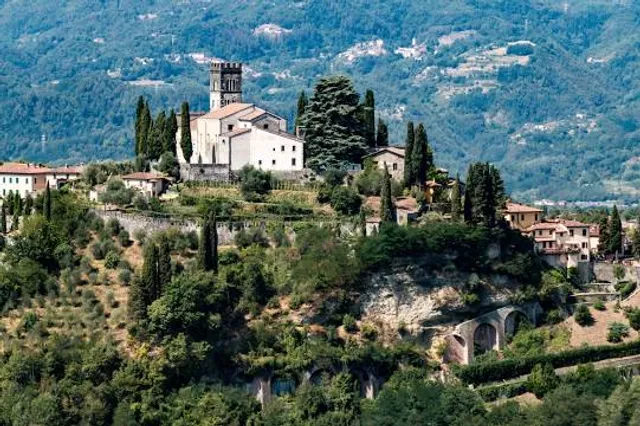
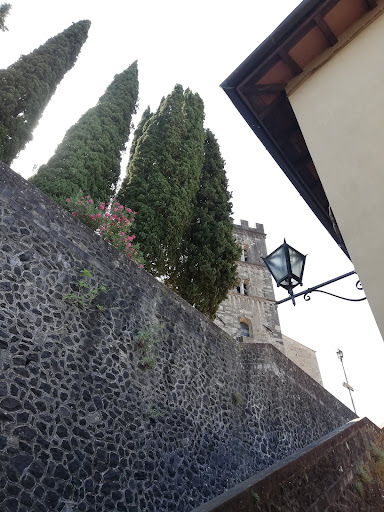
Twas a very rainy day, no one wanted to make the long walk up the cobbles while getting drenched. There was myself, my wife and three daughters (11, 9 & 4). The younger two were happy splashing eachother in the puddles while i trudged up with the eldest. My wife was regretting ever marrying me, for forcing us to make the walk in the weather, but the previous days had been in the mid to high thirties and i was sure this would be the most comfortable time for us to summit to the church. We were rewarded on arrival with magnificent views over Barga and the surrounding valleys with clouds rolling in above and below. I turned and saw the door to the church open, a cavernous but dry welcome. My children, being heathens, showed no interest, but myself and my wife (a very cold woman) entered God's house. The building seemed empty, with not another person, holy or otherwise, in sight. Our whispers of reverence and amazement of how such an edifice had been constructed so many years previous, echoed, seemingly amplified. It didn't seem possible, praise be, i had been gifted, presumably from above, and could only carry out His will.... My rectal expulsion reverberated off the hallowed walls in my proudest achievement to date (including my children awaiting outside). My only regret is that i have no evidence of my deed, other than my wife's swift texting to my mother to admonish her for such poor raising of a son. 5 stars,...
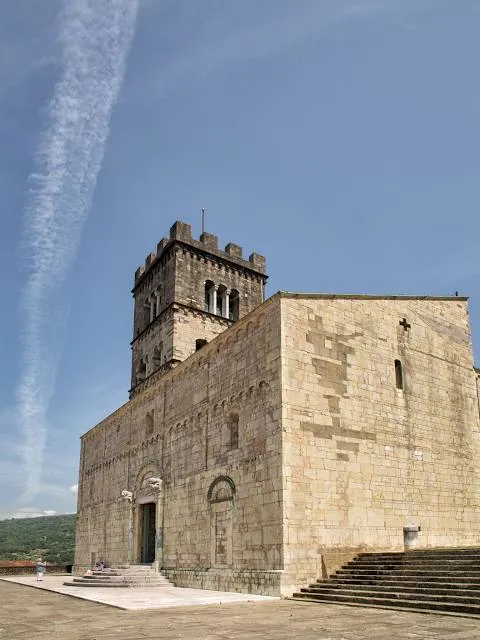
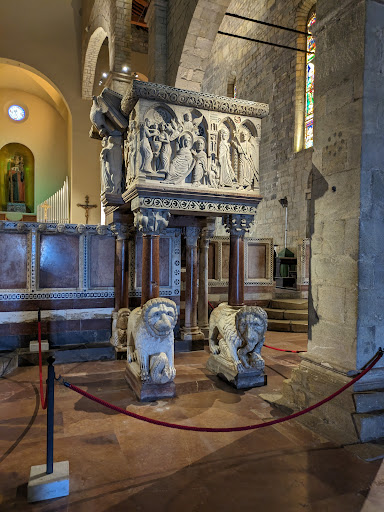
Read moreLa chiesa è stata edificata in tempi diversi, con la primitiva costruzione risalente a prima dell'anno 1000. Negli ampliamenti successivi si evidenziano elementi architettonici e decorativi di suggestiva bellezza che vanno dal romanico al gotico. Con la realizzazione delle due cappelle laterali e del coro si completa la costruzione della chiesa. Il rivestimento esterno dell'attuale facciata è stato realizzato con bozze di pietra detta Alberese di Barga. La porta maggiore è sovrastata da un arco scolpito a foglie di acanto. con un architrave a bassorilievo, raffigurante una scena vendemmiale. La porta è fiancheggiata da due colonne, alla cui sommità sono posti due leoni, che simboleggiano la forza della fede. La porta laterale, quella che guarda verso la Loggetta del Podestà, è sovrastata da un bassorilievo attribuito allo scultore romanico Biduino (XII secolo), opera di grande interesse artistico che raffigura una scena conviviale, il Miracolo dello "Scifo d'Oro" di San Nicola. Il Campanile ospita tre campane che vengono tuttora suonate manualmente a "doppio in terzo" e "doppio a quattro". Piccola diametro 103 cm Peso 680 kg Nota Sol3 Fonditore Natale da Metuno 1580 Mezzana diametro 112 cm Peso 850 kg Nota Fa3 Fonditore Bimbi 1812 Grossa diametro 116 cm Peso 980 kg Nota Mib3 Fonditore Moreni di Pescia 1737 L'interno del duomo è a tre navate,una balaustra litica, formata da lastre di marmo rosso inquadrate da marmo bianco decorato, separa il presbiterio dalla zona riservata al popolo. Ad essa si appoggia senza soluzione di continuità il magnifico pulpito, anch'esso in marmo, opera dei maestri comacini ed attribuito alla scuola di Guido Bigarelli da Como (XIII secolo). Il pulpito è sorretto da quattro colonne, di queste le due anteriori poggiano su altrettanti leoni sovrastanti uno un drago l'altro un uomo. Le colonne posteriori poggiano l'una sul pavimento e l'altra sulla schiena di un vecchio curvo. Nell'abside, alle spalle dell'altare maggiore, entro una nicchia, è collocata la statua lignea policroma di San Cristoforo, del IX secolo. Nella cappella del Santissimo Sacramento, a destra della navata centrale sopra l'altare è posta una pala in terracotta non invetriata raffigurante la Vergine e San Rocco (XVI secolo). Alle pareti laterali si può ammirare il Ciborio degli Olii Santi terracotta invetriata, attribuito ad Andrea Della Robbia e una Madonna con Bambino. Nella cappella della Madonna, a sinistra della navata centrale, sopra un altare seicentesco si può ammirare una tavola trecentesca che rappresenta la Madonna del Molino, compatrona di Barga, inserita in un quadro del XVI secolo. Alla parete destra un Crocifisso di scuola bolognese...
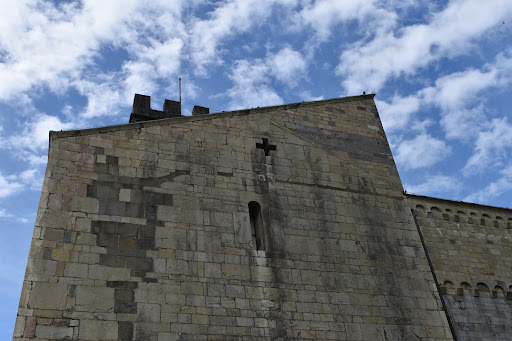
Read moreThis imposing stone structure perched on top of the highest point in Barga is the reward for a long climb from the front historical gate. As with moist Churches in Italy, the front of the Duomo is very plain, but their is a wide plaza in the front, and a small grassy area off to the south side that has a great panoramic view.
Inside, the church is very simple with a stone pulpit with the front pillars supported by two lions. The interesting thing is that the pulpit is only decorated on the sides that face the congregation. Simple wooden pews line the church with some more modern chairs in...
Read more