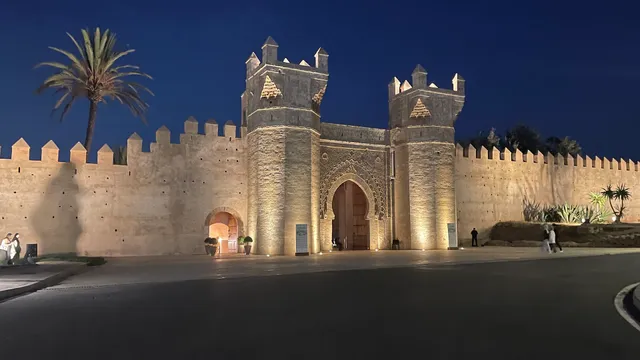
Perched on a serene hill overlooking the Bou Regreg River, Chellah is a captivating blend of ancient history and natural beauty. This fortified medieval necropolis, located just outside Rabat’s bustling center, offers a tranquil escape where time seems to stand still. Once a thriving Roman settlement known as Sala Colonia, the site was later transformed by the Marinid dynasty in the 14th century into a sacred Islamic complex, merging layers of history within its walls.
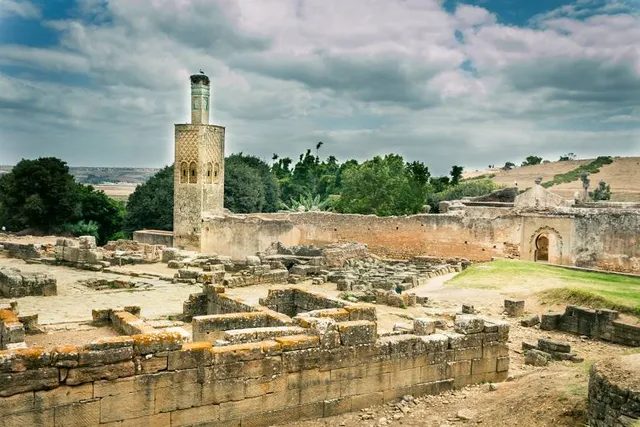
Walking through Chellah’s weathered stone gates, visitors encounter a hauntingly beautiful landscape. Crumbling minarets, ornate Islamic arches, and remnants of Roman baths and columns stand as silent witnesses to centuries of civilization. The site’s centerpiece is the striking Marinid-era mosque and its partially intact minaret, draped in creeping ivy, which overlooks a sprawling cemetery. Nature has reclaimed much of the ruins, with vibrant gardens of orange trees, palms, and fragrant flowers framing the ancient structures.
Chellah’s atmosphere is enriched by its resident storks, nesting atop the ruins, and the soothing murmur of natural springs that feed into reflective pools. The site’s tranquility is occasionally broken by the calls of birds echoing through the stone corridors, creating an almost mystical ambiance. Informative plaques provide context, though the true allure lies in wandering freely, imagining the lives of Roman merchants and medieval scholars who once walked these paths.
A UNESCO World Heritage Site since 2012, Chellah remains underrated compared to Rabat’s more frequented attractions. Its modest entry fee and proximity to the city make it a must-visit for history enthusiasts and those seeking quiet reflection. Here, past and present coexist, offering a poignant reminder of Morocco’s...
Read moreThe Chellah: Ruins with A Bygone but not Forgotten Past
The Chellah is s a medieval fortified Muslim necropolis located in the metro area of Rabat, Morocco. You would notice three sites within one, the wall around it, a garden and a sanctuary. The walls and gate are old and have been repaired often. They do provide a testimony the walls play in ancient [protection of cities. The Garden is full of colors and on a bright day it does shine through. From the garden you can see the river and a valley full of green. Sit anywhere and breathe Peace from the sounds of water running throughout the Garden. The sanctuary as the whole venue has a long history. Under the Phoenicians it was a trading post. The Romans later built their own city, Sala Colonia, very near the same site. Sala continued to exist as a town of the Christianized Berbers. In fact, Sala was the center of Christianity from the 2nd Century. It was mostly in ruins when the Muslim Arabs arrived in the 7th century. They build two mosques. There is a minaret standing. One can see just remains of the mosques. Indeed, the Lisbon earthquake damaged many of the remaining structures in Chellah. However there are a couple burials of Sultans and nearby there is a pool full of eels. The eels love eggs as I found out when feeding them.
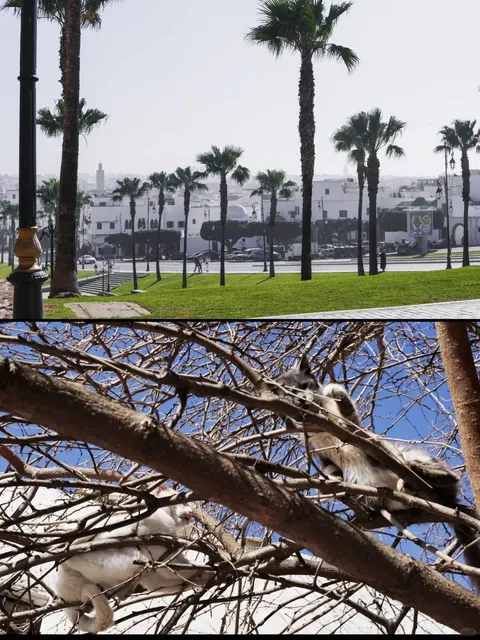
It is quite beautiful site and worth your time to explore. You might be able to see a little old lady that lives there and feed the many cats around. She calls them and they do come. The most amazing site is the huge birds, storks in the area. They nest on top of the trees and also structures – Good for photos!! It cost about 10 DH to enter. And you should wear good walking shoes...walk...walk and truly look around you! Yes, you...
Read moreI went to visit here with couple of Moroccan friends. They paid 10DH, and me as a tourist 70DH. Fair enough! This place is undergoing some repairing from outside, maintaining new access road, making grass areas, but it was made probably also because it was on the way of Pope Francis, to Mausoleum of Mohamed V, during his first historic visit of Morocco. Place has a huge historical and archaeological significance. Two well known Moroccan singers made their clips here, Nabyla Maan, Saad Lamjarred. Its an old phoenicien site, Roman era city and old 13-14th century Muslim royal necropolis of Marinids dynasty, from which the most important is tomb of Marinid sultan Abu El-Hassan known as the Black Sultan and his wife Chams Addoha. Tomb is nearby a tall minaret of the now-ruined mosque that was built of stone and zellige tilework back in 13th century. This walled complex has been converted to a garden and tourist venue, also hosting Mawazine festival of music, and Jazz in Chellah festival. Its a calm place full of history, lot of Roman remains can be found on the site including Latin writing on columns, and remains of massive Victory gate, entrance to the city. On the side , near the wall there is a "wishing well"where you can throw a coin with wishes. Lot storks nesting in the side and clapping with their beaks. Definitely...
Read more