Museum of Freedom: Groesbeek, Province of Gelderland, eastern Netherlands, Dingesdaeg, June 7, 2022.
Interesting space in an innovative housing construction. The main exhibition takes participants along a journey that commences just one year following the first International Peace Conference held at The Hague in 1899.
That international gathering took place at the invitation of Wilhelmina, Monarch of the Dutchlish, but was the brainchild of her second-cousin, Tzar Nicholas II, Emperor of Russia, in St Petersburg.
The Russia Tzar was alerted to the pending and imminent danger of mass annihilation by a Polish industrialist, by the name of Ivan Bloch, and who warned the Russian Tzar that the contemporary scientific innovations around the development of the machine-gun during the 1880s would lead to a situation whereby 'traditional' warfare (as it was known throughout the 1800s since the Irishman Arthur Wellesley defeated French Emperor Napoleon at Waterloo) would be no longer possible and instead could lead to a situation whereby warfare would become 'unwinnable', creating 'intractable stalemate'.
Queen Wilhelmina made 'Huis Ten Bosch' available for that (First) Hague Peace Conference in 1899. And, at that first ever international peace conference, it was decided to establish an international 'Permanent Court of Arbitration' and to build a special 'Peace Palace' for that precise purpose. Wilhelmina herself was present at the opening of the Peace Palace at The Hague in 1913.
Alas, events in Serbia the following year would trigger precisely that which the railroad magnate and Polish-born author, banker and railway financier Ivan Gotlib Bloch had already warned Tzar Nicholas about in 1899 in his acclaimed publication: 'Is War Now Impossible? (Vol. 1, 1899) and 'The future of war; in its technical, economic, and political relations.' (Vol. 2, 1899).
The museum exhibition takes participants on a journey throughout the twentieth century and the two World Wars that scarred it completely.
Specific focus is given to the particular role played by the southeastern Netherlands during the closing battles of the Second World War 1944/45, and the plight of the native, civilian population when the greatest armies to have ever assembled themselves met on opposite sides of the Great Rivers that divide the southern Netherlands' landscape in the autumn of 1944.
Further reading available...
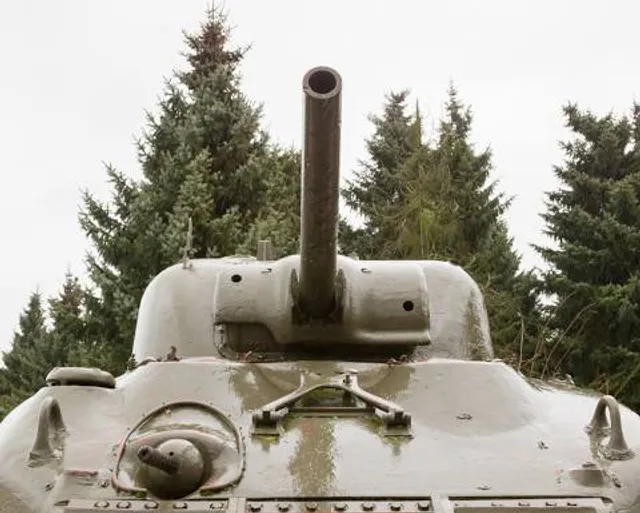
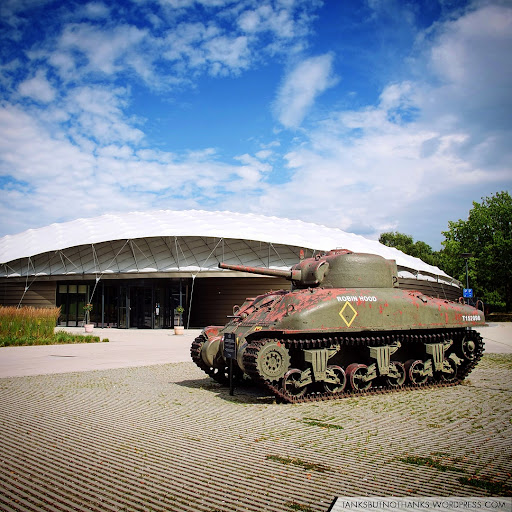
Read moreThe Grizzly I Cruiser tank at the museum's parking lot was painted to resemble the Regimental HQ command tank of the Sherwood Rangers Yeomanry – one of the three tank regiments in the British 8th Armoured Brigade, whose insignia was a red fox‘s mask on a yellow background. The yellow diamond stood for the Regimental Headquarters Squadron, while tanks in A Squadron were marked with a triangle, those in B Squadron with a square and C Squadron with a circle. The SRY was the first British unit to cross into German territory in September 1944 and its tanks played a vital role in the liberation of the Groesbeek area. However, they were not operating Canadian-built Grizzlies, but American-supplied 75 mm Shermans and Firefly conversions. Originally a Canadian Ram II OP tank, which had previously been serving as a gate guard at Amersfoort, was placed at the Sherwood Rangers Monument in Groesbeek. In 1988 it was swapped for a more appropriate Sherman from The Tank Museum in Bovington. This vehicle, which was at some point equipped with the late vision cupola, was one of the Grizzlies supplied to Portugal under NATO’s Mutual Defence Assistance Program (MDAP) in the early 1950s. When Portugal modernised their fleet in the 1980s, many of their tanks were sold to British museums and private collectors. In 2010 the Groesbeek Grizzly was briefly restored in...
Read moreI’ve been to dozens of World War II museums in Europe and beyond, ranging from attic collections in French hamlets to the sprawling premises of the world-renowned memorial Yad Vashem. Along that axis, the Vrijheidsmuseum (Freedom Museum) in Groesbeek would be mid-range. However, in terms of the collection and in particular how its items are exhibited, this museum excels way beyond its league. The exhibition is experience-driven, while remaining rich in information, too. I was particularly impressed by the immersive quality of the air raid shelter. Another feature that works quite well is the longue durée approach to the history of freedom, spanning across the entire 20th century as an age of totalitarian lies and colonial deceptions. Lastly, the museum upholds its local and regional memory of being a town on the frontlines. Very much...
Read more