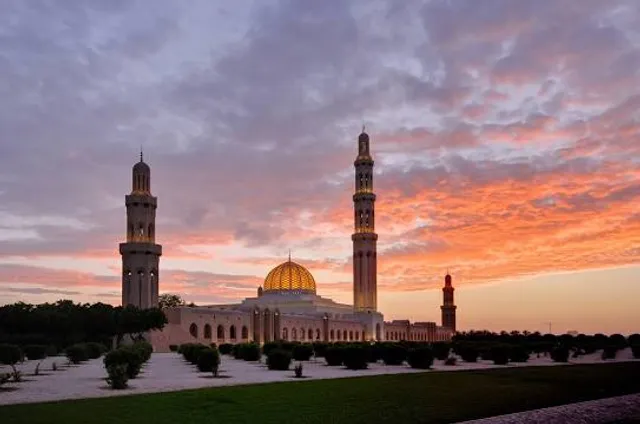
The Sultan Qaboos Mosque, the largest mosque in the Sultanate of Oman, is located in the heart of the capital, Muscat, specifically in the Wilayat of Bausher, in order to be easily accessible from the outskirts and center of the city, with a total area of 416,000 square meters, a length of 1,000 linear meters and a depth of 885 meters from north to south, after Sultan Qaboos ordered its construction to be a center for interaction with the spirit of Islam as a religion, science and civilization, and with the product of its literary and cultural history. the mosque, which was opened in 2001 and continued to be built for nearly six years of continuous work, is an architectural masterpiece created by the Arab architect Muhammad Saleh Makiya, who combined in his design the originality of Islamic architecture, its standards and global modernity, and the requirements of modern and future construction and design. The mosque complex was built on a spacious ground and is raised 1.8 meters above the site’s surface. Its architecture aims to preserve the prevailing Omani principle of raising the architecture of traditional mosques existing in the neighborhoods and villages of old cities at the level of residential or public architecture. Cream-white sandstone (or yellowish) arabescato was used to cover the buildings of the sanctuary of prayer, to distinguish it from the light purple stone, the “lilac crown” that covers the walls of the corridors and the various facilities of the mosque. The main entrance to the mosque is located through the southern corridor road of the site, where the southern facade of the complex stands out with its expressive stone bare, without suggesting or suggesting the interior spaces and divisions of places. Southern Corridor Contracts. As for the main prayer hall, it was designed to house more than six thousand and five hundred worshipers, while the capacity of the women’s prayer hall is seven hundred and fifty, with the possibility of containing the outer courtyard for eight thousand worshipers, in addition to the inner courtyard and the corridors. The total capacity of the mosque reaches the possibility of containing twenty thousand worshippers. The walls of the main prayer hall are crowned with balconies whose style is rooted in the architecture of Omani castles in particular, and the serrations of the balconies in Islamic architecture in general. As for the qibla wall, it is distinguished by the mihrab niche prominent in its protrusion at the facade, as is the tradition in the clarity of expression of the qibla wall in the design of mosques in general, and Omani mosques in particular. The mosque also includes a library full of references amounting to about 20,000 volumes in various Islamic and human sciences and culture, in addition to courtyards and special halls. The mosque has five minarets symbolizing the five pillars of Islam, rising about 45 meters, which adds to the architectural openness of the mosque’s space and its connection to the surrounding urban fabric visually. The floor of the main prayer hall is covered with a Persian carpet in the form of a single piece, its dimensions are more than 60 by 70 meters, and it covers a total area of 4,263 square meters, and it is composed of 1,700 million knots and weighs 21 tons. The delicacy and complexity of its fine texture is due to the quality of its knots, which reach 40 knots per 6.5 centimeters. The manufacture and production of the rug took four years, 15 months to prepare, designs, threads, dyes, and establishes its own weaving workshops. As for the knitting process, it lasted for 27 continuous months, followed by a 5-month period of finishing, cutting and traditional washing. The number of workers in the knitting process reached 600 women from the Iranian...
Read more⭐⭐⭐⭐⭐ Sultan Qaboos Grand Mosque – A Grand Testament to Omani Beauty and Hospitality
From the moment you arrive, Sultan Qaboos Grand Mosque in Muscat impresses. The design, craftsmanship, and serenity combine into an experience that feels both humbling and uplifting. Below are the key details and what makes a visit here truly outstanding.
📍 Location & Getting There • The Mosque is located on Sultan Qaboos Street in Muscat, Oman.  • It is about 12.5 km from Muscat International Airport (≈ 15-minute drive under usual traffic).  • There is ample free parking for those driving. For public transit, the nearest bus stop is Al Maha, followed by a ~13 minute walk.
🕰️ Hours / Visiting Times • For non-Muslim visitors (tourists), the mosque is open Saturday through Thursday from approximately 8:00 AM to 11:00 AM.  • On Fridays, the mosque is closed to non-Muslim visitors due to Jum’ah (Friday) prayers.  • For Muslims there are full daily prayer times; the mosque remains accessible for worship beyond visitor hours.  • Note: visiting hours may vary slightly during Ramadan or Islamic holidays – checking local or official sources before planning is wise.
👗 Dress Code & Etiquette
To respectfully enter and experience the interior, especially the prayer hall: • Women: Loose‐fitting clothing covering arms and legs (full‐length skirts or trousers recommended), and a headscarf (hair must be covered). Clothing should not be tight or transparent.  • Men: Long trousers, sleeved shirts (no shorts or sleeveless tops).  • All visitors must remove shoes before entering the prayer hall; shoe racks are provided.  • If you arrive without appropriate clothing, there are abayas and headscarves available for rent (cost around 2.5 OMR for women) at the entrance / gift shop. 
🏛 What to Expect / Highlights • The architecture is breathtaking: sweeping domes, elegant minarets, beautiful marble work, and extensive, detailed tile-work.  • The prayer hall is especially impressive: it houses one of the largest hand-woven Persian carpets in the world, and a massive chandelier.  • The atmosphere inside is cool, calm, and very well maintained. Because of the morning hours and restricted visiting hours for tourists, visitors generally enjoy a peaceful, respectful ambience.
💡 Tips for a Best Visit • Arrive right at opening (8:00 AM) to avoid crowds and get cooler temperatures and better photo lighting.  • Avoid visiting on Fridays for tourists, since the mosque is closed to non-Muslims then.  • Be sure to dress appropriately. Even if you think your outfit is modest, the staff will check; rentals are available so if you aren’t compliant, you can still gain entrance.
🌟 Final Thoughts
The Sultan Qaboos Grand Mosque is not just a must-see landmark in Muscat—it’s a profound example of Omani grace and faith in stone and art. The care in its design, the hospitality extended to visitors, and the ambiance make it one of my favorite religious sites anywhere in the world. Whether you’re interested in architecture, culture, or spirituality, it delivers.
Highly recommended for every...
Read moreLocated in the heart of Muscat, the capital city of Oman, the stunning Sultan Qaboos Grand Mosque is a must-visit for any tourist. This magnificent mosque is not only a place of worship for the Muslim community, but also a popular tourist attraction, drawing visitors from all around the world.The Sultan Qaboos Grand Mosque was built in 2001 to honor the memory of the beloved Sultan Qaboos bin Said Al Said. Spread over an area of 416,000 square meters, the mosque is an architectural masterpiece, showcasing a harmonious blend of traditional Islamic and contemporary Omani design elements. The main prayer hall, which can accommodate up to 20,000 worshippers, is a stunning display of intricate stucco work, with the central dome reaching a height of 50 meters.One of the most striking features of the Sultan Qaboos Grand Mosque is its beautiful gardens, spread over an area of 162,000 square meters. These gardens are meticulously maintained, with a variety of local flora and fauna, adding to the serene and peaceful atmosphere of the mosque. Visitors can take a leisurely stroll around the gardens, admiring the colorful flowers and enjoying the tranquil ambience.Another highlight of the Sultan Qaboos Grand Mosque is its breathtaking interior, adorned with exquisite hand-crafted decorations. The main prayer hall boasts of beautiful chandeliers, adorned with millions of crystals, adding a touch of opulence to the overall ambiance. Moreover, the mosque houses one of the world's largest hand-woven carpets, spanning an area of 70 meters by 60 meters. This magnificent carpet was hand-woven by over 600 women, using 1.7 million knots and took over 4 years to complete.Apart from its architectural and design marvels, the Sultan Qaboos Grand Mosque is also a symbol of religious tolerance and inclusivity. The mosque welcomes visitors of all faiths, allowing them to appreciate the beauty and grandeur of Islamic architecture and culture. Moreover, the mosque also offers guided tours, giving visitors an opportunity to learn about Islam and the history of the mosque.In conclusion, the Sultan Qaboos Grand Mosque is a must-visit for anyone traveling to Oman. With its stunning architecture, beautiful gardens, and a rich cultural and religious significance, a visit to this mosque is an enriching and unforgettable experience. Non-Muslim visitors can enter the mosque from 8:00 am to 11:00 am, Saturday to Thursday, and must dress modestly, covering arms, legs, and for...
Read more