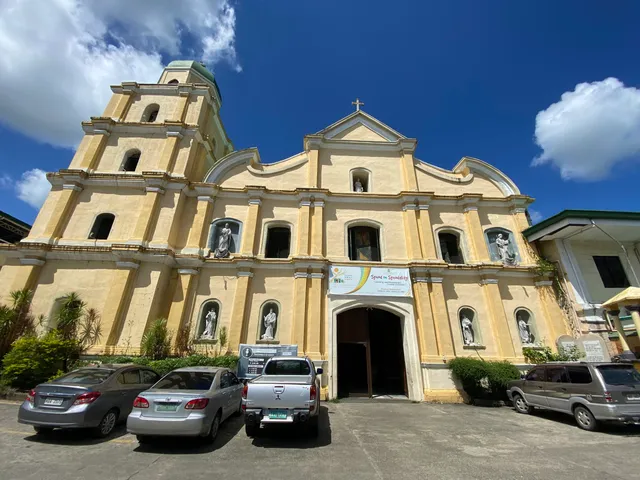
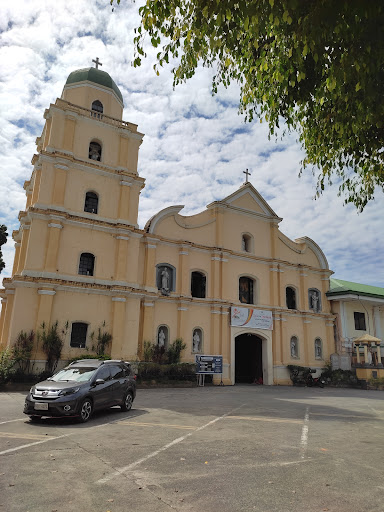
In 1743, the Zambal pioneers settled in what is now the seaside barangay Baleyadaan of Alaminos, with the settlement named after their leader Suyang.[3] There, they built houses and a chapel dedicated to Saint Joseph. Due to the frequent typhoons, they resettled to the wide plains southwest of their previous area and named it Casboran, in reference to the plants abundant in their new settlement. A continued increase in population led into the creation of a new local government with its church and convent being constructed in 1768. A disagreement in town leadership led to the burning of the whole town including the church, with its residents fleeing in all directions. Survivors of the fire resettled some 5 kilometres (3 miles) from the sea and was called Salapsap or Zarapzap.
The Augustinian Recollects, who are in charge of the area, then formally established a parish, with Fr. Toribio Raymundo as the first parish priest who would go on to serve from 1778 until 1815. In 1834, the church was charred again. It was then reconstructed under the helm of Fr. Manuel Busqueto from 1837 to 1849. The architect-engineer Maestro Cenon, who also designed the church of Aguilar, was tapped by Fr. Busqueto to design the church of Sarapsap. The entire town was told to contribute in rebuilding the church. Fr. Busqueto died after 16 years of being Sarapsap's parish priest.
From 1849 to 1878, Fr. Jose Tornos continued the rebuilding of the new church. In 1857, the church was inaugurated built with stone walls, nipa roofing, a tabernacle and a niche for the church's patron, Saint Joseph. In 1860, Juan Alaminos y Vivar visited the town and in 1873, the town's name was changed into Alaminos in honor of the governor-general of the Philippines.
Fr. Victoriano Vereciano became Alaminos' parish priest in 1879. In 14 years, he made improvements in the Alaminos' church and convent which include: obtaining hardwood agaro from the forests of Zaragoza and tindalo from Alos; galvanized iron sheets replaced the church's nipa roof; installation of wood parquet for the loft's floor; the ceiling was repainted; and communion rails made of iron were placed. A silver altar, a sanctuary light, floors made of concrete, and church bells were also added or implemented.
Fr. Andres Romero succeeded Fr. Vereciano who died in 1893. Under his term, the cemetery was enlarged and the chapel was reconstructed. During the Philippine-American War in 1901, the Augustinian Recollects ceded the parish's administration to the local clergy.
Among the improvements made to the church of Alaminos from 1926 include: the Sacred Heart of Jesus statue installation in 1930; construction of grotto of Our Lady of Lourdes with its image sculpted by the late Filipino artist and clergyman, Lingayen-Dagupan Archbishop Mariano Madriaga; adding of new church pews; the church belfry was remade into concrete; fences were added for the church's front yard; new tabernacle installation; Our Lady of Mount Carmel chapel and mortuary construction; and the installation of large Stations of the Cross, done by a local artist.
The church of Alaminos was elevated into a cathedral when the Diocese of Alaminos was founded in 1985. Bishop Jesus Cabrera, its first bishop, spearheaded more cathedral improvements which include: installation of marble on the cathedral's altar and floor; new sacristy; constructions of Alaminos Pastoral Center and perpetual adoration chapel; and the repainting of the whole...
Read moreA monument next to Hundred Islands of Alaminos City, Pangasinan.
Situated 5 KMS South of Lucap wharf.
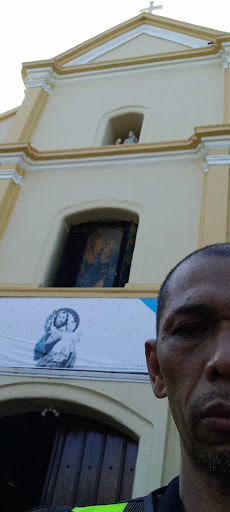
Its exterior and interior designs are one of the best among other local cathedrals in rural areas. It has been renovated with new paints outside and paintings inside.
The aesthetic and lighting inside are well organized. The altar, ceilings and walls have murals and paintings. On the altar, you'll see angels on its ceilings and a Latin phrase which I missed to get. On the walls, you'll see the 14 stations of the cross paintings, one station per column. On the ceiling, magnificent mural.
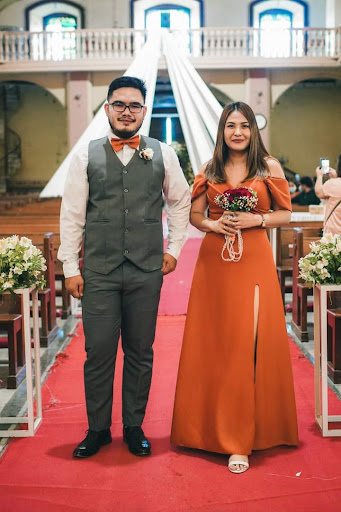
The interior is spacious and the architecture is well balanced. The altar lighting accompanied with its back draft is great for picture taking (see pictures).
The building design makes it well ventilated. It's cool inside without air conditioning but it has 2 huge ceiling fans.
The Priest and Parish singer have great voices which are well harmonized when they sing. Good sermon and spiritual (according to the wedding...
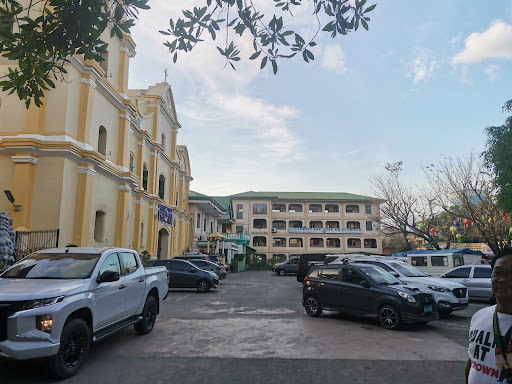
Read moreLet me describe their parking space. It's wide and good for private vehicles. You have to pay a few coins for the parking. Buses and others may opt to park beside the church if you run out of space but I guess that's for free. Observe the right way for...
Read more