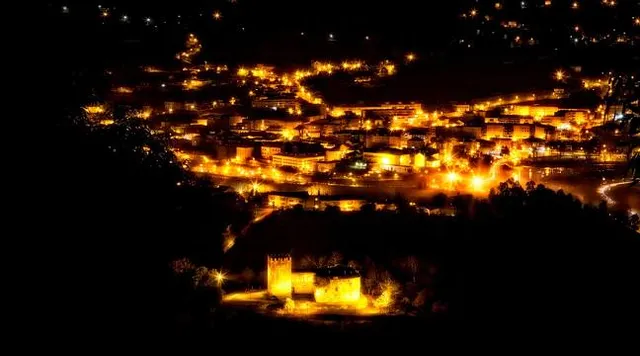
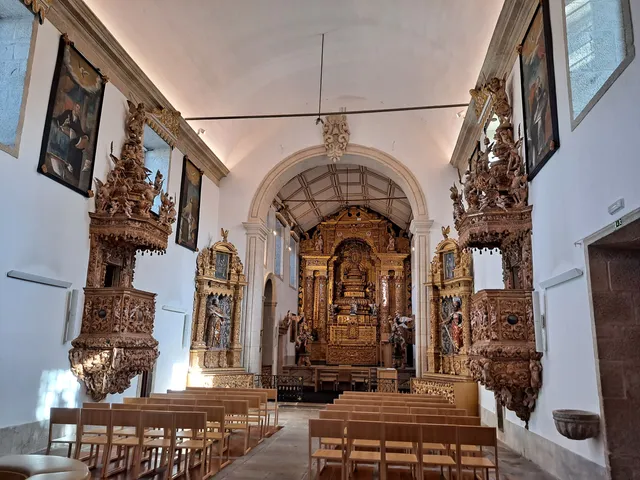
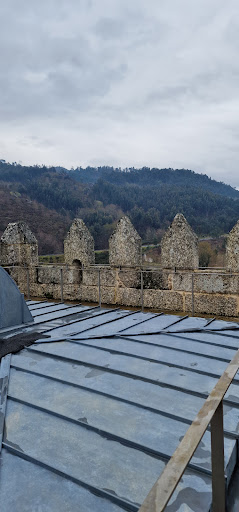
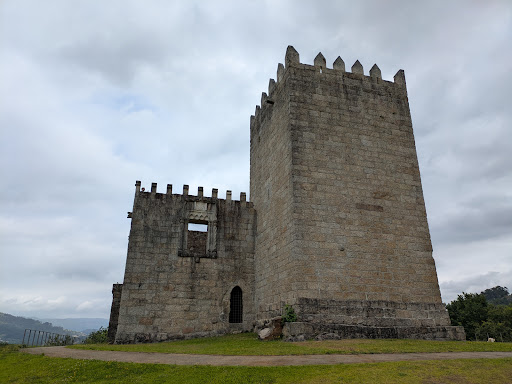
Accordingly to the historian and archaeologist Mário Barroca, the site where the Paço de Giela currently stands was occupied by a castle-refuge dating back to the 11th century, of which the northern section of the wall remains. Excavations carried out in 2014 also identified signs of this tower adjacent to the wall, close to the current one but smaller. This structure will have lost importance and would even be abandoned, possibly in the second half of the same century. There is no certainty about the date on which the Giela site acquired its second configuration, marked by the presence of a manor tower. Mário Barroca's stylistic analysis led him to argue that it was "a construction from the first quarter of the 14th century, from the final phase of the reign of D. Dinis, or at most from the second quarter of the century". This dating coincides with the possibility that it was founded by D. João Fernandes de Lima, married to Maria Anes de Aboim, suggested by other authors. It is known that in 1398, João I donated the "house of Geella", together with the Terra de Valdevez, to Fernão Anes de Lima, father of the 1st Viscount of Vila Nova de Cerveira, D. Leonel de Lima. Its current appearance is the result of two major construction stages: one from the first half of the 14th century, and another from the beginning of the 16th century, in addition to living space and agricultural use in the 19th and 20th centuries. It has been owned by the Municipality of Arcos de Valdevez since 1999. It opened completely recovered and rehabilitated after a broad and multidisciplinary intervention project, with an investment of 1.2 million euros, financed by Structural Funds of the European Community and the Municipality of Arcuense. The inauguration took place on July 11, 2015, Municipality Day, and was part of the commemoration program for the 500th anniversary of the Foral de Valdevez. The ceremony was presided over by the then Prime Minister Pedro Passos Coelho. The intervention endowed the property with cultural features and tourist promotion and is part of a project for that area, consisting of classified buildings and a surrounding property with a total of 22 hectares, municipal property, called Parque Urbano do Paço de Giela, which learn about future improvement interventions. In addition to the total rehabilitation of the property comprising the tower and former living areas, and in respect for the historical characteristics and time marks of its evolution, the intervention recovered the former caretakers' houses as a reception space for visitors and an auditorium/exhibition area, as well as like the primitive Chapel of Santa Apolónia, from the 16th century. The space functions as a true heritage "sanctuary", in a unique coexistence between history and nature, being one of the mandatory places to visit in the municipality and in the region, in what is considered one of the most important National Monuments and a remarkable example of residence. castled manor house from the Middle Ages and Modern.[citation needed] The former Torre do Paço, completely restored, has an interpretive and exhibition space inside, consisting of three floors, as in the original project: one is dedicated to Archeology of the Municipality, another to the interpretation of the monument itself and a third dedicated to Recontro de Valdevez, who in 1141 opposed Afonso Henriques to his cousin Alfonso VII of León and Castile. These spaces are supported by an effective and dynamic project that articulates new technologies and the museological component.[citation needed] The top of the keep, and its primitive round path, is a fantastic viewpoint over the ancient and medieval "Terras de Valdevez" and the beautiful valley of...
Read moreHistorical monument related to portuguese history and Nationality! The monument has a parking area, then at the main desk you can purchase your tickets (1€ per adult, until 12yo included it's free), there is also a chapel "Santa Apolónia Chapel". The castle itself was rehabilitated in 2014 and reopened in 2015. There is an outside part that represents the manoir, originally divided into different divisions, and the tower is divided into three floors. The one from where you enter has information about the evolution of the monument through the centuries - interactive screen with 3d features; there is another dedicated to archeology, besides the elements found previously from archeological works in several areas of Arcos de Valdevez, including the Paço de Giela, it is also possible to observe a map of the town and all the sites you can go and explore more about the subject; The last one has a short movie about "Recontro de Valdevez", which was a medieval battle that occurred in Arcos de Valdevez and was very important for the country. To finish the visit, the top of the tower has a very charming 360° view around...
Read moreThis manor house (it looks like a castle) is lovely. The outside is intact (mostly) and the inside is in good-enough condition to explore. A few of the upper levels are missing a room or two, but there is still plenty to see. The parking is right outside the manor house/castle, and is free. You must stop into the reception area to get a ticket (1 Euro per person) before exploring the manor, but this nets you a brochure in addition to entry. Dogs are welcome to explore inside and out. The staff were very friendly and helpful. I enjoyed looking around the manor, and highly...
Read more