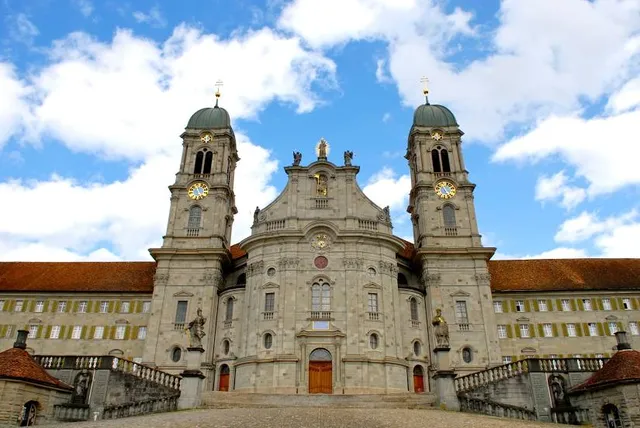
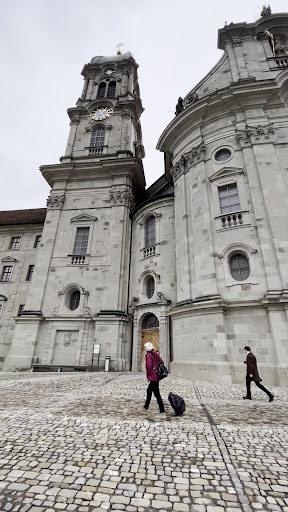
The Monastery in Einsiedeln, Switzerland, is an architectural gem that stands as a testament to centuries of religious and cultural significance. Dating back to around 300 A.D., this monastery holds a unique place in the architectural history of Switzerland.
The monastery's design is a blend of various architectural styles reflective of the different periods it has withstood. The structure's longevity and ability to adapt to changing times are evident in its architectural evolution. The use of Romanesque and Gothic elements showcases the craftsmanship of the medieval builders, while subsequent renovations and additions have seamlessly integrated Renaissance and Baroque features.
The exterior of the monastery is characterized by its imposing presence, with sturdy stone walls and soaring spires that reach towards the heavens. The intricate detailing on the façade, including sculpted reliefs and ornate windows, tells a visual narrative of the monastery's rich history and religious significance. The careful preservation of these details speaks to the dedication of those who have maintained the monastery over the centuries.
Upon entering, the interior reveals a harmonious balance between grandeur and simplicity. The nave, with its high vaulted ceilings and elegant arches, creates a sense of awe and reverence. The play of light through stained glass windows adds a spiritual dimension to the space, enhancing the overall experience for visitors.
The monastery's layout reflects a thoughtful organization of spaces, each serving a specific purpose in the monastic life. Cloisters provide tranquil areas for contemplation, while the refectory and dormitories speak to the practical needs of the resident monks. The architectural arrangement encourages both communal worship and individual reflection, embodying the core principles of monastic living.
In terms of structural integrity, the monastery's architects employed innovative techniques for their time, ensuring the longevity of the building. The enduring nature of the construction materials used has contributed to the preservation of this architectural masterpiece.
As a cultural and religious landmark, the Monastery in Einsiedeln remains a focal point for pilgrims and tourists alike. Its architectural significance extends beyond the physical structure, encompassing the spiritual and historical layers embedded in its walls. The monastery stands as a living testament to the enduring power of architectural design to inspire, uplift, and connect individuals...
Read moreThis is Darwin, I wanted to make a picture of the quote, God sees you with the eye with which you see him. I kept thinking about Darwin and his powers of observation with which he finally founded the theory of evolution. Once he had overcome it, his faith was strengthened.
The deeper you look into the microcosm or macrocosm, and no matter how many new things you discover in the process, you are filled with wonder, amazement and usually also with helpless incomprehension, as we repeatedly come across the unexplained and unexplored. However, all halfway attentive people notice one thing. Namely the structure of the order behind everything. No matter how deep we look into the detail, or into the vastness of size.
Everything is related and interacts with each other.
Everything is connected through and through on all levels.
If you then take a step back, rest in yourself and reflect.
You realise the truth that is inherent in reality.
Namely that it is a creation and that the unity of spirit must permeate it.
Because nothingness, the absence of something, is not capable of organising or structuring anything. Let alone result from itself.
"God said let there be light and there was light"
Das ist Darwin,ich wollte ein Bild zum Zitat, Gott erblickt dich mit dem Auge,mit dem du ihn erblickst, machen. Dabei schwirrte mir ständig Darwin und seine Beobachtungsgabe mit der er schliesslich die Evolutions Theorie begründete durch den Kopf.Er hatte zwischenzeitlich während seiner Arbeit dahin eine gröbere Glaubenskrise. Als er sie überwunden hatte,war er in seinem Glauben gefestigt.
Je tiefer man seinen Blick in den mikro oder Makrokosmos setzt, und ganz gleich wie viel neues man dabei entdeckt dass einen ins wunder,staunen und meist auch in ohnmächtiges Unverständniss verersetzt,da wir immer wieder auf unerklärliches,unerschlossenes stossen. Fällt allen halbwegs achtsamen,jedoch eines dabei auf. Nämlich die Struktur der Ordnung die hinter allem steckt. Ganz gleich wie tief wir ins Detail,oder den Blick in die weite der Grösse setzen.
Alles steht in einer Beziehung und Wechselwirkung zueinander.
Durch und durch auf alle Ebenen ist alles miteinander verknüpft.
Wenn man dann einen Schritt zurück tritt,in sich ruht und reflektiert.
Erkennt man die Warheit die der Wirklichkeit innewohnt.
Nämlich dass sie eine Schöpfung ist und die Alleinheit von Geist durch drungen sein muss.
Den das Nichts,also die Abwesenheit von etwas ist nicht in der Lage etwas zu Ordnen oder zu Strukturieren. Geschweige den aus sich zu resultieren.
"Gott sprach es werde Licht und es ward Licht"
Este es Darwin, quería hacer un dibujo de la cita, Dios te ve con el ojo con el que tú le ves. No dejaba de pensar en Darwin y en su capacidad de observación, con la que finalmente fundamentó la teoría de la evolución. Una vez superada, su fe se fortaleció.
Cuanto más profundizas en el microcosmos o en el macrocosmos, y no importa cuántas cosas nuevas descubras en el proceso, te invade la maravilla, el asombro y, por lo general, también la incomprensión impotente, al toparnos una y otra vez con lo inexplicado e inexplorado. Sin embargo, todas las personas medianamente atentas se fijan en una cosa. A saber, la estructura del orden que hay detrás de todo. No importa lo profundo que miremos en el detalle, o en la inmensidad del tamaño.
Todo está relacionado e interactúa entre sí.
Todo está conectado en todos los niveles.
Si entonces das un paso atrás, descansas en ti mismo y reflexionas.
Te das cuenta de la verdad inherente a la realidad.
A saber, que es una creación y que la unidad del espíritu debe impregnarla.
Porque la nada, la ausencia de algo, no es capaz de organizar ni estructurar nada. Y mucho menos resultar de sí misma.
"Dios dijo hágase la luz y se...
Read moreThe Benedictine Abbey is an impressive baroque pile on the edge of the old town. Founded on the site where the hermit St Meinard once lived and was martyred, it housed a thriving and learned community and an enormous and still growing library, although the monastic population is now much smaller than at its height. It is well-worth joining the guided tour for 20 CHF if you can speak German or, like me, have your own translator. Well worth it for access to the library and the chance to view some of its special volumes. Tickets from the information centre on the Hauptstrasse off the Klosterplatz. At 16:30 you can hear sung vespers in the Abbey church after which the monks process to the chapel of the Black Madonna and sing Salve Regina in...
Read more