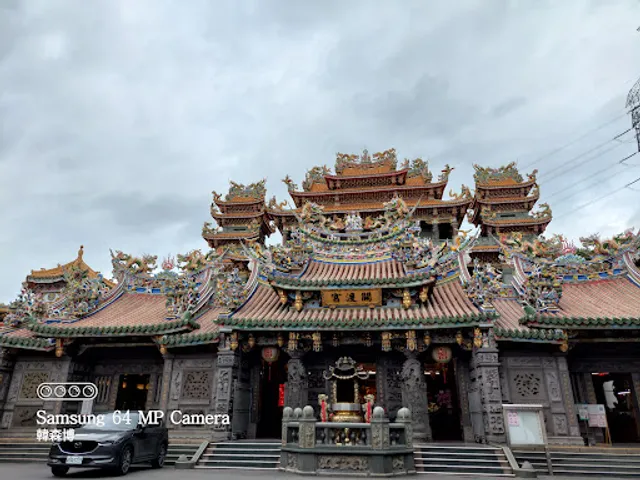
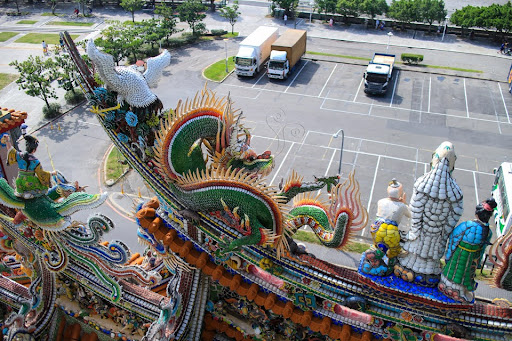
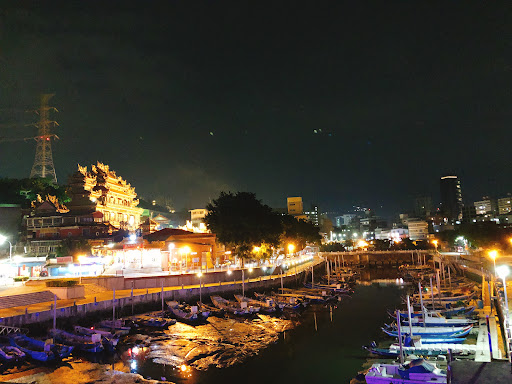
The Temple, registered as a Taoist temple, worships Mazu or Goddess of the Sea as its primary deity in front worship hall, although the Temple also worships various Buddhist deities, including Bodhisattva, and other folklore, Medicine God, and other deities, including Supreme Emperor, Lad God or Earth God, Literary God. It appears that the Temple is the first temple in north Taiwan to worship Mazu, because its fishing port location for the early immigrants.
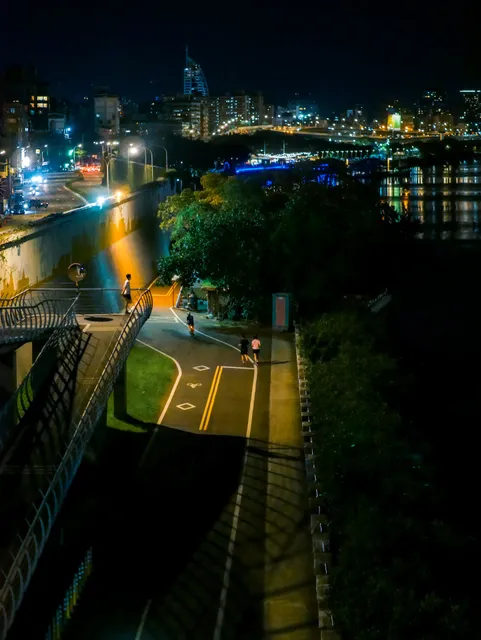
Although the Temple was first built in 1712, it was damaged and rebuilt a few times at various sites in Beitou area, and, it was rebuilt in current site in 1922. Then, the Temple has various new additions of the worship halls at side and in rear where is facing Danshui River. Thus, the Temple is composed of ancient or classic deity sculptures or statutes with rather "new" religious building structures. It is recommended that visitors walk to the rear section of the Temple where visitors can overlook the Danshui River and nearby area.
The Temple provides free incense and other worship material, and has free toilet and parking spaces for the visitors and worshippers.
The Temple is NOT crowded in weekend or weekdays unless it is Chinese new year, special religious days for the worships, such as Mazu's birth day celebration week [farmer calendar- March 17 to March 25].
From Guangdo Transit Station, visitors can walk to the Temple within 10 to 15 minutes, while there are bus lines running between subway station...
Read more「關渡宮」的前身天妃廟,草創於康熙51年(1712),主祀天上聖母媽祖。
從此成為北台灣最早的媽祖廟,當時流傳著:「南有北港媽,北有干豆媽」的諺語。從清代到日治時期,經歷過幾次不同階段的擴建,直至明治40年(1907),才奠下今日所見的規模。當嶄新的廟宇落成之後,正式改名為「關渡宮」。
二次大戰結束之後,由當地仕紳陳紅英先生,於民國42年發起重建委員會,展開戰後首度的重修工程。民國50年代首屆董事長黃定先生,則為關渡宮的建設畫下基礎藍圖。在當年擴建了「三川殿」、加高了「正殿」,以及整建「廣渡寺」,並在其上方續建「藥師佛祖殿」。另在「三川殿」的左右,建造休憩亭台式的「鐘樓」和「鼓樓」。此外又在「三川殿」前興建「天壇」,以供酬神獻演、與民同樂的戲台。
民國60年代「古佛洞」落成,是將空襲避難的防空洞,擴建為蜿蜒綿長、開龕造像的石窟。民國 70年代又開鑿「財神洞」,位於財神洞出口的「福德正殿」,則成為進入關渡宮的新捷徑。民國70年代末「凌霄寶殿」落成,80年代殿內的木雕裝修工程,以及90年代圖書館前「媽祖神蹟牆」的石雕工程等等,都為近代的民間宗教藝術,立下了更新的里程碑。除了民國90年「三川殿」的修建之外,民國100年展開華藏大樓的修繕工程,並於民國105年3月6日,隆重舉行華藏大樓之五佛殿安座與三聖殿開光大典。
具有三百多年歷史的關渡宮,不僅是北台灣媽祖信仰的開端,而且擁有珍貴的古蹟文化資產,以及周邊豐富的自然生態與人文景觀,可以說是同時滿足心靈、知性與感性的最佳名勝景點。
Established in 1712 CE, Guandu temple was known as the Heavenly Consort or Tianfei Temple as its main deity was Mazu, the Saintly Mother of Heaven.
It is the oldest Mazu temple in Northern Taiwan, as the saying goes, "There is Mother of Beigang in the South and Mother of Guandu (Kantou) in the North". From the Qing dynasty to the period under Japanese rule, the temple underwent various phases of expansion until 1907 that established the temple at its present state. After the project was completed, it was officially known as Guandu Temple.
After the Second World War, Mr. Chen Hung-Ying, a local gentry set up a committee in 1953 to launch its first post-war revamp project. In the 1960s, Mr. Huang Ding, the first chairman of the temple's board of directors, drew up a construction plan.
The'Sanchuan Hall' was expanded and the main hall elevated. The Guangdu Temple is also renovated and the main hall of Bhaisajyaguru is added above. At the sides of the Sanchuan Hall, two pavilions, the 'Bell Tower' and 'Drum Tower' were built and a'Heavenly stage' added in front to entertain both the deities and the people.
In the 1970s, the 'Ancient Buddha Pit' was constructed. Converted from a bomb shelter, it resembles a tunnel-shaped shrine housed in a rock grotto. In the 1980s, the Elephant Trunk Mountain was opened up and transformed into what is known as the"God of Prosperity Pit'.
Located at the entrance of the pit is the 'Main Hall of Fude God', visitors can now visit Guandu temple via this entrance. During the late 1980s, the 'Lingxiao Treasure Hall' was established. Important works including wood carving works inside the hall and stone carving of 'The Wall of Mazu's Miracles' were carried out in the 2000s, creating another milestone in contemporary times. Other than the Sanchuan Hall constructed in the 2000s, the Hua Zang Building was renovated in 2011.A grand ceremony was conducted on 6 March 2016 to mark the dotting ritual of the Five Buddha Hall and the Three Saints Hall.
With over 300 years of history, not only does Guandu Temple mark the beginning of Mazu worship, it is also a place where historic sites of cultural heritage are based. Surrounded by nature and places of interest, the Guandu Temple is one of the best places of interest to engage in a spiritual, sensory and perpetual...
Read moreThe most ancient and most inspiring temple of the North. The history of the Goddess Matzu is legendary. If you need help with anything, this is an excellent place to visit. Enter on the left and ask anyone for help. The halls are extremely beautiful with the ancient ways of the people. It doesn't matter who, or what you worship. What matters is your intentions and your ambitions... Hike up above the temple to the relaxing landscaped gardens/park. There is a very old Catholic church locked up there too. Probably for good reasons 😉! You can learn a lot from watching the turtles in the fountain, or watching the pigeons who like to walk around the big circle. Remember that Taoism is the secret to life here. If you can figure this out then you...
Read more