The entire place is fabulous, but this review is mainly about the house. It is hard to imagine a better house; it really has everything.
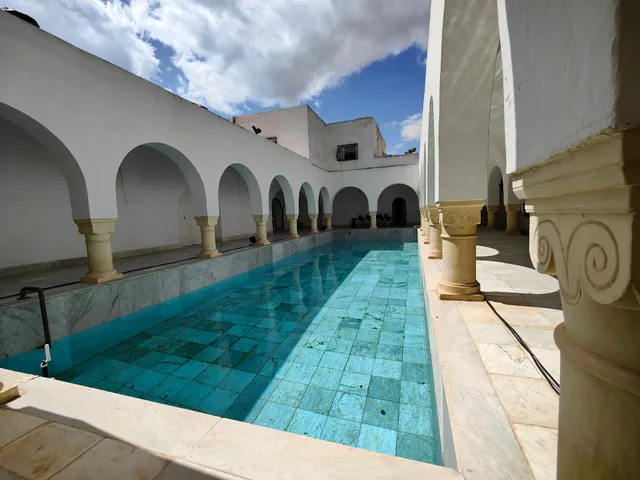
Sure, there are grander, more luxurious, larger palaces and castles and estates, but the allure of Dar Sébastien is that it is a perfect yet reasonable house that any of us could imagine living in. It's essentially a two level four bedroom four bath beachfront house with a large garden and a decent sized marble swimming pool surrounded by a covered Moorish arcade. It has a sweeping circle drive to the entrance, and a generous patio facing the sea.
But, my goodness, it is so much more. The living room is simple, but 100 people could sit there for a concert, and a small room curtained off the living room provides a backstage area for a band or actors. The master bathroom has a large marble bathtub that is in the shape of the Byzantine era baptismal basins found at several Roman archaeological sites in Tunisia. Built in shelves and window seats and other features turn up wherever you wander. The poolside dining table chairs are of an original art deco design and have only one arm. There is a bathroom poolside. A large fireplace and even more built in seating are off the kitchen if you prefer a cottage feel or want to spend a cold evening in a more intimate space.
I'd move there tomorrow if I could, and I can imagine replicating the house in many other places. And I might.
If you are anywhere near it, take an hour to visit Dar Sébastien and...
Read moreDon’t miss this tourist attraction in Hammamet! 🔝 The former villa of a rich Romanian 🇷🇴 aristocrat, named George Sebastian, a descendant of the Ghika family, which became the property of the Tunisian state in 1962 and, nowadays, the seat of the Hammamet Cultural Center. George Sebastian and his wife, Flora, of American origin, built the most beautiful house in town. This home with a Romanian soul ♥️ and Arab clothes has attracted a lot of world personalities. After his death, Sebastian left everything to the Tunisian state. George Sebastian hosted several kings of England here, Churchill wrote part of his memoirs under these white walls, and during the German occupation, it was the headquarters of Rommel's headquarters ✅ Having a land of nine hectares, the Romanian aristocrat 🇷🇴 built his house in 1927 and thus "invented an architectural vocabulary based on research and knowledge of vernacular architecture. Much of the hotel architecture on the Tunisian coast has taken up and amplified - sometimes even in excessive forms - the harmonious architecture of George Sebastian's villa. It is a remarkable phenomenon that started from the taste of a Romanian 🇷🇴 for the charm of oriental art. Visited...
Read moreDar Sebastian: Dar Sebastian ou Villa Sebastian est un domaine qui comprend des résidences, des jardins et un parc arboré en front de mer. Réalisée dans les années 20 par Gheorge Sebastian, mécène roumain et conçue pour recevoir de nombreux hôtes, Dar Sebastian est vite devenu un lieu cosmopolite de rencontres d'artistes, d'intellectuels et de personnalités de tous horizons. De 1932 à 1962, Giacometti, Schiaparelli, Paul Klee, André Gide, entre autres, se succèdent dans ce qui est devenu un chef d'oeuvre de l'art architectural hammametois Pendant la guerre elle abrite le Maréchal Rommel qui la réquisitionne pour y vivre le "crépuscule de son reve africain' et qui cède la place, ironie de l'histoire, à Winston Churchill qui y rédige une partie de ses mémoires. Les travaux de la maison, que l'on doit à Vincenzo Decara, ont duré trois ans et ont fait l'objet de plusieurs réfections au point que l'adage "construire et démolir comme Sebastian" circulait a Hammamet. C'est Jean-Michel Franck qui signera le design du mobilier de la villa. Six ans après l'indépendance, en 1962, le domaine est vendu à l'Etat tunisien qui y crée le centre culturel. Cest la fondation Gulbenkian qui finance, en 1964, le théâtre de plein air qu'on doit à l'architecte Paul Chemetov, au maitre d'oeuvre Armand Meppiel et à son équipe tunisienne Depuis 1999, la villa et le parc sont inscrits sur la liste du Patrimoine Classé. Le Centre Culturel International de Hammamet est membre du Réseau International des Centres Culturels de rencontre, qui compte près de 40 centres actifs...
Read more