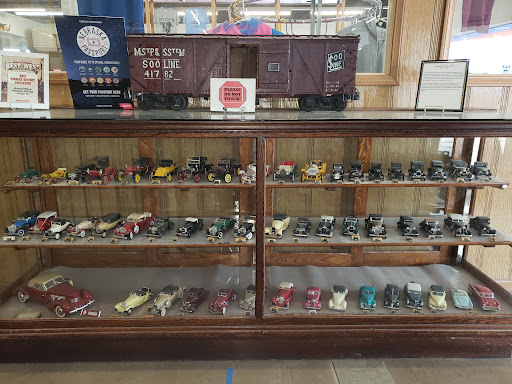
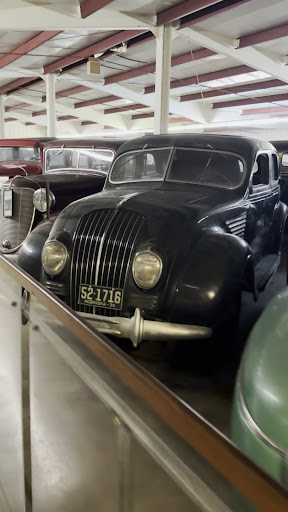
Harold Warp's Pioneer Village is an amazing place.
Some people have compared it to the Smithsonian Museum, and although comparable in some ways, this privately owned and minimally endowed collection is the remarkable life work of one man, Harold Warp, who came from a family of modest resources. Mr. warp became wealthy later in life solely as the result of his inventions and success in developing and marketing them.
Pioneer Village is intended to display the material artifacts of the Industrial Revolution in the context of their contemporary cultural impact, and it has accomplished that mission in an extraordinary way. Its creator described it as "Showing Man's progress since 1830".
This place represents the lifelong mission of Harold Warp, himself an inventor and contributor to the culture and technologies he sought to preserve for succeeding generations.
Mr. Warp is best known for the invention and marketing of transparent plastic film.
Pioneer Village includes outdoor and indoor exhibits.
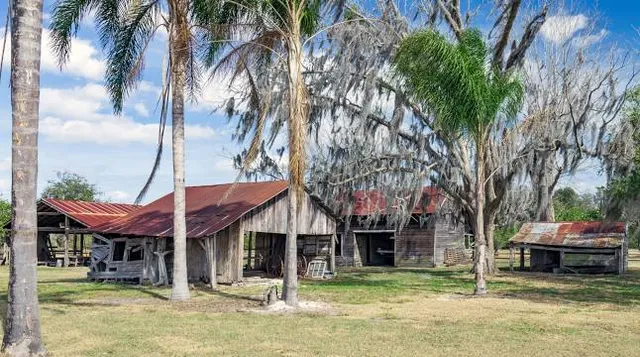
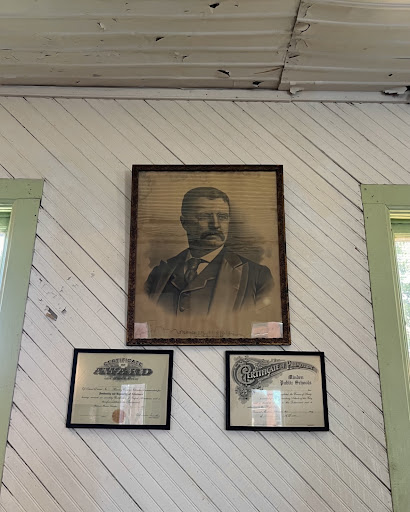
Mr. Warp even preserved entire buildings and their contents, including the one room school that he attended as a child, complete with it's original furnishings and many of it's contemporary books and papers.
Mr. Warp told of watching a train that regularly went past in the distance as he worked in the fields as a youth, wondering what it would be like to be able to afford to ride on the train.
Later in life he was able to purchase the locomotive and some rail cars of that very train and they're on display at Pioneer Village.
The collections are grouped by category and arranged in chronological order, spanning the latter half of the Nineteenth Century and the first seven decades of the Twentieth Century.
Pioneer Village is now becoming a museum depicting a museum. It has changed little in the past half century, preserved like a time capsule as it was when Mr. Warp was no longer able to continue adding to the collections.
Unless, by some miracle, this unique representation of a moment in the history of mankind can be saved from the relentless ravages of time and decay, it will inevitably cease to exist.
If you're interested in the history, culture and material technologies of Nineteenth and Twentieth Centuries, go see it as soon as possible. You may not have the opportunity if you wait too long.
Take your children or grandchildren, and talk to them about a world that has changed in your lifetime, and how it will change in their's. This is a unique educational opportunity.
Another reviewer mentioned "a Twilight Zone feel". If you're past middle age, you'll see once familiar things in a museum of obsolete culture and technologies. There's an airplane there like one I flew when I was a young man. Not only is it obsolete, but it's hanging from the roof of museum that has become obsolete itself.
Plan to stay at least one full day. Maybe three days or longer if you're interested in this sort of thing. There's a tremendous amount of history crammed into this place.
Tours are self guided and there are no staff to respond to questions, although the exhibits are accompanied by signage with printed interpretations.
I found it useful to use my mobile phone to look up additional information about interesting exhibits as I toured the facilities.
I have visited several times over several decades and have yet to thoroughly appreciate the entire facility, which has changed very little over the years.
Pioneer Village is showing its age and the effects of benign neglect. Some indoor displays are dimly lit and the buildings are not heated in winter.
Some parts of the facilities may not be handicapped accessable.
Pioneer Village is reported to be open in summer 2020 during the COVID-19 pandemic. It is suggested that visitors call ahead and enquire about operating hours and possible restrictions.
First posted January 13, 2018. Edited June 2020.
If you find this review useful, please mark the...
   Read moreOur family loves visiting Pioneer Village and Minden, Nebraska. It is a real step back in time.
We first heard of Pioneer Village when they ran a fairly large ad in the Denver Post. That was in about 1987. In the ad they showed a photo of their display of Chevys on one side of the isle and Fords across the isle from the earliest years to about the mid 60s. I was impressed with that layout with the two big car makers across he isle from each other. In the ad they also had a photo of a long row of Farm-all and john Deer tractors across from each other very much like the Chevys and Fords were lined up in the order of their development. Another photo showed bare airplane engines from the earliest ones to perhaps WWII era engines but I noticed that they were right in front of you... you could actually touch them. They had the 4th engine the Wright brothers had made on display... their carburetor for that engine was literally a tin can! Specifically it had been a can of tomatoes! I cut the ad out of the paper and hung it on the back of my office door and my wife and I and our two girls did the 6 hour drive (each way) and visited Pioneer Village later that summer.
We were mesmerized at what all they had on display there. We thoroughly enjoyed the Saturday visit so much we stayed overnight to visit again Sunday before we headed back for Denver. We have since been back over a dozen times since with our girls as they grew up and other friends. Our girls whey were into music, movies and and video games as much as any other kids yet they always loved going back to Pioneer Village. Over those visits we got to see Minden dressed in it's Christmas lights and have enjoyed the Pioneer Village Restaurant and their beef barley soup countless times as well. Unfortunately, the last times we went the restaurant was closed, apparently for good now.
Now, here we are 30 years later and my older daughter has already taken her husband and two children there twice. My younger daughter and her husband live in Portland,, Oregon. They are visiting in April. A highlight for her is to take her husband and their 5 year along with her sister and family old to Pioneer Village while they are back in Denver.
When you go, be aware that it has perhaps a dozen buildings full of artifacts and displays so three hours is a bare minimum quick visit. If you are into the development of mechanical items (cars, trains, airplanes, tractors, etc) or antiques, you can easily me entertained there for a 10 hour visit over two days. Bring your camera.
Over those decades we have visited, the place has, of course, gotten older and the displays perhaps less cared for. Many people will go there and feel it has seen it's better days. To us, we love the fact that is is still the exact same as it was 30 years or perhaps even 60 years ago.
Perhaps you can tell.... our family really has enjoyed...
   Read moreLet's start with the good: there are some fantastic gems in here. Very early cars, some historic airplanes, etc. The building where they set up kitchens, living rooms, and bedrooms for every decade from the 1830s to the 1980s was particularly fantastic. I had heard of Delco light plants before, but never seen one until going here. Vintage and classic cars by the hundreds, exhibits on everything from the evolution of refrigerators to washing machines. The preserved historic buildings were also great: from the old depot to the old church, it felt like a step back in time.
Now the meh: They could really stand to curate the collection better. Sometimes there are 5 or more examples of basically the same thing - sometimes all at one place, sometimes scattered around multiple buildings. It's pretty cool when you see one rare old item. Nifty when you see the second. And it gets pretty "blah" by the time you're at example #5. Some things you wonder why they have them; there was a thing full of hundreds of promotional pens, but hung too high up to be able to see what they were. It seems they sort of gave up by the time you get to the massive sheds in the back. They really are massive, and there are great things in there, but unlike the front "main building" which describes why a given car or object is there and its significance, if those had any signage at all, it was a photocopy of the title to the vehicle. Here's a collection of snowmobiles, there motorcycles, here Chevys, there farm equipment, mostly just dozens of things without much explanation.
And the bad: they have placed artifacts -- ones that should be carefully lit -- under damaging fluorescent lights. They have clearly ruined some of their artifacts by putting them under those lights for decades, causing them to fade. They remain under those lights even now. If you visit many museums, you will note how careful they are with lighting color prints, textiles, etc. to avoid that. No such care was taken here, and it made me sad to see what has become to what would otherwise be some lovely artwork. A number of signs and such look like they may have been written by Harold Warp in the 1950s, and lack the contextualization you would see in a more modern...
   Read more