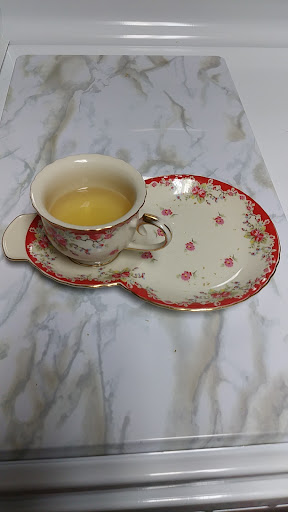
Update: 1Feb 2020, Sat.,11:31am: I just found that tea plate and was not looking for it. Check out the photo inside the cupboard.
Update: 18 Nov 2019: I still cannot find that plate.
Update: Last night, Thur, 13 Jun 2019, I am using the little cup to drink tea and look for the plate. I look, look, look, and look. The plate cannot be found...ANYWHERE!!! I had the plate and saucer out of the cupboard earlier in the week, maybe Sunday. I am the only person here. Yet, the plate is no where to be found. I am heartbroke and disappointed that it could mystetiously disappear. Then I look for the medical alert neck unit and it has disappeared. I am seen on the security camera wearing it at 9 am, Mon, 3 Jun 2019 when I go out, but came back wearing work clothes about 7 pm without the neck unit. I looked, looked, and looked at both homes and it, too, cannot be found. Two Disappearing Objects Phenomon (DOP).
I have been robbed about 6 times: 3 times at Tanger Mall (safe with Mikimoto cultured pearl necklace with marquis diamond clasp in blue pesentation folder & a blue stone encrusted cross, (Dec 2014), a 2015 $20 Victoriana calendar (Jan) and a black legal folder with all my legal documents (Nov 2015));
I was pickpocket at Food World (now Piggly Wiggly) $18 in money clip engraved with my initials in my mother's red change purse;
One time at Walmart ( my deceased mother's silk scarf) (1999);
One time at St Margaret Catholic Church (black leather tote with 2 priceless family geneology books that took 14 years to research, then bind and print (Jan 2019);
One time at Parent's home (2 black solar lampost lights, Jan 2017);
One time at Warerfront Mission (prescription wire rim eyeglasses) when they first opened the store in Foley;
One time at Council on Aging (April 2018 (expensive prescription sun glasses in the office I used (Apr 2018). I Checked back 3 seperate visits for them.)( One year later the prescription sunglasses reappeared in their confrence room in Jan 2019. Guess they got tired of trying to wear someone else's prescription sunglasses.).
I know where to go to relpace the plate. All the other items I cannot replace.
Great tour. Cost is $10 for adults aged 12 and above. $5 for age 5 to age 12 or 11. Wish they allowed photos inside. Here is a photo of a tea set I purchased for $19.80. Nice tour. They recovered the mirror from a building in New York City. The building was vacant 10 years and many original items were removed. The mirrors were recovered because the name was on the back of...
Read moreDías de comercio de pieles Jacques Vieau, un comerciante de pieles francocanadiense de North West Fur Company, estableció puestos de comercio de pieles a lo largo de la costa oeste del lago Michigan; Kewaunee, Manitowoc, Sheboygan y, en 1795, un puesto de Milwaukee en la cima de un acantilado con vista al valle de Menomonee. Este puesto/cabaña se convirtió en la residencia de invierno de Vieau lejos de su hogar permanente en las afueras de Green Bay. Un monumento de piedra marca este lugar en la vista más alta de Mitchell Park.
En 1818, Vieau le dio el puesto a su yerno, Solomon Juneau, y a su hija, Josette. Años más tarde, Juneau se convertiría en el primer alcalde de Milwaukee. La escuela primaria Vieau y la calle Vieau todavía existen en Milwaukee.
La familia Mitchell y su conservatorio (1839-1890) Alexander Mitchell se mudó de Escocia a Milwaukee en 1839 y se convirtió en el habitante de Wisconsin más rico. Vivía en una mansión en 9th y Spring Street (Wisconsin Avenue) con su esposa, Martha Reed de Vermont. A fines de la década de 1860, Mitchell construyó el primer conservatorio de horticultura e invernaderos adjuntos a su hogar, que totalizaban 15,000 pies cuadrados. La familia Mitchell era conocida por compartir sus flores cultivadas en invernaderos con organizaciones cercanas. Tres años después de la muerte de Mitchell, la Sra. Mitchell vendió la mansión al Deutscher Club, que cambió el nombre a Wisconsin Club durante la Primera Guerra Mundial.
Milwaukee establece seis parques (1890-1891) Alexander Mitchell desarrolló originalmente aproximadamente 30 acres de tierra como un parque privado llamado Mitchell's Grove con vista al valle de Menomonee cerca del puesto comercial original de Vieau. Después de la muerte de Mitchell, la recién formada Junta de Comisionados de Parques de la Ciudad de Milwaukee compraría 24.5 acres como una de las áreas originales del parque. Estos parques incluían Lake, Washington, Kosciuszko, Mitchell, Humboldt y Sherman. En 1880, la familia Mitchell donaría cinco acres adicionales y los comisionados del parque comprarían 28.5 acres de la propiedad de John Burnham. Para 1906, el parque aumentó en tamaño a 62 acres con terrenos de Milwaukee Southern Railway Company, originalmente propiedad de Alexander Mitchell y Jeremiah Milbank con un nombre diferente.
Conservatorio Mitchell Park (1898-1955) Henry C. Koch sirvió en el 24º Regimiento de Wisconsin en la Guerra Civil como ingeniero cartográfico del general Philip Sheridan. Los diarios y mapas de Koch ahora son propiedad de la Sociedad Histórica de Wisconsin como registro de varios campos de batalla de la guerra. Una vez que Koch regresó a casa, diseñó el Mitchell Park Conservatory junto con el Ayuntamiento de Milwaukee, Turner Hall, Pfister y otros 700 edificios durante su carrera. En 1898 comenzó la construcción del Conservatorio bajo la supervisión de HC Koch and Company. La estructura rindió homenaje al Crystal Palace de Londres, Inglaterra (1851-1936). Cyril Colnik, artista y herrero, creó elegantes puertas en la entrada del Conservatorio dando la bienvenida a los invitados a impresionantes exhibiciones florales y colecciones de plantas hasta que fue demolido en 1955, dando paso a un moderno conservatorio.
Las puertas de hierro y ladrillo de Cyril Colnik se exhiben en el actual Show Dome en honor al primer conservatorio de...
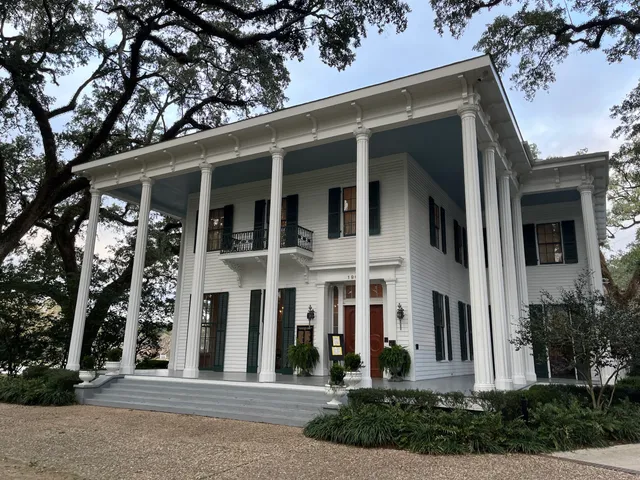
Read moreSituated away from the centre of Mobile and with a most impressive facade, the house is well worth seeking out. Visits take place on the hour, and last c. 60 minutes.Although not a plantation house, this was initially the winter abode of its owner, and was lived in as a home until the second half of the 20th century. It has been significantly restored in recent years and the signs of continuing maintenance on the day that we visited were gratifying to see. Our guide (Irene) was welcoming and knowledgeable and provided interesting anecdotes to illustrate the history of this impressive home: the recovery in New York of the four large ornate mirrors that grace the large ballroom is just one of these.Do take time to walk in the grounds and admire the large old oak trees that...
Read more