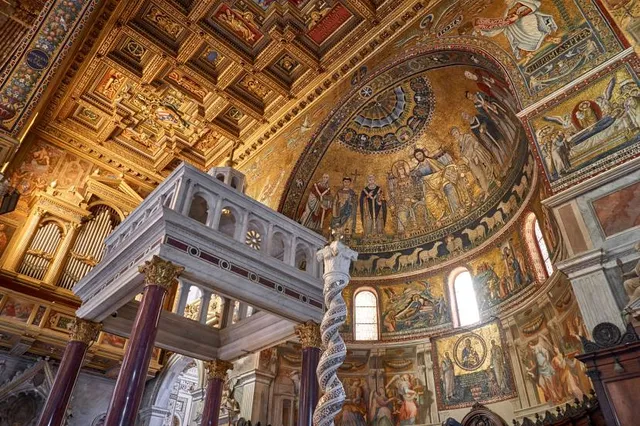

The Basilica of Santa Maria Maggiore ⛪✨
Compared to Milan's central train station, Rome's Termini Station makes me feel more anxious. It's not that there are many thieves, but the place can be confusing, especially for someone unfamiliar with the city. In this state, I can't help but feel tense, glancing left and right. 😰 In such a situation, it’s easy to get tired, and the nearby Basilica of Santa Maria Maggiore naturally becomes a place to catch my breath. With security checks at the entrance, I know it’s safe from pickpockets. Once inside, I feel completely relaxed, surrounded by stunning golden splendor that balances out the chaos and discomfort of the outside world. (To be honest, the thieves at Milan’s central station can be more aggressive, but I feel more confident in Milan since I'm familiar with the area.) 😌✨ This church was built in the 5th century, and in Italy, the name "Maria" is incredibly common—two out of my three neighbors have that name. Perhaps it’s because of Catholicism, where the Virgin Mary is the true object of faith rather than Jesus (just a guess; I’m not too interested in religious culture). The interior of the church is as lavish as St. Peter's Basilica, though it's much smaller. The exterior is quite simple. On that rainy day, a beggar mimicked the image of the suffering elderly woman from the Bible, lingering at the entrance. This kind of suffering-themed begging is actually quite rare in northern Italy. Santa Maria Maggiore holds significant status; many wealthy individuals hope to have their ashes interred here, and there is never a shortage of donors. It has a vibe similar to the Huawlin Temple in Guangzhou—small in size but with a great atmosphere. In fact, Rome resembles Guangzhou in some ways, serving as a southern commercial hub. Rome’s wholesale markets for small goods are among the top in the EU, and naturally, the Chinese community plays a major role. 🌏💼 #Italy #Architecture #EuropeanLife #Rome