

HTML SitemapExplore
logo
Find Things to DoFind The Best Restaurants

The Pinnacle of Renaissance Architecture – Rome’s Tempietto

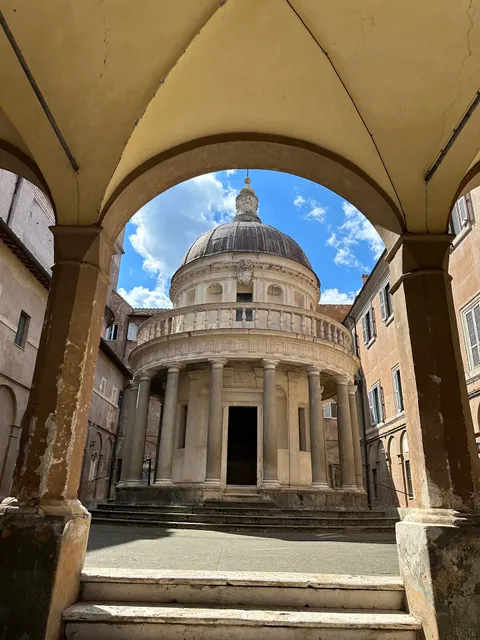
Students of architecture or art history visiting Rome will almost certainly check off this hidden gem atop Janiculum Hill. Nestled within the courtyard of the San Pietro in Montorio monastery, the Tempietto was designed by Donato Bramante and built in 1502. Though unassuming in appearance, this small circular structure is not only hailed as the pinnacle of Renaissance architecture but also an important prototype for all subsequent Christian buildings. 🏛️ Its significance lies in two key aspects: - On one hand, as a monumental structure marking a Christian sacred site, it denotes the place where St. Peter was martyred. ​ - On the other hand, it almost defined the ideal form of Christian architecture after the Renaissance. The Tempietto is also regarded as one of the most exquisite Renaissance buildings, with its strictly proportioned facade and pure form. It consists of two circular spaces (inner and outer): the outer circle features a colonnade that creates rhythm and order, while the inner space is a domed rotunda that evokes a sense of sublimity. This centralized layout—seemingly common today—was an innovative breakthrough in reviving ancient Roman architectural traditions in the early Renaissance. ✨ Beneath the Tempietto lies a hidden altar. Legend has it that a dot in the center of the floor marks the spot where St. Peter was crucified. Bramante added an oculus directly above this dot (without which the lower altar would easily go unnoticed), vertically connecting the basement, the inner sanctuary, and the dome to form an upward spatial axis. This connection symbolizes the ascension of St. Peter’s soul, turning the building itself into a tangible expression of faith. 🙏 The later-built St. Peter’s Basilica also shares a consistent formal logic with the Tempietto. It can be said that the Tempietto is seen as the epitome of the ideal Christian building (you can sometimes spot its model on other altars in Rome). During the Renaissance, the Tempietto was already praised as the first "contemporary" building to truly revive the spirit of ancient Rome. Even today, it remains an architectural paradigm, continuously studied and reinterpreted. Included here is an axonometric drawing by NADAAA titled Down to Earth, Looking up to the Heavens. This drawing cleverly illustrates the Tempietto’s spatial complexity—especially the relationship between its altar, dome, and basement. This expressive method allows viewers to observe the building both from top to bottom and bottom to top, gaining a deeper understanding of its spatial layout and symbolic meaning. 📐 Recommendation: 🌟🌟🌟 A non-negotiable pinnacle in Western architectural history and a must-visit for architecture and art enthusiasts. Even if you’re not studying architecture, it’s well worth a visit—not only is it one of the most famous Renaissance buildings, but it also offers panoramic views of Rome. Remember to check the opening hours before you go! #RomeTravel #RomanHoliday #Italy #RomeHiddenGems #Renaissance #ClassicalArchitecture #EuropeTravel #ArchitectureStudies
Related posts
Rome | Nero's Golden House (Domus Aurea) Rome’s Hidden Gems: The Pyramids and the Graves of Keats & ShelleyAmbient Handmade Pasta Restaurant Next to the Trevi Fountain in RomeIf You Can Only Try One Pasta Place in Rome 🍝🇮🇹 Italy | Rome's Must-Try Tiramisu 🍰For Our Discerning Taste Buds 🍽️✨
Ava Taylor
Ava Taylor
4 months ago
Ava Taylor
Ava Taylor
4 months ago
no-comment

No one has commented yet...

The Pinnacle of Renaissance Architecture – Rome’s Tempietto

Students of architecture or art history visiting Rome will almost certainly check off this hidden gem atop Janiculum Hill. Nestled within the courtyard of the San Pietro in Montorio monastery, the Tempietto was designed by Donato Bramante and built in 1502. Though unassuming in appearance, this small circular structure is not only hailed as the pinnacle of Renaissance architecture but also an important prototype for all subsequent Christian buildings. 🏛️ Its significance lies in two key aspects: - On one hand, as a monumental structure marking a Christian sacred site, it denotes the place where St. Peter was martyred. ​ - On the other hand, it almost defined the ideal form of Christian architecture after the Renaissance. The Tempietto is also regarded as one of the most exquisite Renaissance buildings, with its strictly proportioned facade and pure form. It consists of two circular spaces (inner and outer): the outer circle features a colonnade that creates rhythm and order, while the inner space is a domed rotunda that evokes a sense of sublimity. This centralized layout—seemingly common today—was an innovative breakthrough in reviving ancient Roman architectural traditions in the early Renaissance. ✨ Beneath the Tempietto lies a hidden altar. Legend has it that a dot in the center of the floor marks the spot where St. Peter was crucified. Bramante added an oculus directly above this dot (without which the lower altar would easily go unnoticed), vertically connecting the basement, the inner sanctuary, and the dome to form an upward spatial axis. This connection symbolizes the ascension of St. Peter’s soul, turning the building itself into a tangible expression of faith. 🙏 The later-built St. Peter’s Basilica also shares a consistent formal logic with the Tempietto. It can be said that the Tempietto is seen as the epitome of the ideal Christian building (you can sometimes spot its model on other altars in Rome). During the Renaissance, the Tempietto was already praised as the first "contemporary" building to truly revive the spirit of ancient Rome. Even today, it remains an architectural paradigm, continuously studied and reinterpreted. Included here is an axonometric drawing by NADAAA titled Down to Earth, Looking up to the Heavens. This drawing cleverly illustrates the Tempietto’s spatial complexity—especially the relationship between its altar, dome, and basement. This expressive method allows viewers to observe the building both from top to bottom and bottom to top, gaining a deeper understanding of its spatial layout and symbolic meaning. 📐 Recommendation: 🌟🌟🌟 A non-negotiable pinnacle in Western architectural history and a must-visit for architecture and art enthusiasts. Even if you’re not studying architecture, it’s well worth a visit—not only is it one of the most famous Renaissance buildings, but it also offers panoramic views of Rome. Remember to check the opening hours before you go! #RomeTravel #RomanHoliday #Italy #RomeHiddenGems #Renaissance #ClassicalArchitecture #EuropeTravel #ArchitectureStudies

Rome
Tempietto del Bramante
Tempietto del BramanteTempietto del Bramante