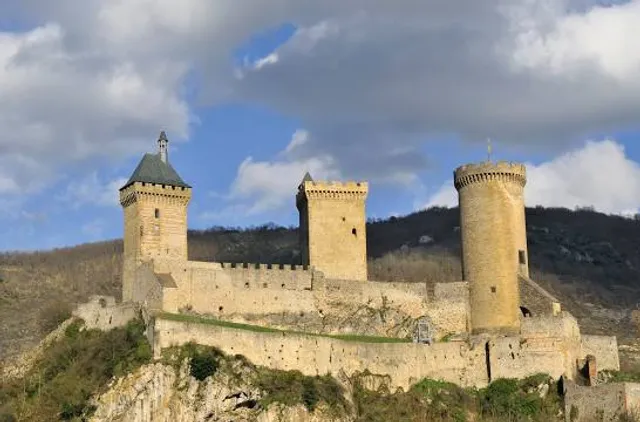
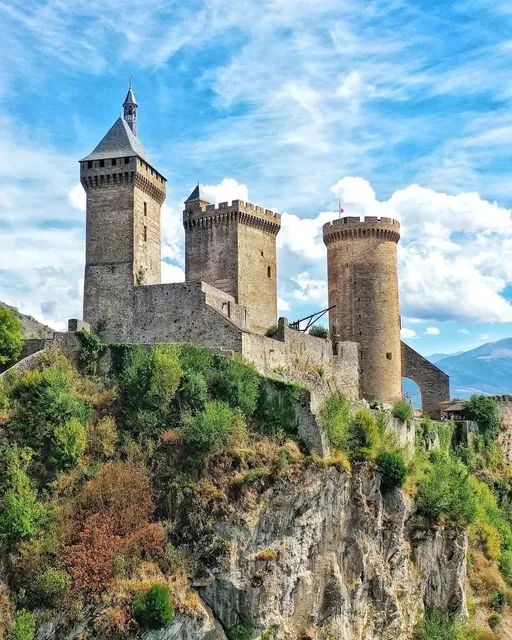
The Château de Foix is a castle which dominates the town of Foix in the French département of Ariège. An important tourist site, it is known as a centre of the Cathars. It has been listed since 1840 as a monument historique by the French Ministry of Culture. Built In the style of 7th-century fortification, the castle is known from 987. In 1002, it was mentioned in the will of Roger I, Count of Carcassonne, who bequeathed the fortress to his youngest child, Bernard. In effect, the family ruling over the region were installed here which allowed them to control access to the upper Ariège valley and to keep surveillance from this strategic point over the lower land, protected behind impregnable walls.
In 1034, the castle became capital of the County of Foix and played a decisive role in medieval military history. During the two following centuries, the castle was home to Counts with shining personalities who became the soul of the Occitan resistance during the crusade against the Albigensians. The county became a privileged refuge for persecuted Cathars.
The castle, often besieged (notably by Simon de Montfort in 1211 and 1212), resisted assault and was only taken once, in 1486, thanks to treachery during the war between two branches of the Foix family. From the 14th century, the Counts of Foix spent less and less time in the uncomfortable castle, preferring the Governors' Palace (Palais des gouverneurs). From 1479, the Counts of Foix became Kings of Navarre and the last of them, made Henri IV of France, annexed his Pyrrenean lands to France.
As seat of the Governor of the Foix region from the 15th century, the castle continued to ensure the defence of the area, notably during the Wars of Religion. Alone of all the castles in the region, it was exempted from the destruction orders of Richelieu (1632-1638).
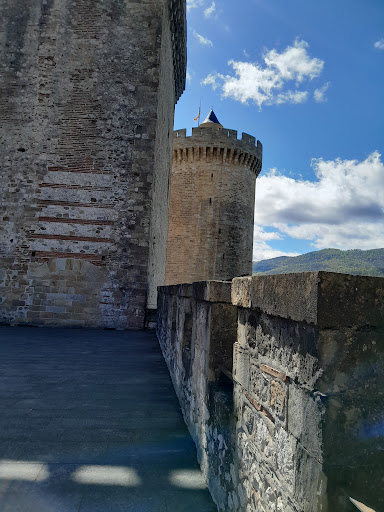
Until the Revolution, the fortress remained a garrison. Its life was brightened with grand receptions for its governors, including the Count of Tréville, captain of musketeers under Louis XIII and Marshal Philippe Henri de Ségur, one of Louis XVI's ministers. The Round Tower, built in the 15th century, is the most recent, the two square towers having been built before the 11th century. They served as a political and civil prison for four centuries until 1862.
Since 1930, the castle has housed the collections of the Ariège départemental museum. Sections on prehistory, Gallo-Roman and mediaeval archaeology tell the history of Ariège from ancient times. Currently, the museum is rearranging exhibits to concentrate on the history of the castle site so as to recreate the life of Foix at the time...
Read moreThere's scaffolding up with works going on (it looks like wheelchair access works). So on arrival, we weren't sure if it was open, but it is !! We followed signs in the town centre for the castle-Parking, only to find ourselves going round in a circle 3 times !!! Luckily it's Easter Mon and not very busy, so we found a spot for the camper in the middle of the two main town roads. €12.50 each entry. Great castle, lots of steps once at the top. There's a long stone ramp up/down, or a lift - with several floors gor the museum. The castle itself has 'displays ' on throughout the day, blacksmith, stone mason, weapons, etc. Unfortunately very little information in English (but, of course, totally acceptable - we're in France !!!). It's a fair bit of walking - first up the the castle, and then once uo there. The towers are fabulous, but cares needed as people are going to pass up/down on spiral staircases. Loads to see in the museum - excellent value. Gift shop, toilets (no cafe). Hero exhibition upstairs is very...
Read morePlease like and follow. Foix Castle is an impressive monument dominating the city of Foix. You can see it from every angle. You can drive and park 5 minutes away from it, or you can ignore the pedestrian only road and park next to it. Ignore all the construction and into the new building which hosts the museum. This is where you buy access ticket It is a rough climbing pedestrian winding narrow road with an amazing view on the valley and the city below. You can see miles and miles away. The castle itself had a couple of towers and a court ( space outside) Dew rooms that can accommodate the leadership and soldiers and ob one tower you have a room for the load to sleep and bathe. You have to climb the narrow stairs in the tower to have the birds view of everything below. In the end, you can choose to walk back the windings pebble road or take the elevator to the museum. The museum hosts all the pictures, history, furnitures and arms used since the establishment of Foix thousand years...
Read more