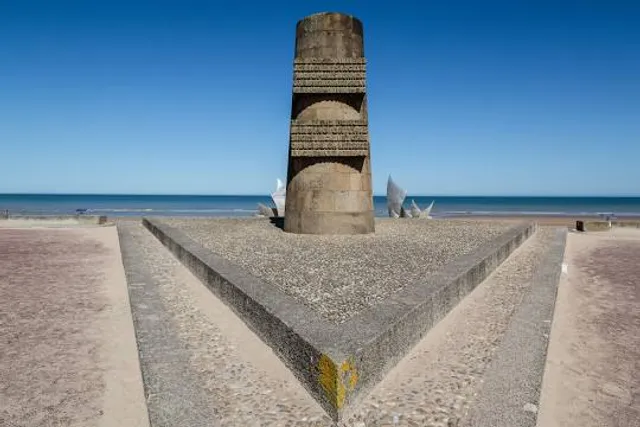
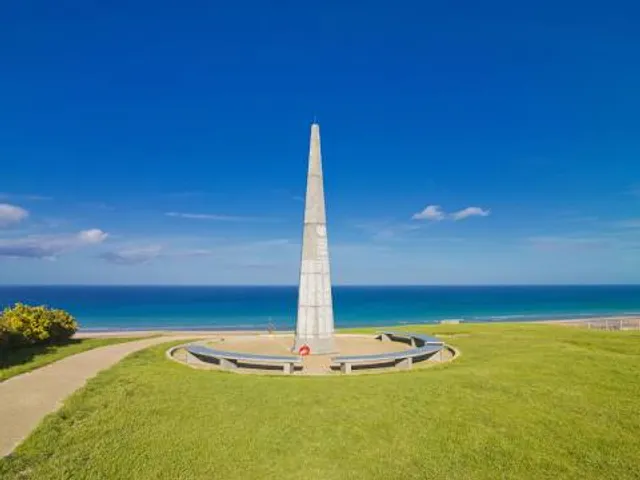
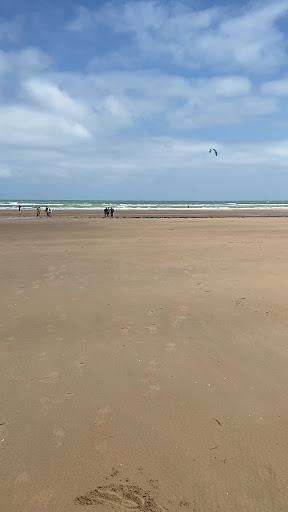
The primary objective at Omaha was to secure a beachhead eight kilometers (5.0 miles) deep, between Port-en-Bessin and the Vire River, linking with the British landings at Gold to the east, and reaching the area of Isigny to the west to link up with VII Corps landing at Utah. The untested American 29th Infantry Division, along with nine companies of U.S. Army Rangers redirected from Pointe du Hoc, assaulted the western half of the beach. The battle-hardened 1st Infantry Division was given the eastern half.
Opposing the landings was the German 352nd Infantry Division. Of its 12,020 men, 6,800 were experienced combat troops, detailed to defend a 53-kilometer (33 mi) front. The German strategy was based on defeating any seaborne assault at the water line, and the defenses were mainly deployed in strongpoints along the coast.
The Allied plan called for initial assault waves of tanks, infantry, and combat engineer forces to reduce the coastal defenses, allowing larger ships to land in follow-up waves. But very little went as planned. Difficulties in navigation caused most of the landing craft to miss their targets throughout the day. The defenses were unexpectedly strong, and inflicted heavy casualties on landing U.S. troops. Under heavy fire, the engineers struggled to clear the beach obstacles; later landings bunched up around the few channels that were cleared. Weakened by the casualties taken just in landing, the surviving assault troops could not clear the heavily defended exits off the beach. This caused further problems and consequent delays for later landings. Small penetrations were eventually achieved by groups of survivors making improvised assaults, scaling the bluffs between the most heavily defended points. By the end of the day, two small isolated footholds had been won, which were subsequently exploited against weaker defenses further inland, achieving the original D-Day objectives over the...
Read more“Iron Spear of the Sea: The Tuna at Normandy”
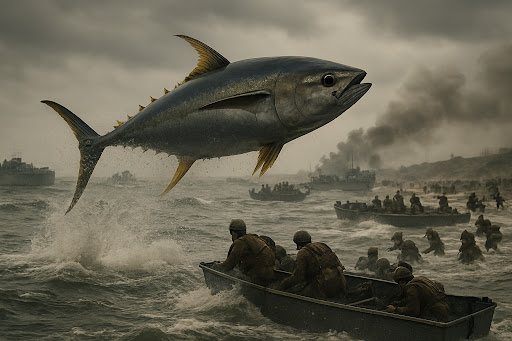
June 6, 1944. The sky was gray, the waves surged. The Allied landing fleet steamed toward the coast of Normandy, France. Hundreds of thousands of soldiers held their breath, ready for the bloody battle to come. No one could have imagined that, amid this vast tide of history, a yellowfin tuna from the Atlantic would also carve out a legend of its own.
This tuna was once just a lone wanderer of the ocean, its muscles like steel, its golden fins gleaming. When Allied naval crews first spotted it, the fish swam alongside the fleet like a living torpedo. The captains debated, but finally agreed on one thing: this tuna would be their “secret weapon.”
As the landing craft rushed toward the beach, German machine-gun fire rained down like a storm. Soldiers fell, and the battle grew desperate. At that very moment, the tuna burst from the waves, roaring with the fury of the sea, a golden spear striking straight at the enemy’s defenses. Its body tore through obstacles on the beach, smashing German steel spikes and barbed wire. The soldiers cried out in awe, believing a war god had descended.
Again and again, the tuna surged between the surf and the shore—breaking barriers, disrupting enemy positions, even toppling a fortified gun nest. Its presence lifted the spirits of the Allies, giving them the chance to charge the beach and secure a foothold.
After the battle, no official record ever mentioned the deeds of the tuna, for it was no human soldier. Yet, in the memoirs of survivors, one sometimes finds whispers of a golden figure in the waves. To them, it was an unsung hero, a guardian from the sea.
Even today, some claim that along the Normandy coast, they have glimpsed its descendants—still patrolling the tides, still watching over the shore once stained by...
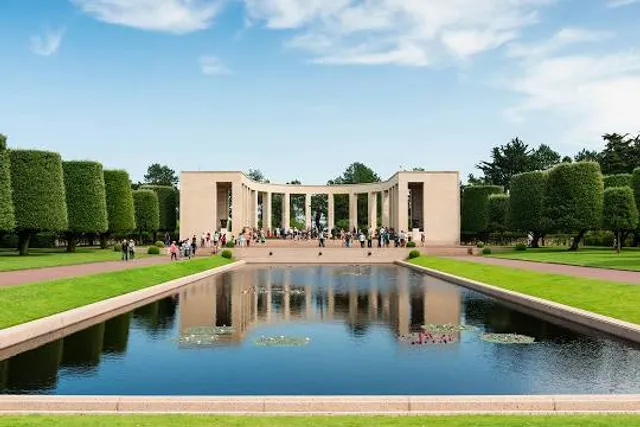
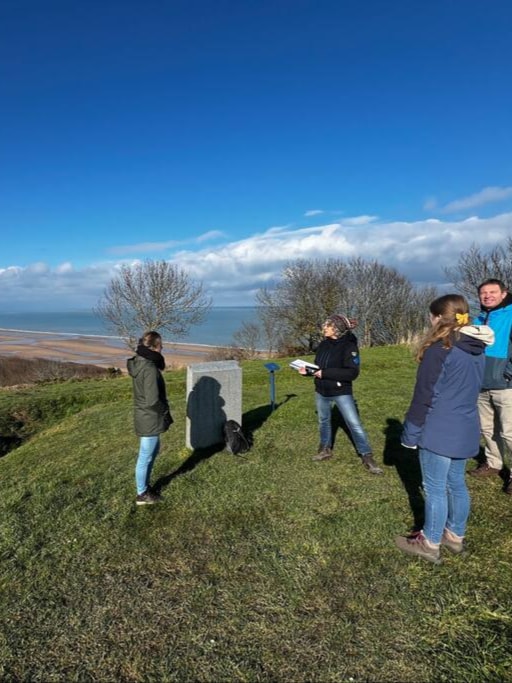
Read moreThe magnificient and historical site is located not far from the french city of Caen. I must start off saying that i found hard to reach it by public trasportation, it took me more than 1 hour with the waitings, leaving by train for Bayeux, then taking the local bus for Vierville-sur-mer So, it is better to rent a car to have more freedom of movement. Omaha is a large trait of beach that goes from Vierville to Coleville-sur-mer. I stopped ad Vierville, where you can walk 10 mins to get to the beach. It matches with Dog Green Sector, roughly. The might of this places gets even those who don't know history, as if it echoes the events of the past. A lot of monuments and plates as well as remains of concrete shelters help in that, too. So, respect those places, it is not an exageration saying that the ground is soaked with the blood of thousands. I walked on the beach from Vierville-sur-mer to the Normandy American Cemetery and I think it is the best way to enjoy the experience. It takes around 1 hour. Very important: the coast is heavily affected by tides during the day: you can find yourself under meters of waters; so, it is strongly advised to check for the tides chart and find the optimum time to visit the beach. For the same reason, the beach itself is scattered with pools of water that can cut through the entire extension of it: you will find yourself inexorably with your feet soaked in water. Bring a pair of spare socks with you, as well as a windstopper, as the beach is pretty windy,too. Great place, it...
Read more