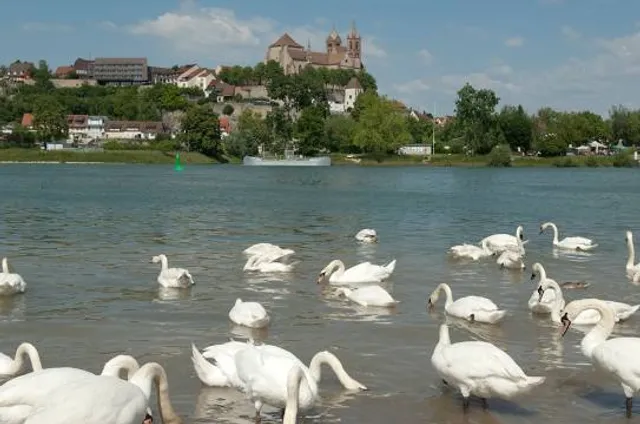
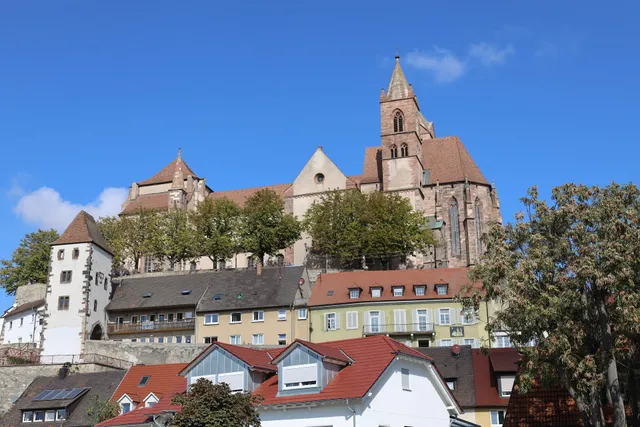
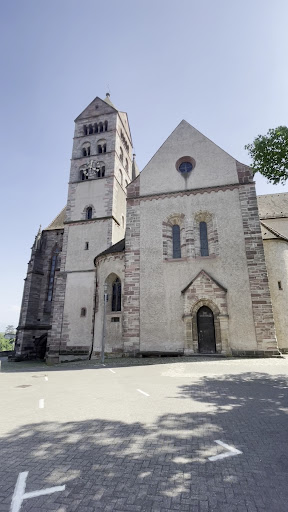
The Breisach Minster on the Rhine is clearly visible from afar. The two distinct church towers of the three-aisled building are striking. These towers are located in the choir area, atypically for a Christian religious building. The church dates from the late Romanesque period of the 12th century and was expanded to the Gothic style of the 15th century. Breisach's patron saints, Gervasius and Protasius, are also venerated here. The Breisach Minster is known for its art-historically significant interior furnishings, for example, the over 100-square-meter mural "The Last Judgment" by Martin Schongauer and, above all, the high altar from the workshop of Master H. L. The exact construction date of the minster is unknown. It was probably begun after 1185 and completed in 1230. In the 13th century, the church was expanded with a Gothic choir with a polygonal spire, the roof of which was dendrochronologically dated to 1292.
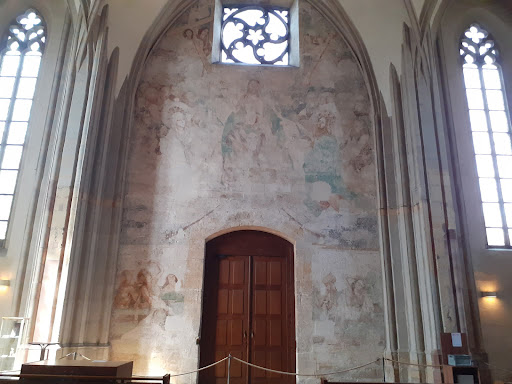
The high altar of Breisach Minster is an open reredos made of linden wood. It consists of two massive wings, a predella, and a rising spire. The high altar was carved between 1523 and 1526 by a master who left the monogram HL (→ Master HL). These initials could be attributed to the sculptor Hans Loy, who was registered in the Freiburg Painters' Guild in 1519/20. However, almost nothing is known about Hans Loy. According to a local legend, the initials stand for an artist named Hans Liefrink. The altar is signed three times with the master's monogram HL in the form of small tablets, each at the feet of Mary, Christ, and God the Father. On a prayer book held aloft by an angel next to the figure of God the Father on the right side of the altar, the year 1526—the year of completion—is visible under infrared light. The high altar survived both the iconoclasm and the destruction of the Second World War; it and its figures were brought to safety in the storage room of the Archbishop's Ordinariate in Freiburg. The mural of the Last Judgment by the Colmar painter and graphic artist Martin Schongauer is located on three walls in the west wing of St. Stephen's Cathedral. It is assumed that Schongauer acquired, or had to acquire, citizenship in order to receive the large commission. Schongauer, who was already highly respected during his lifetime, created a significant mural, which is the largest depiction of this subject north of the Alps. Based on current research, it can be assumed that Schongauer applied his paintings to existing plaster. The triptych depicts the Last Judgment in the central panel on the west wall (13.2 by 7.4 meters), while the wings depict the Entry of the Blessed into Paradise on the south wall and the Fall of the Damned into Hell on the north wall (each 14.4 by 7 meters). The painted surface of the three walls together measures 145 square meters. This work by Schongauer is described as unusually monumental. The events unfold almost at the viewing level. The small number of figures is remarkable – eleven in the paradise scene, ten in the hell scene, and seven in the resurrection scene. The figures are depicted approximately twice life-size, thus underscoring the powerful effect. Art historians highly value the significance of this mural. They say it is not only characterized by its masterly craftsmanship; the style of depiction and the selection of motifs are also...
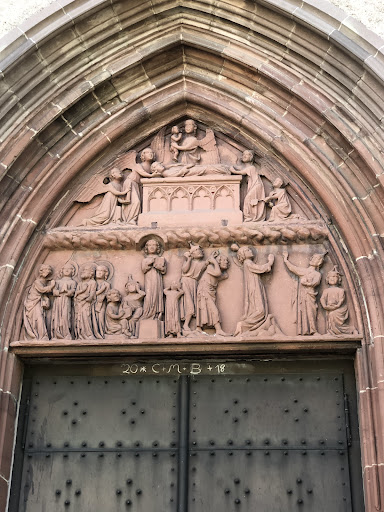
Read moreLa iglesia de San Esteban de Breisach se eleva sobre una de las dos lomas que conforman la villa. El edificio es básicamente románico, de la segunda mitad del XII, aunque ciertos capiteles que muestran la influencia del taller de la catedral de Estrasburgo hacen que se lleve su finalización a la década de 1230. Muy dañada en la sucesivas guerras franco prusianas, fue bastante reconstruida tras los desperfectos sufridos en la Segunda Guerra Mundial. Del conjunto destaca la torre norte, románica, mientras que los pisos superiores de la meridional son ya góticos y del XIII, como el ábside. Bajo éste, la cripta abierta al exterior ha sido restaurada en 1978. La fachada occidental, ya del XIV, se decora con un tímpano que ilustra el martirio y entierro de san Esteban. En el interior son varias las obras destacables. De finales del siglo XV son las pinturas de los pies de la iglesia, realizadas por Martín Schongauer, que vivió en Breisach desde 1488 hasta su muerte en 1491. En los muros oeste, sur –el más dañado– y norte se representa el Juicio Final. De la misma época es el «jubé», obra maestra del gótico flamígero. Delante de él, en una urna de cristal, está la tercera gran obra, contemporánea de las anteriores. Se trata del arca que conserva las reliquias de los santos Protasio y Gervasio, traídas a Breisach en 1162 por el arzobispo de Colonia tras la toma por Federico Barbarroja de Milán, donde habrían sufrido el martirio en tiempos de Nerón. El relicario fue encargado por el concejo de la villa en 1480 por un voto hecho por la población para que los santos acabasen con la falta de agua potable. Es obra de Peter Berlin de Wimpfen, orfebre de Estrasburgo, que grabó su nombre encima de la vista de Breisach que ilustra el traslado de las reliquias a la villa en uno de los lados. Por último, el altar mayor es obra del maestro H. L. –que así firma sus obras– realizado entre 1523 y 1526. Con un marco flamígero, en el centro se representa la coronación de la Virgen, siguiendo el modelo del altar mayor de la catedral de Friburgo. En el panel de la izquierda figuran los santos Esteban y Lorenzo, y Protasio y Gervasio en el de la derecha. En la predela se representa a los cuatro...
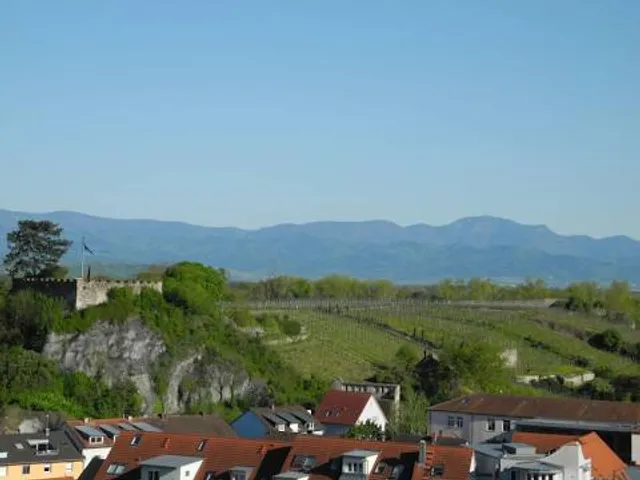
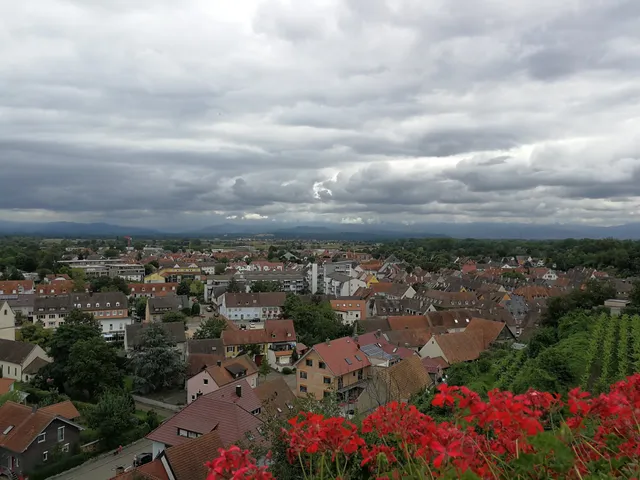
Read moreIt was a bit of a steep walk up to St. Stephan today but we’ll worth it. The view from the courtyard spans the Old town and the Rhine Valley and is so lovely! The cathedral itself is magnificent. The original was heavily bombed during WW II but has been rebuilt.
Located high on the Münsterberg, its two towers, the building hides outstanding...
Read more